



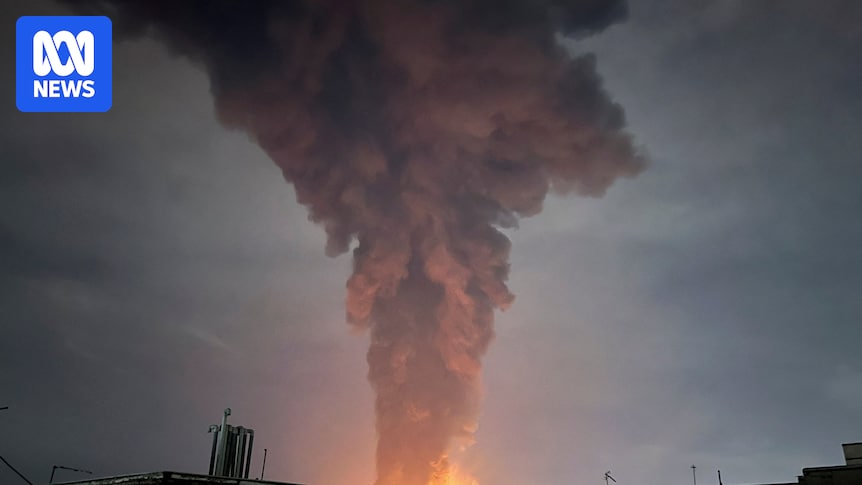
Tensions are mounting globally following US and Israeli military strikes on Iran, with Türkiye’s Foreign Minister Hakan Fidan warning that any attempt to incite a civil war within Iran could be a “historic” mistake. This warning comes after NATO intercepted a Türkiye-bound ballistic missile launched from Iran earlier this week. Fidan’s comments were made amidst reports that Washington is considering arming Kurdish guerrillas to infiltrate Iran, a move supported by US President Donald Trump.
“We are against all scenarios that aim to instigate a civil war in Iran, that target ethnic or religious fault lines,” Fidan stated to journalists in Istanbul. “This is the most dangerous scenario.” He noted that he had discussed the matter with US Secretary of State Marco Rubio.
Global Protests and Political Backlash
Meanwhile, hundreds of protesters have gathered in Jakarta, urging Indonesia’s President Prabowo Subianto to withdraw from US President Donald Trump’s Board of Peace (BoP). The protests reflect growing domestic discontent over Indonesia’s involvement in the BoP, particularly following the US and Israeli strikes on Iran.
In Indonesia, the world’s most populous Muslim nation, there is increasing pressure for President Prabowo to withdraw from the board and retract an offer of 8,000 troops for a Gaza stabilization force. Major national Islamic organizations and dozens of civil society groups have voiced their opposition, with a petition stating:
“Consequently, the Board of Peace has effectively transformed into a ‘Board of War’, as the BOP, chaired and dominated by Donald Trump, has carried out military attacks on Iran. The Chair of the BOP, who is supposed to safeguard peace as stipulated in the BOP Charter, has instead acted against peace itself. In this context, Indonesia should immediately withdraw from the BOP.”
At the protests, demonstrators held signs reading “Indonesia is not Israel’s security guard” and “Board of Peace is not a solution”. President Prabowo has been consulting with former presidents, vice-presidents, foreign ministers, and senior Islamic leaders regarding the Middle East conflict and Indonesia’s role in the BoP.
Indonesia’s Diplomatic Maneuvers
The recent strikes have prompted senior Indonesian officials to reconsider the country’s membership in the BoP. A spokesperson for Indonesia’s foreign ministry stated that the government is “carefully assessing” its position. President Prabowo has indicated to Indonesian Islamic leaders that he would withdraw from the BoP if it no longer benefits Palestinians.
Furthermore, President Prabowo has offered to mediate the ongoing conflict, with Indonesia’s Foreign Minister Sugiono suggesting that he could travel to Tehran to help de-escalate tensions. “Indonesia is ready to play a constructive role in advancing peace, including offering our willingness to facilitate dialogue or mediation,” Sugiono said in a social media video earlier this week.
Protests in London and Iranian Political Developments
In London, crowds marched outside Westminster against the US-Israeli attacks on Iran. Organized by the Stop the War Coalition and other groups such as the Palestine Solidarity Campaign, the protest began at Millbank and moved towards the US embassy. Demonstrators carried signs with slogans like “Stop bombing Iran”, “Stop Trump’s wars”, and “Stop arming Israel”, while waving Palestinian and Iranian flags.
Stop the War Coalition issued a statement ahead of the protest, condemning the conflict as “causing untold death and destruction in Iran and risks plunging the already devastated region into wider war”. The statement urged all who value peace to take a stand.
Meanwhile, in Iran, clerics are calling for the swift appointment of a new supreme leader following the killing of Ayatollah Ali Khamenei. Ayatollah Hossein Mozafari, a member of the Assembly of Experts, indicated that the assembly could meet within the next 24 hours to decide on a successor, although it remains unclear if this will involve an in-person gathering.
Grand Ayatollah Naser Makarem Shirazi emphasized the urgency, stating that a quick appointment is needed to “help better organize the country’s affairs”. A temporary three-man council has been established to oversee state matters in the interim.
As tensions continue to rise, the international community watches closely, with potential implications for regional stability and global diplomatic relations.