



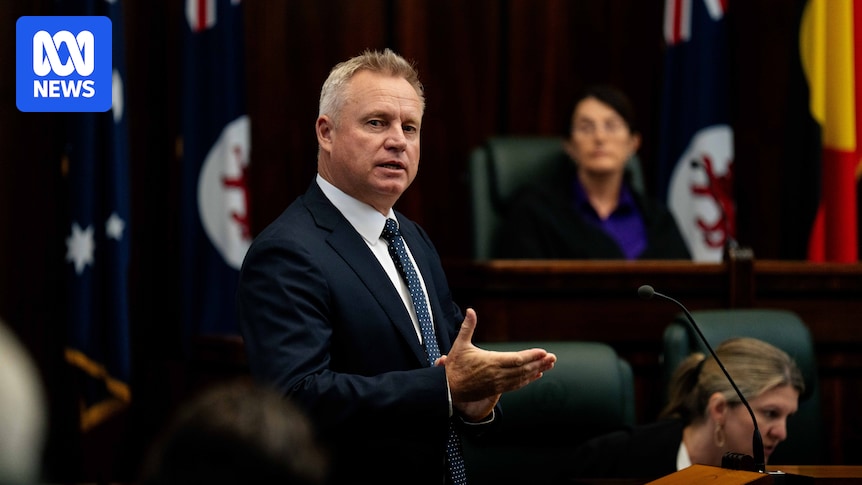
Tasmanian Premier Jeremy Rockliff delivered his State of the State address yesterday, unveiling plans for significant public service job cuts while promising “exciting days ahead” for the state. The announcement comes as Tasmania grapples with a mounting debt crisis, prompting the government to propose a major overhaul of its infrastructure and public service sectors.
In his speech, Rockliff highlighted several infrastructure achievements, including the secured Macquarie Point Stadium and the establishment of Tasmania Devils AFL and AFLW teams. He also celebrated the decision to proceed with the Marinus Link undersea connector project and the refurbishment of the research ship Nuyina’s home on the Hobart waterfront.
Infrastructure and Economic Promises
The premier’s address painted a picture of optimism, emphasizing Tasmania’s entry into a “new era of opportunity.” Rockliff assured that the foundations laid by his government would lead to a prosperous future. However, the speech also hinted at the state’s looming financial challenges, which were addressed only in the latter part of his address.
Among the proposed changes is the replacement of the Department of State Growth with a new agency, “Building Tasmania,” which is expected to save a quarter of a billion dollars over five years. This move, according to Rockliff, is part of a broader strategy to “right-size” the public service, with an immediate reduction of 250 full-time positions.
Debt Crisis and Budget Repair
The announcement comes against the backdrop of a dire fiscal situation. The Treasury’s Fiscal Sustainability Report, released last week, warned that without significant action, Tasmania’s net debt could escalate from $4 billion to $129.5 billion. The report recommended a mix of expenditure cuts and new revenue-raising measures to address the crisis.
“Without action, the net debt could blow out from $4 billion to $129.5 billion,” the report stated, urging budget repair of about $3.3 billion over the next five years.
Despite these recommendations, Rockliff reiterated that the upcoming budget would not introduce new or increased taxes, though a new “levy” on short-stay properties is expected, as promised in the 2024 state election.
Public Reaction and Political Implications
The proposed abolition of the Department of State Growth has sparked varied reactions. The Tasmanian Chamber of Commerce and Industry (TCCI) has long advocated for a leaner public service, criticizing the department as a source of confusion. Michael Bailey of the TCCI described it as a “behemoth” that hindered efficiency.
However, the Community and Public Sector Union expressed concern over the sudden announcement, with members reportedly shocked and fearful about the impending job cuts. Natalie Jones of the union noted that many workers learned of the restructure just before it was announced in parliament.
Meanwhile, the opposition has criticized the lack of a clear agenda for the year ahead. Labor Leader of Opposition Business Ella Haddad described the announcement as lacking initiatives to improve the lives of Tasmanians. The Greens also expressed disappointment, though neither party directly opposed the restructuring move.
Looking Ahead: The Path to Budget Repair
The state government has been transparent about its aim to reduce the public service workforce by over 2,000 positions, a goal outlined in successive budgets. However, the size of the state service has continued to grow, complicating efforts to achieve this target.
As Tasmania faces tough economic decisions, the government is considering measures such as slashing pension payments for high-earning retirees. The path to budget repair will require difficult choices, and the opposition and crossbench may need to consider supporting some form of budget repair, despite its potential unpopularity.
With the fiscal challenges looming large, the premier’s address marks the beginning of what promises to be a year of significant economic and political shifts for Tasmania. The success of these initiatives will depend on the government’s ability to balance fiscal responsibility with the needs of its citizens.