


More than five years have passed since former President Donald Trump issued his first architectural decree, which, as of December 21, 2020, mandated that all new public buildings in the federal capital adhere to “classical and traditional architecture.” The decree was part of Trump’s broader vision to infuse “beauty and visual embodiment of America’s ideals” into the nation’s infrastructure. Although President Joe Biden repealed this decree upon taking office, Trump’s second term reignited a series of edicts aimed at “Making America Beautiful Again” (MABA). While the notion of beauty is universally appreciated, the power to define it, especially when wielded by a single individual, poses significant risks.
The danger lies in the potential for beauty to be dictated rather than suggested, a hallmark of dictatorial regimes. Initially, Trump’s architectural ambitions seemed more like harmless eccentricity than genuine censorship. However, the situation took a serious turn when plans were unveiled to transform the historic East Wing of the White House.
The Transformation of the East Wing
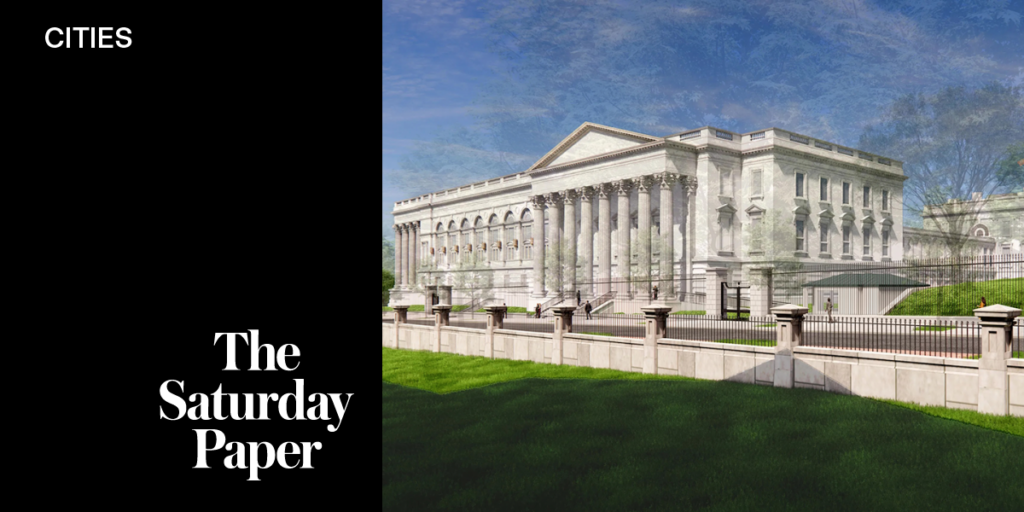
The East Wing, a modest structure built by President Teddy Roosevelt in 1902 and expanded by Franklin D. Roosevelt in 1945, was known for its polite classicism. It was designed by architect Lorenzo Winslow to complement, rather than overshadow, the main White House. Traditionally the domain of the First Lady, it housed the Jacqueline Kennedy Garden, which has now been erased.
Trump’s new East Wing, however, is a stark contrast. Spanning approximately 8,360 square meters and estimated to cost $400 million, it occupies more than three times the footprint of the previous structure. Designed by architect Shalom Baranes and approved by a select panel, the ballroom alone is designed to seat 650 guests. The interior, featuring giant Corinthian colonnades and full-height arched windows, lacks the charm of its predecessor, echoing the stuffy neoclassicism of the 19th century.
Architecture as a Cultural Battleground
This architectural shift positions Trumpitecture squarely in the ongoing culture war between ancient and modern design philosophies. The debate is less about the architectural substance—such as spatial delight or environmental engagement—and more about the messaging and meaning conveyed by architecture.
Fifty years ago, the question of whether form could convey meaning sparked extensive academic debate, leading to movements like semiotics and postmodern revivalism. Today, the discourse has shifted, leaving behind assumptions that classical architecture implies moral conservatism, while modernism is viewed as inherently progressive. These assumptions merit closer examination.
Historical Parallels and Totalitarian Tendencies
Throughout history, classical architecture has been associated with diverse values, from democracy to fascism. The parallels between Trump and mid-century dictators with classical preferences are hard to ignore. For instance, Mussolini’s plans for New Rome and Hitler’s designs for Germania both embodied imperial dominance through classical motifs.
Similarly, Nicolae Ceaușescu’s ornate neoclassical palace in Romania, rumored to have attracted a $1 billion offer from Rupert Murdoch, stands as a testament to the power dynamics inherent in classical architecture.
“Classicism may not be fascist, but it is about power, and when that power focuses on a single ego, we’re in trouble.”
Trumpitecture’s Place in Modern Society
Trump’s architectural edicts, such as the “Fact sheet: President Donald J. Trump Works to Make Our Nation’s Capital Safe and Beautiful,” promote classicism as a noble and socially desirable style, reviling modernist styles like brutalism and deconstructivism as subversive. Yet, the desire for stability and symmetry, often associated with classical architecture, reflects a deeper psychological need for order.
While many beloved civic buildings have arisen from autocratic regimes, this does not justify abandoning democratic principles. The proposed 91-story Trump Tower on the Gold Coast, potentially Australia’s tallest building, exemplifies this tension. Despite its grandeur, it lacks classical elements, falling instead into the realm of bronzed-glass aesthetics.
In conclusion, Trumpitecture highlights the complex interplay between architecture, power, and political ideology. As society continues to grapple with these issues, it remains crucial to demand from leaders a maturity that transcends mere aesthetic preferences.