




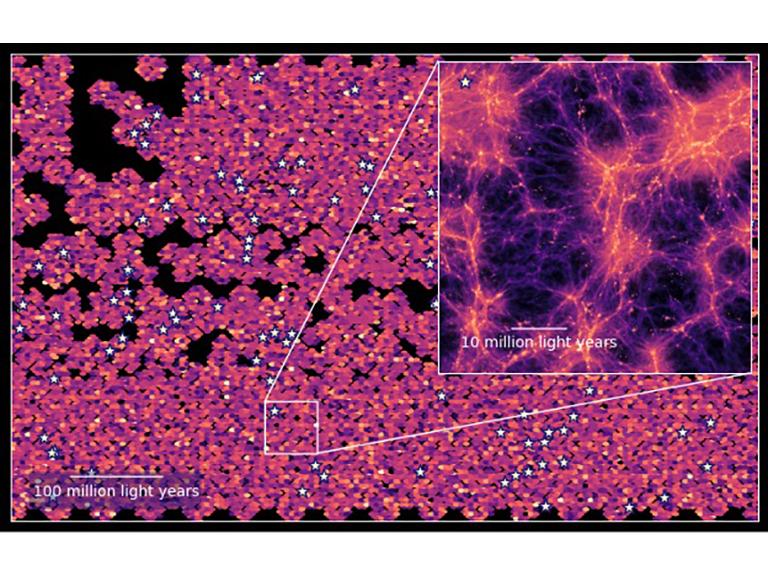
An international team of scientists, including astronomers from Penn State, has unveiled the most comprehensive 3D map of the early universe’s light structures. Utilizing data from the Hobby-Eberly Telescope Dark Energy Experiment (HETDEX), the researchers focused on light emitted by excited hydrogen atoms, known as Lyman alpha radiation, which dates back 9 to 11 billion years. This breakthrough offers unprecedented insights into the universe’s formative years.
The Lyman alpha radiation is crucial for understanding galaxies during a period of intense star formation. Robin Ciardullo, a professor of astronomy and astrophysics at Penn State and a member of the research team, emphasized the significance of this discovery. “Lyman alpha radiation is an important characteristic of galaxies at this period in the universe’s history, an era of vigorous star formation,” he stated. “Previous to this study, the locations of fainter galaxies and gas, which also emit Lyman alpha radiation, have remained largely unknown.”
Mapping the Early Universe
The team employed a technique known as Line Intensity Mapping to bring these elusive objects into view. This innovative approach adds depth and detail to our understanding of the universe’s early stages. The findings were published in The Astrophysical Journal, marking a significant milestone in astronomical research.
Maja Lujan Niemeyer, a HETDEX scientist and recent graduate from the Max Planck Institute for Astrophysics, led the development of the map. She explained the challenges of observing distant objects: “Observing the early universe gives us an idea of how galaxies evolved into their current form and what role intergalactic gas played in this process. But because they are far away, many objects in this time are faint and difficult to observe.”
Understanding Line Intensity Mapping
Line Intensity Mapping differs from traditional galaxy surveys by capturing a broader spectrum of light. Julian Muñoz, a HETDEX scientist and assistant professor at the University of Texas at Austin, illustrated this with an analogy: “Imagine you’re in a plane looking down. The ‘traditional’ way to do galaxy surveys is like mapping the brightest cities only: you learn where the big population centers are, but you miss everyone that lives in the suburbs and small towns. Intensity mapping is like viewing the same scene through a smudged plane window: You get a blurrier picture, but you capture all the light and not just the brightest spots.”
Despite being a known technique, this marks the first time Line Intensity Mapping has been applied to such a vast dataset with high precision. The Hobby-Eberly Telescope at McDonald Observatory in Texas has charted over one million bright galaxies, aiming to unravel the mysteries of dark energy. The project stands out for its extensive data collection, amassing over 600 million spectra across a sky area equivalent to more than 2,000 full moons.
Unlocking Potential for Future Research
Interestingly, only a small fraction of the collected data, about 5%, is currently utilized. Karl Gebhardt, HETDEX principal investigator and chair of UT Austin’s astronomy department, highlighted the untapped potential: “There’s huge potential in using that remaining data for additional research.”
The research team leveraged this additional data to construct the Lyman alpha radiation map, revealing the hidden light in seemingly empty patches of the sky. “HETDEX observes everything in a patch of sky, but only a tiny amount of that data is related to the galaxies that are bright enough for the project to use,” Lujan Niemeyer noted. “But those galaxies are only the tip of the iceberg. There’s a whole sea of light in the seemingly empty patches in between.”
Implications and Future Directions
This development opens new avenues for exploring the early universe’s structure and evolution. By mapping these hidden structures, astronomers can better understand the processes that shaped galaxies and intergalactic gas. The implications extend beyond astronomy, offering insights into the fundamental forces that govern the universe.
As research continues, the team hopes to refine their techniques and expand their observations. The vast amount of unused data presents an opportunity for further discoveries, potentially revolutionizing our understanding of the cosmos. The next steps involve deeper analysis and collaboration with other astronomical projects to enhance the map’s accuracy and scope.
The announcement comes as a significant advancement in the field of astronomy, demonstrating the power of innovative techniques and collaborative research. As scientists delve deeper into the universe’s past, the potential for groundbreaking discoveries remains vast and exciting.