



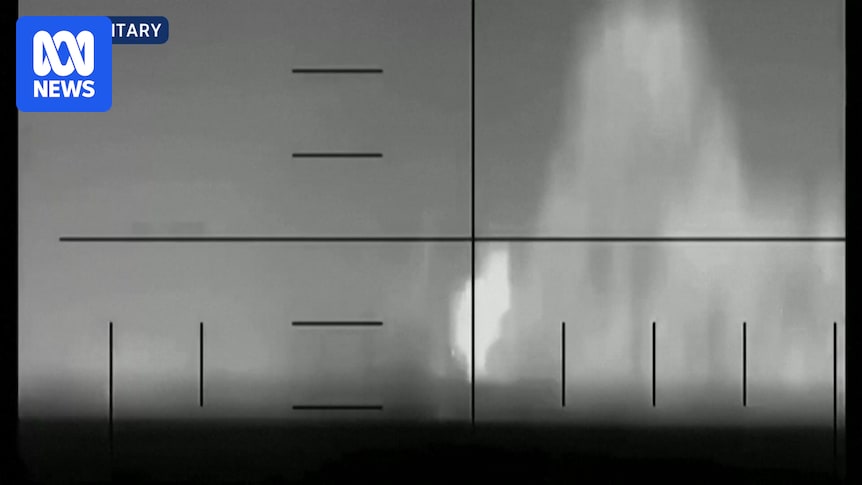
The United States military has released dramatic footage showing a submarine torpedoing an Iranian warship, the IRIS Dena, off the coast of Sri Lanka in international waters. This incident marks a significant escalation in the ongoing conflict between the US and Iran, with the vessel being described as a “prize ship” by US Defense Secretary Pete Hegseth.
The IRIS Dena, one of Iran’s newest and most advanced warships, was heavily armed and carried a crew of 180 sailors. Sri Lankan authorities have reported recovering 87 bodies and rescuing 32 individuals, while 60 sailors remain unaccounted for. The Sri Lankan navy responded to a distress signal but found only oil patches and life rafts upon arrival.
Escalating Tensions in International Waters
This development follows a series of aggressive moves by the US and Israel aimed at crippling Iran’s naval capabilities. President Donald Trump has emphasized the strategic importance of neutralizing Iran’s navy, particularly given Tehran’s attempts to disrupt the Strait of Hormuz, a critical global oil shipping route.
The IRIS Dena was reportedly returning to Iran from eastern India when it was targeted. The attack underscores the expanding geographical scope of the conflict, extending well into the Indian Ocean, as noted by Donald Rothwell, a professor of International Law at the ANU College of Law.
“This is a significant escalation by the United States in terms of the area of combat operations extending well into the Indian Ocean and quite some considerable distance from where we’ve seen the conflict being seen centred at the moment in the Middle East,” Rothwell stated.
Reactions and Consequences
In the aftermath of the attack, Sri Lanka’s Foreign Minister Vijitha Herath confirmed that rescue operations were underway, with ships and planes dispatched to aid the stranded sailors. The injured have been transported to a hospital in Galle, while those who perished have been taken to a nearby mortuary.
Despite the severity of the incident, Iran’s leadership has yet to publicly comment on the sinking. Meanwhile, US Defense Secretary Hegseth has hailed the operation as a significant blow to Iran’s naval strength.
Strategic Implications
The sinking of the IRIS Dena is part of a broader campaign by the US and Israel to systematically dismantle Iran’s naval power. According to US General Dan Caine, the Pentagon has destroyed 20 Iranian vessels since the onset of hostilities. Satellite imagery has confirmed significant damage to Iranian naval bases, with numerous ships either sunken or severely damaged.
By the Numbers: “Iran’s navy consists of over 18,500 personnel and more than 100 vessels, including ships and submarines,” according to a report by the Australian Naval Institute.
Historical Context and Future Outlook
This incident marks the first time a US submarine has sunk a warship since World War II, although similar events have occurred, such as the British HMS Conqueror sinking an Argentine ship during the Falklands War in 1982.
The move represents a deliberate strategy by the US to extend its military operations beyond the Middle East, raising questions about the potential for further escalation. As the conflict progresses, the international community watches closely, concerned about the implications for global shipping and regional stability.
Looking ahead, the US’s aggressive posture in the Indian Ocean could provoke a response from Iran, potentially leading to a broader confrontation. The situation remains fluid, with diplomatic efforts and military strategies likely to shape the conflict’s trajectory in the coming weeks.