




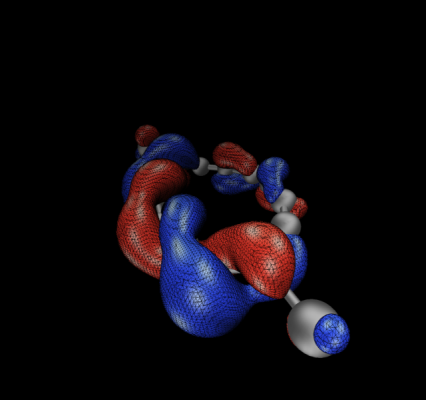
An international team of scientists has synthesized a molecule with a unique electronic topology, marking a significant milestone in both chemistry and quantum computing. Researchers from IBM, The University of Manchester, Oxford University, ETH Zurich, EPFL, and the University of Regensburg have created a molecule where electrons travel in a corkscrew-like pattern, fundamentally altering its chemical behavior. This groundbreaking discovery, published in Science, represents the first experimental observation of a half-Möbius electronic topology in a single molecule.
The molecule, denoted as C₁₃Cl₂, was constructed atom-by-atom at IBM, utilizing a custom precursor from Oxford University. It features an electronic structure that twists 90 degrees with each circuit, requiring four loops to return to the starting phase. This half-Möbius topology is unlike any previously known molecule and can be switched between different twisted states, demonstrating that electronic topology can be deliberately engineered.
Quantum Computing: A Tool for New Discoveries
The creation and characterization of this molecule required high fidelity quantum computing simulations. This advance is significant for both fields involved. For chemistry, it shows that electronic topology can be engineered rather than just discovered. For quantum computing, it provides a tangible demonstration of its capability to simulate quantum mechanical behavior at the molecular level, offering insights previously unattainable with classical computers.
Alessandro Curioni, IBM Fellow and Director of IBM Research Zurich, emphasized the importance of this achievement:
“First, we designed a molecule we thought could be created, then we built it, and then we validated it and its exotic properties with a quantum computer. This is a leap towards the dream laid out by renowned physicist Richard Feynman decades ago to build a computer that can best simulate quantum physics.”
Implications for Chemistry and Physics
Dr. Igor Rončević, a co-author of the paper and a lecturer in Computational and Theoretical Chemistry at The University of Manchester, highlighted the broader implications of this work. He noted that the discovery introduces topology as a new, switchable degree of freedom in controlling material properties, akin to the impact of spintronics in the late 20th century.
Rončević explained,
“The non-trivial topology of this molecule, and the exotic behavior of many other systems, arises from interactions between their electrons. Simulating electrons with classical computers is very hard – a decade ago we could exactly model 16 electrons, and today we can go up to 18. Quantum computers are naturally well-suited for this problem because their building blocks – qubits – are quantum objects, which mirror electrons.”
A New Era of Quantum-Centric Supercomputing
The researchers leveraged IBM’s quantum computer to explore the molecule’s electronic structure, revealing helical molecular orbitals for electron attachment, a hallmark of the half-Möbius topology. This work underscores the potential of quantum-centric supercomputing, which integrates quantum processing units (QPUs), CPUs, and GPUs to solve complex problems by leveraging the strengths of each system.
This achievement builds on IBM’s legacy in nanoscale science, which began with the development of the scanning tunneling microscope (STM) in 1981. This invention, which earned IBM scientists Gerd Binnig and Heinrich Rohrer the Nobel Prize in 1986, enabled researchers to image surfaces atom by atom. Over the years, IBM has refined these techniques to manipulate individual atoms and construct increasingly exotic molecular structures.
Future Prospects and Scientific Exploration
The success of this research signals a step towards realizing the vision of using quantum computing to explore and understand the fundamental nature of matter. As quantum hardware continues to advance, the potential for discovering new materials and phenomena grows exponentially.
As Curioni noted,
“The future is quantum. This is just the start, and quantum hardware is advancing rapidly. We are opening the door for new ways to explore our world and the matter within it.”
The publication of this research in Science marks a pivotal moment in the fields of chemistry and quantum computing, setting the stage for further breakthroughs that could reshape our understanding of molecular science and the capabilities of computational technology.