



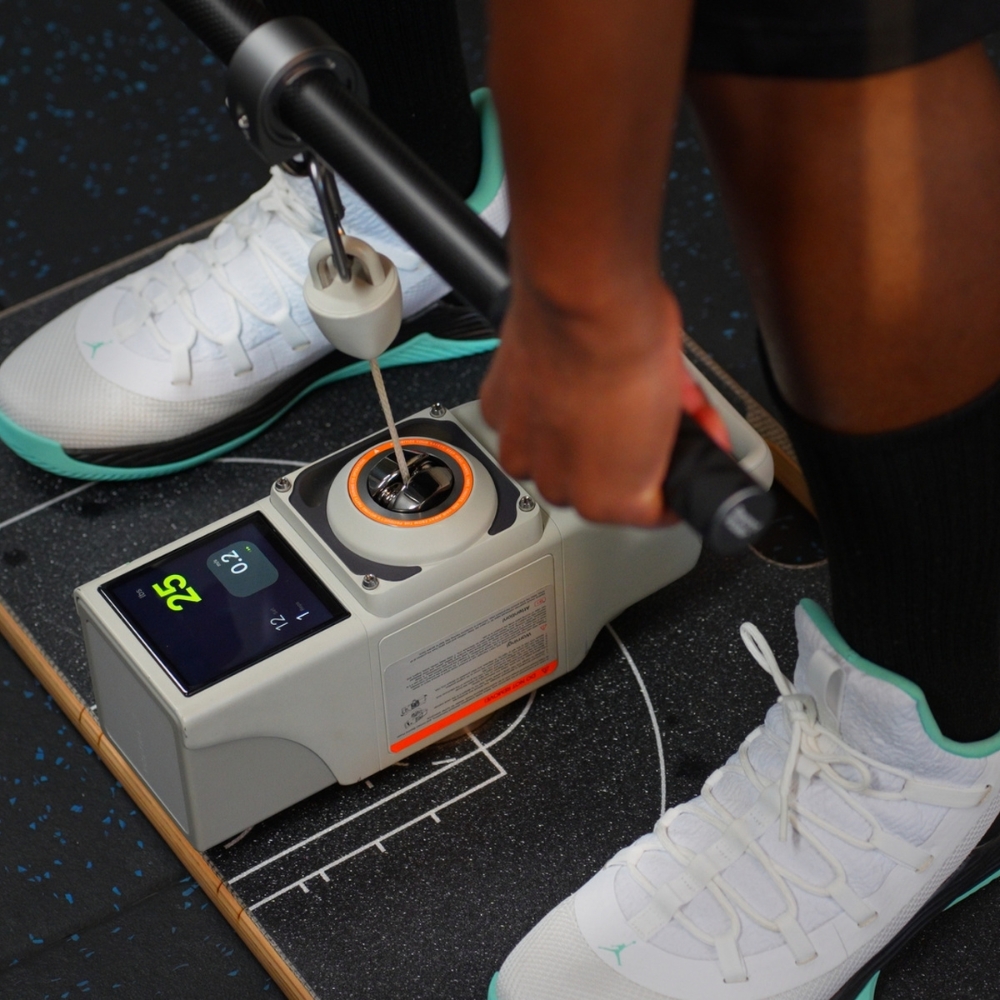
There was a time when phones were bolted to walls. Then they went mobile, and eventually, they became smart. According to exercise physiologist Chris Tzarimas, strength training may now be undergoing a similar transformative shift. Tzarimas recently conducted an independent review of the BEYOND POWER Voltra I, a 5.8kg portable device that replaces traditional weight plates with a motor that generates resistance electronically. Based on expert reviews and his own findings, Tzarimas argues that this technology represents more than just incremental innovation.
“This isn’t just another home gym accessory,” Tzarimas asserts. “What we’re seeing is a fundamental shift in how resistance can be delivered, progressed, and measured.”
The Evolution of Resistance Training
At a surface level, the appeal of the Voltra I is obvious. The unit fits into a gym bag, mounts onto racks, beams, or stable anchor points, and delivers resistance in one-pound increments up to 200lb without the need to manually load or strip plates. But the implications, Tzarimas argues, go far deeper than convenience. Because resistance is motor-driven, it can change instantly mid-set, adjust automatically when fatigue sets in, and be programmed to apply different loads during different phases of a lift.
The Voltra I allows users to reduce load on the concentric phase and increase it on the eccentric automatically, while also detecting failure and deloading in real time. “For decades, resistance training has been constrained by gravity,” Tzarimas explains. “Digital motorized systems remove that constraint. You’re no longer limited to fixed stack jumps or manually loading plates. Resistance becomes programmable.”
Bringing Laboratory Precision to the Gym
The device also brings a form of training previously confined to sports science laboratories into a portable format: isokinetic resistance. Traditionally delivered via large, expensive dynamometers, isokinetic training maintains a constant movement speed by adjusting resistance dynamically to prevent acceleration. By allowing users to set a movement speed and automatically modulating resistance to enforce it, portable digital systems could extend this methodology beyond rehab clinics and elite facilities.
“For athletes, this means velocity-controlled power work,” Tzarimas says. “For rehab, it means measurable joint loading. For performance-driven lifters, it means data-backed training.”
It’s this convergence of portability and precision that has begun attracting attention beyond the consumer fitness market. When NASA’s HumanWorks Lab required a compact digital resistance solution for research into preserving astronaut musculoskeletal health during long-duration missions, it selected the Voltra I platform. The device was also named one of the Best Inventions of 2025 by TIME Magazine.
Data-Driven Workouts and Market Impact
Where traditional weight machines offer little more than load selection, the Voltra I integrates with an app that tracks force, power, velocity, time under tension, and asymmetry between limbs. For coaches and athletes operating in high-performance environments, the ability to quantify concentric versus eccentric output or detect side-to-side discrepancies may influence programming decisions in ways conventional machines cannot.
“For anyone who’s ever wished resistance training had the same data depth as cycling or running – this is it,” says Tzarimas.
However, for all the praise, there are still some downsides to the Voltra I. Tzarimas notes the $2,199 USD price tag and 200lb of maximum resistance. “It won’t replace a fully loaded barbell for elite powerlifters chasing absolute maximal lifts,” he says. “But for the vast majority of strength-focused men, the versatility, safety, and precision are hard to ignore.”
A New Era in Strength Training
As Tzarimas points out, there are very few exercises that require more than 200lbs of resistance. And while many will balk at the price tag, it is worth noting that heavy plates don’t come cheap either. Tzarimas believes the broader shift the Voltra I is bringing about matters more than its limitations.
“Traditional resistance machines haven’t meaningfully evolved in decades,” he says. “The Voltra I introduces software-defined resistance, programmable overload, and embedded analytics. This may be the moment everything changes.”
The announcement comes as the fitness industry continues to embrace technology-driven solutions, reflecting a broader trend towards personalized and data-driven workouts. As more consumers and professionals experience the benefits of digital resistance, the Voltra I could indeed mark a pivotal moment in the evolution of strength training.