

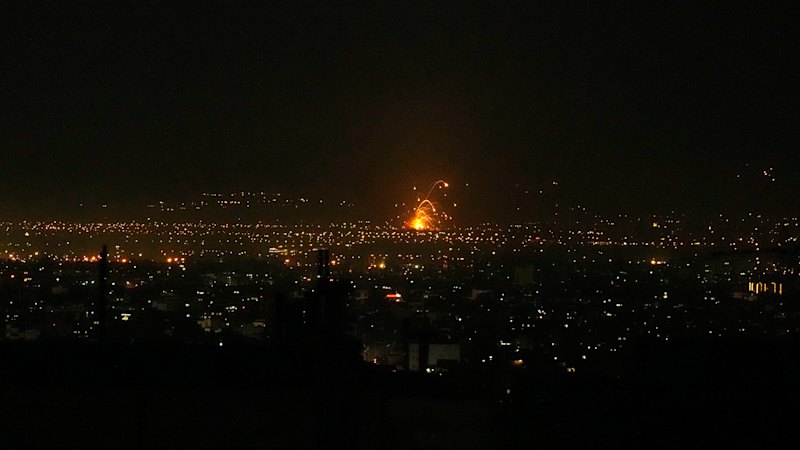
Jerusalem: In a dramatic escalation of regional tensions, Israel launched another wave of strikes on Tehran on Sunday, following the assassination of Iran’s Supreme Leader Ali Khamenei. This development has thrown the Middle East and the global economy into a state of deep uncertainty.
The strikes, which were met with retaliatory missile barrages from Iran, have reverberated through key sectors such as shipping, air travel, and oil. Experts warn of rising energy costs and potential disruptions to business activities in the Gulf, a critical global trade hub.
US President Donald Trump, speaking to Fox News, confirmed that 48 Iranian leaders were killed in the strikes, describing the operation as a significant success. “It’s moving along rapidly. Nobody can believe the success we’re having,” Trump stated, emphasizing the aim to prevent Iran from acquiring nuclear capabilities and to curb its missile program.
Global Reactions and Strategic Implications
According to US Central Command, over 1000 Iranian targets have been hit since the campaign began. Trump revealed in an interview with The Atlantic that Iran’s leadership has expressed a desire to negotiate, and he has agreed to talks. However, he noted that the military campaign could extend for several weeks, leaving Iran in a precarious power vacuum.
The closure of the vital Strait of Hormuz and attacks on Gulf cities like Dubai and Abu Dhabi underscore the high stakes of the conflict. A Reuters/Ipsos poll revealed that only about 25% of Americans support the operation, with concerns mounting over potential spikes in oil prices.
Israel’s military announced that its air force had achieved aerial superiority over Tehran, targeting key intelligence and military sites. An Israeli official, speaking anonymously, stated that the goal is to destabilize the Iranian government, encouraging public dissent.
Regional and International Responses
Iran’s Revolutionary Guards reported attacks on three US and UK oil tankers in the Gulf, with shipping data indicating a halt in vessel movements. The global air travel sector is also experiencing severe disruptions, with major Middle Eastern airports closed.
In Iran, President Masoud Pezeshkian announced that a leadership council has temporarily assumed the duties of Supreme Leader. Meanwhile, international reactions have been mixed, with Russian President Vladimir Putin condemning Khamenei’s death as a “cynical murder,” and China’s Foreign Minister Wang Yi labeling it a “blatant killing.”
Israel claimed responsibility for Khamenei’s assassination, with military spokesperson Lieutenant Colonel Nadav Shoshani asserting, “We have the capabilities and the targets to keep going on for as long as necessary.”
Escalating Military Engagements
Amid renewed Iranian missile barrages, air raid sirens blared across Israel, including in Tel Aviv. The Israeli ambulance service reported casualties, with nine fatalities in Beit Shemesh. The United Arab Emirates and Kuwait also reported deaths due to Iranian attacks.
Trump warned of unprecedented force if Iran retaliates further, while the leaders of Britain, France, and Germany expressed readiness to defend their regional interests. British Prime Minister Keir Starmer confirmed that the UK had granted the US permission to use its bases for defensive strikes against Iranian missile sites.
Internal Strife and International Diplomacy
Inside Iran, reactions to Khamenei’s death have been polarized, with some mourning and others celebrating. The Supreme Leader’s passing has exposed deep societal divisions, with reports of both mourning and jubilant celebrations across the country.
Khamenei’s death marks a significant shift in Iran’s political landscape. He had ruled with an iron fist for 36 years, shaping Iran into a formidable anti-US force. Experts caution that while his death is a major blow, it may not dismantle Iran’s entrenched clerical regime or the Revolutionary Guards’ influence.
Protests have erupted in neighboring countries, with clashes reported in Pakistan and Iraq. The US consulate in Karachi was breached, resulting in fatalities, while protests outside the US Embassy in Baghdad were met with tear gas.
This unfolding crisis continues to draw global attention, with significant implications for regional stability and international relations. As the situation develops, the world watches closely for signs of de-escalation or further conflict.