



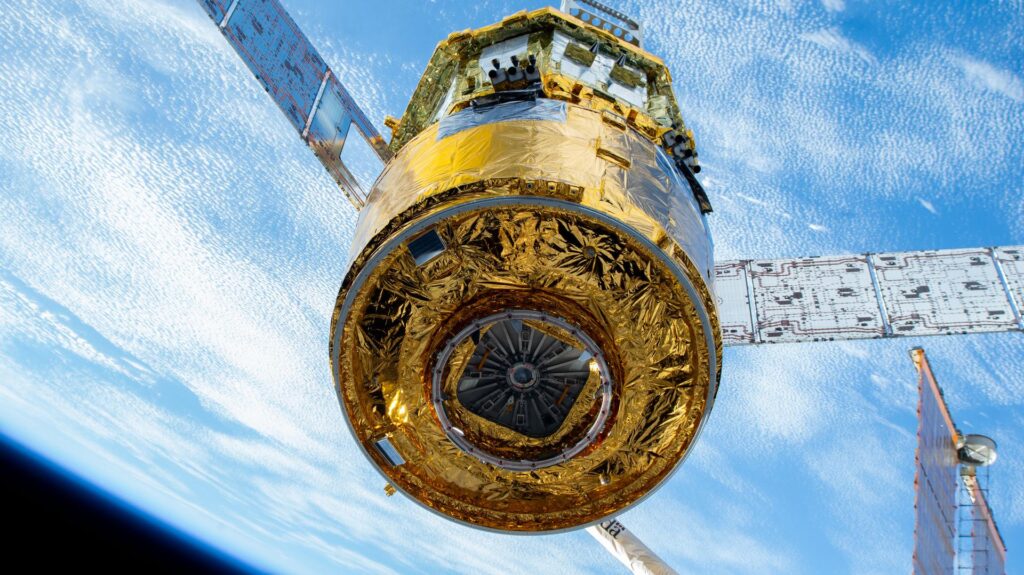
After successfully delivering approximately 12,000 pounds of supplies, scientific investigations, hardware, and other essential cargo to the International Space Station (ISS), the Japan Aerospace Exploration Agency’s (JAXA) uncrewed HTV‑X1 cargo spacecraft is set to depart on Friday, March 6. The departure marks a significant milestone in the ongoing collaboration between NASA and its international partners in space exploration.
NASA’s live coverage of the event will begin at 11:45 a.m. EST, accessible via NASA+, Amazon Prime, and the agency’s YouTube channel. The spacecraft’s release is scheduled for 12 p.m., offering the public a chance to witness this critical operation. Viewers are encouraged to learn more about accessing NASA content through various online platforms, including social media.
Preparations for Departure
On Thursday, March 5, flight controllers are tasked with using the space station’s Canadarm2 robotic arm to detach the HTV-X1 from the Harmony module’s Earth-facing port. This maneuver will position the spacecraft for its scheduled release. Although NASA will not provide live coverage of the detachment process, NASA astronaut Chris Williams will closely monitor HTV-X1’s systems during its undocking and departure.
The HTV-X1 spacecraft will remain in orbit for over three months, serving as a scientific platform for JAXA’s experiments. This extended mission underscores the spacecraft’s dual role in both delivering critical supplies and facilitating scientific research.
Scientific and Operational Significance
The HTV-X1’s mission is an integral part of the broader objectives of the ISS, which has been continuously inhabited for more than 25 years. The space station serves as a vital testbed for advancing scientific knowledge and achieving research breakthroughs that are not feasible on Earth. The insights gained from these missions are crucial for understanding and overcoming the challenges associated with long-duration spaceflight.
Upon receiving the deorbit command, HTV-X1 will dispose of several thousand pounds of trash during its re-entry into Earth’s atmosphere, where it will burn up harmlessly. This disposal method highlights the ongoing efforts to manage waste in space responsibly.
A Collaborative Future in Space Exploration
The HTV-X1 arrived at the ISS on October 29, 2025, following its launch on October 25 from Japan’s Tanegashima Space Center aboard an H3 rocket. This mission exemplifies the collaborative spirit of international space agencies working together to achieve common goals.
As commercial companies increasingly focus on providing human space transportation services and destinations, NASA is redirecting its resources towards deep space missions. The agency’s Artemis campaign aims to return humans to the Moon and prepare for future astronaut missions to Mars, leveraging the knowledge gained from ISS operations.
For more than 25 years, people have lived and worked continuously aboard the International Space Station, advancing scientific knowledge and making research breakthroughs that are not possible on Earth.
Looking ahead, the HTV-X1’s departure is a reminder of the ongoing evolution in space exploration, where international cooperation and commercial partnerships play pivotal roles. As NASA and JAXA continue to push the boundaries of what is possible, the lessons learned from these missions will pave the way for future endeavors beyond low Earth orbit.