

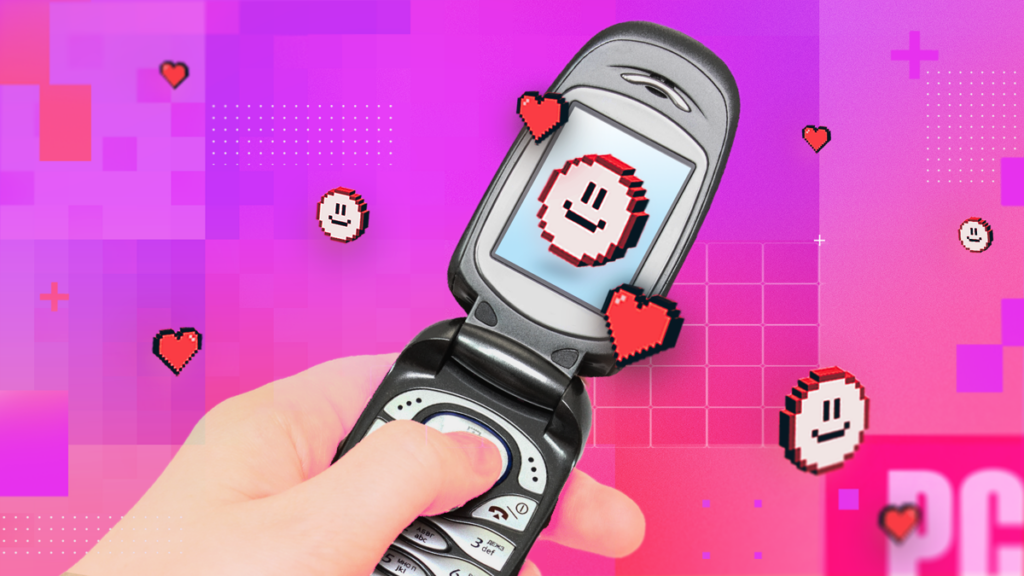
Are you constantly scrolling on your smartphone? If so, you are far from alone. The average American checks their phone nearly 186 times per day, equating to 11.6 times per hour, and 46% say they’re addicted to their devices, according to a recent study. In response to this trend, a growing number of people are reclaiming control over their digital lives by switching to a flip phone.
The subreddit r/Dumbphones, which counts 200,000 weekly participants, serves as a hub for those looking to unplug and veterans sharing stories of how they did it. Celebrities like Aziz Ansari and Ed Sheeran have publicly stated they do not use smartphones. “I’m team flip phone revolution,” the pop singer Camila Cabello declared in a 2023 X post. Business Insider recently declared “offline is the new luxury,” as a wave of digital minimalism takes hold.
Why People Are Making the Switch
We recently spoke to six individuals, the oldest of whom is 45, who are part of the flip phone revolution. Each has a different rationale for the decision, but consistent themes emerge. Without the constant temptation to scroll, they find it easier to focus on their priorities. Their social interactions are more satisfying, and they save money. Flip phones can cost as little as $30, with monthly plans available for $15.
Most are not anti-technology—in fact, three are software engineers. Here’s what they each had to say about how downgrading their tech has been the best upgrade of their lives.
Trevor Brown, 35: Making Time for Family
When Trevor Brown started his career as a software engineer, he had multiple cell phones. But by 2020, the thrill began to fade. “I started to realize that while a smartphone was very powerful, there were many downsides,” he says. The biggest issue was the ease of accessing the internet and social media at any time, which led to mindless scrolling during “small windows of downtime.”
Living in Florida and starting a family prompted him to reassess his priorities. He wanted to be more present with his children, so he bought a $30 Alcatel Go Flip 2. The device was primitive but synced with Google Calendar so he didn’t miss appointments. Later, he upgraded to the Cat S22 flip phone, which runs a full Android operating system but has a small screen, making it less “fun” to use social media or browse online.
There are inconveniences, like when customer service asks to send a text message for verification. “I’m like, ‘No, I can’t do that. I’m on a flip phone,'” Brown says. “It does one thing at a time, so to see the text message I have to hang up.”
“There’s always a new thing, whether it’s cryptocurrencies or AI, and a lot of people go along with it and get into it,” he says, “even though it doesn’t always benefit them.”
Zoe Rodriguez, 24: Overcoming Childhood Phone Addiction
Zoe Rodriguez was 10 when her parents gave her a pink iPhone to use whenever she wanted. “It set me up for phone addiction,” she says. For the next decade, Rodriguez spent nearly every waking hour on her phone. By age 20, she was fed up and decided to switch to a flip phone.
She chose the $195 Sunbeam F1 and signed up for a $15-per-month Mint Mobile plan. The decision still has “compounding returns to this day,” she says. Without the powerful pull of a smartphone, she no longer glances at her device during awkward moments. She’s found new ways to use her time, like exploring her emotions over a quiet cup of coffee or working on her figure drawing.
“I have all this knowledge, and I feel smarter,” she says. “What guy wouldn’t want a girl who’s not constantly on their phone?”
Joel Epstein, 45: Leading by Example
Joel Epstein, who lives in New York, runs five businesses, including the cabinetry company Fabuwood. For the past three years, he has not allowed any of Fabuwood’s 1,200 employees to have a smartphone in the office. “We’re producing 20% more with the same amount of people,” he says.
Epstein had felt “addicted” to his BlackBerry. When BlackBerry fell out of favor, and iPhones took over, he hesitated to switch. “I thought, ‘Why should I have a phone that dictates my life?'” Epstein says. He gives employees a free flip phone to stay connected in case of emergencies during work.
He estimates that about 100 of his employees have switched to using flip phones in their personal lives.
The Broader Implications
This movement towards digital minimalism is not just a personal choice but reflects broader societal shifts. As technology becomes increasingly pervasive, more individuals are questioning its role in their lives. The flip phone revolution is a testament to the growing desire for balance and intentionality in a hyper-connected world.
Experts suggest that this trend could lead to a reevaluation of how technology fits into our daily routines. As more people opt for simpler devices, tech companies may need to reconsider their strategies to cater to a market that values simplicity over complexity.
As the digital landscape continues to evolve, the flip phone revolution highlights the importance of choice and control in our interactions with technology. Whether this trend will gain further momentum remains to be seen, but for those who have made the switch, the benefits are clear: a more focused, intentional, and connected life.