



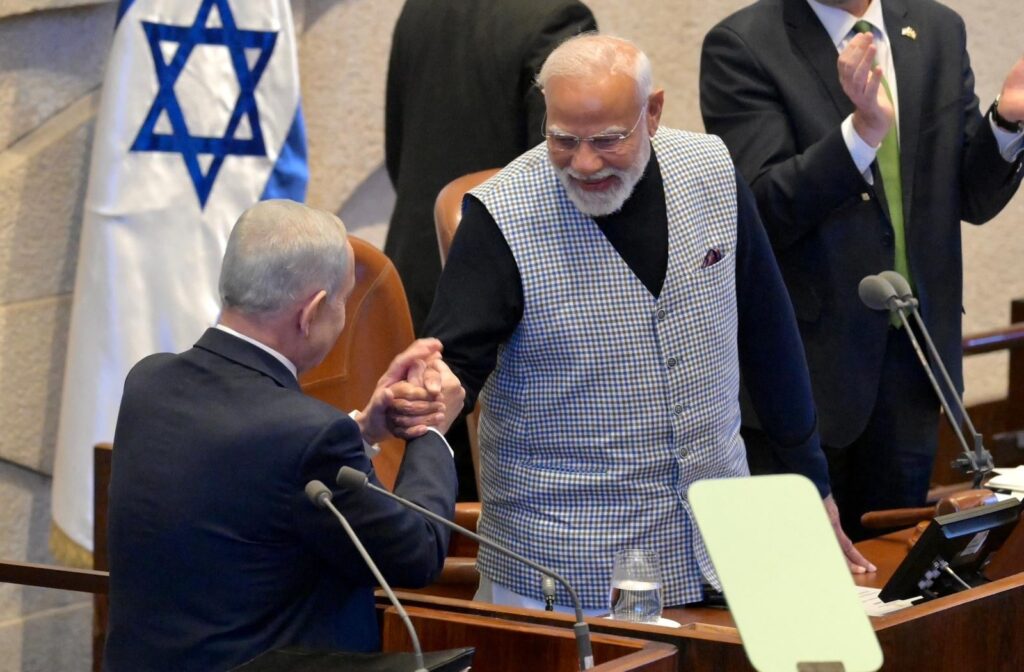
In a historic address to the Knesset, Indian Prime Minister Narendra Modi affirmed India’s unwavering support for Israel, emphasizing the strength of their alliance in confronting Islamist terrorism. Speaking on Wednesday, Modi declared, “India stands with Israel firmly with full conviction in this moment and beyond,” marking the first time an Indian leader has addressed Israel’s parliament.
Modi’s visit underscores the deepening strategic relationship between India and Israel, a bond that has been cultivated over decades. Israeli Prime Minister Benjamin Netanyahu, who spoke before Modi, highlighted their shared commitment to forming an “iron alliance” against extremist Islam. This visit, part of Modi’s two-day trip to Israel, further cements the personal rapport between the two leaders.
Strategic Alliances and Regional Initiatives
Netanyahu elaborated on the collaborative efforts between the two nations, particularly the development of the IMEC initiative. This US-backed transport project aims to connect India to Europe via the Middle East using sea and rail routes. “This maritime-land corridor can exist and flourish only if it passes through stable and secure countries. And there are no stronger and more secure countries on this axis than India and Israel,” Netanyahu stated.
The idea of creating a new regional alliance has been a recurring theme for Netanyahu. On Tuesday, he informed the Shin Bet domestic intelligence agency of Israel’s efforts to establish a regional alliance opposing Iranian and Muslim Brotherhood influences. “I am talking about an entire circle that encompasses the Middle East,” he remarked.
Condolences and Condemnations
During his address, Modi expressed condolences for the victims of the October 7 terrorist attack by Hamas, which led to a regional conflict involving Israel and Iran. “The massacre of October 7 made it absolutely clear: either the jihadist axis of evil will break us, or we will break it,” Modi asserted, reinforcing India’s solidarity with Israel. Netanyahu appreciated Modi’s support, saying, “After this murderous attack, you stood in such a clear way, so moral, so sharp… We will never forget this.”
Modi also praised India’s historical tolerance towards its Jewish communities, highlighting that India is a civilization where Jews were never persecuted. “In a world where antisemitism is rising, India stands out,” Netanyahu acknowledged.
Diplomatic Nuances and Domestic Politics
The visit wasn’t without its political complexities. Opposition members walked out during parts of the session to protest the exclusion of High Court president Isaac Amit from the special Knesset session. However, they returned for Modi’s speech, emphasizing that their protest was not directed at the Indian leader. Opposition Leader Yair Lapid assured Modi, “The entire State of Israel is filled with admiration for your leadership, for your friendship, for the fact that you were here for us in our time of trouble.”
Economic Cooperation and Future Prospects
Bilateral relations between India and Israel have seen significant growth, particularly in military cooperation, agriculture, science, and technology. India, the world’s most populous country and the fifth-largest economy, is Israel’s second-largest trading partner in Asia. In 2024, the trade volume between the two nations reached approximately $5 billion.
Despite the positive trajectory, challenges remain, particularly regarding a proposed free trade agreement. According to an Israeli official, India is keen on including foreign workers in the FTA, a move Israel opposes due to concerns over controlling the influx of Indian workers. Nonetheless, both leaders are committed to overcoming these hurdles to further their strategic partnership.
Modi and Netanyahu’s camaraderie was evident as they posted on social media in each other’s languages, symbolizing the deep personal and diplomatic ties that continue to grow between India and Israel.