



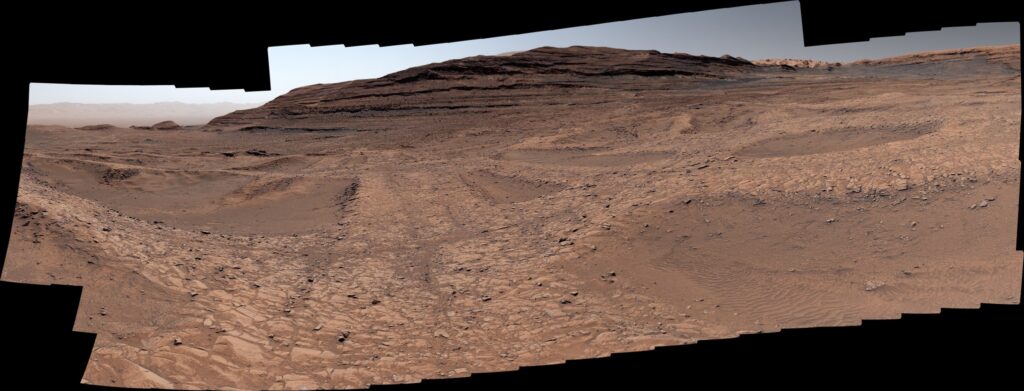
For the past six months, NASA’s Curiosity Mars rover has been traversing a region rich with geological formations known as boxwork. These structures, which resemble giant spiderwebs from space, are composed of low ridges standing approximately 3 to 6 feet tall, interspersed with sandy hollows. The formations suggest that ancient groundwater flowed in this part of Mars later than previously thought, raising intriguing questions about the planet’s habitability billions of years ago.
The boxwork formations are believed to have formed when groundwater moved through fractures in the bedrock, depositing minerals that reinforced the ridges. Wind erosion then hollowed out the less mineralized areas. Before Curiosity’s arrival, scientists could only speculate about these formations’ appearance and origins.
Unpacking Boxwork: A Closer Look
While Earth also features boxwork ridges, they rarely exceed a few centimeters in height and are typically found in caves or arid environments. The Curiosity team aimed to closely examine the Martian formations to gather more data, a task that presented significant challenges. The rover, comparable in size to an SUV and weighing nearly a ton, had to navigate narrow ridges and sandy hollows without slipping or encountering obstacles.
“It almost feels like a highway we can drive on. But then we have to go down into the hollows, where you need to be mindful of Curiosity’s wheels slipping or having trouble turning in the sand,” said Ashley Stroupe, operations systems engineer at NASA’s Jet Propulsion Laboratory. “There’s always a solution. It just takes trying different paths.”
For scientists, the challenge is understanding how such an extensive network of boxwork could exist on Mount Sharp, the 3-mile-tall mountain Curiosity is exploring. Each layer of the mountain corresponds to a different era of Mars’ ancient climate, with higher layers showing signs of drying with intermittent wet periods.
Scientific Discoveries and Implications
“Seeing boxwork this far up the mountain suggests the groundwater table had to be pretty high,” explained Tina Seeger of Rice University. “And that means the water needed for sustaining life could have lasted much longer than we thought looking from orbit.”
Previous orbital imagery revealed dark lines across the “spiderwebs,” hypothesized to be central fractures where groundwater concentrated minerals. Curiosity’s close-up investigation confirmed these lines are indeed fractures. The rover also discovered nodules, indicative of past groundwater, although their distribution remains puzzling.
“We can’t quite explain yet why the nodules appear where they do,” Seeger noted. “Maybe the ridges were cemented by minerals first, and later episodes of groundwater left nodules around them.”
Curiosity’s Roving Laboratory
Curiosity’s scientific mission includes collecting rock samples with its drill, analyzing them with onboard instruments. Last year, samples from the boxwork region were collected and analyzed, revealing clay minerals in the ridges and carbonate minerals in the hollows. These findings provide additional insights into the formation of these features.
Recently, a fourth sample underwent a special wet chemistry technique, enhancing the detection of organic compounds, which are crucial to understanding potential life formation on Mars.
Sometime in March, Curiosity will move beyond the boxwork formations. The region is part of a sulfate-rich layer on Mount Sharp, formed as Mars’ water sources dried up. The mission will continue exploring this layer to unravel more about Mars’ ancient climate changes.
More About Curiosity
Curiosity was developed by NASA’s Jet Propulsion Laboratory, managed by Caltech in Pasadena, California. JPL leads the mission for NASA’s Science Mission Directorate in Washington as part of the Mars Exploration Program.