


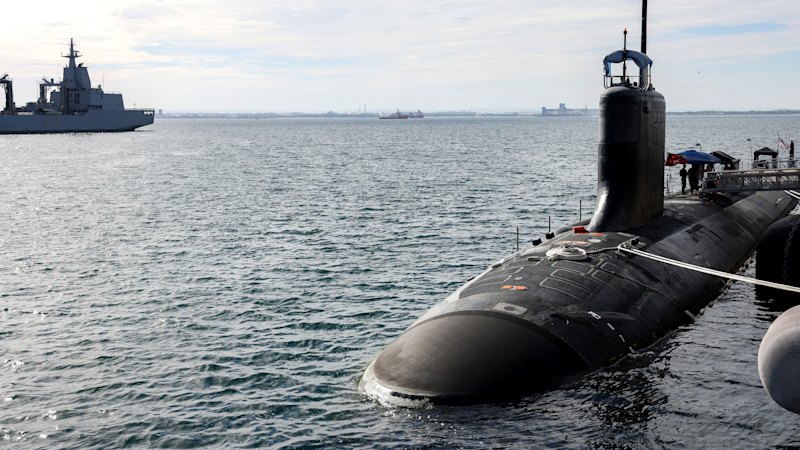
Australia is set to enhance its defense collaboration with the United Kingdom by investing $310 million in the AUKUS submarine project. This initiative, announced in London on Monday night, marks a significant step in the development of nuclear-powered submarines and includes joint efforts on radar systems, drones, and missile tests that could support Ukraine.
The agreement was finalized during a meeting between Australian and UK ministers, paving the way for a strengthened defense industry relationship aimed at developing advanced defensive weapons. This comes after Australia’s previous commitment of $5 billion towards the nuclear power systems for the AUKUS fleet. The new funding represents the first payment for equipment from Rolls-Royce, which will be installed in the initial submarines.
Strategic Investments in Defense
The $310 million allocated will procure the initial components for the nuclear reactors supplied by Rolls-Royce, which will be transported to South Australia for integration into the first two AUKUS vessels at the Osborne shipyard. Australia’s Minister for Defence Industry, Pat Conroy, and UK Minister for Defence Readiness and Industry, Luke Pollard, confirmed the funding after their discussions.
“This is the start of the construction process for these reactors,” Conroy stated in London. “We’re on track. We’re hitting all major milestones for the AUKUS project.”
Conroy also highlighted the Australian government’s recent $3.9 billion commitment to the expansion of the Osborne shipyard, a cost expected to rise to $30 billion over several decades. “This investment will build the only submarine yard in the Southern Hemisphere capable of constructing a nuclear-powered submarine,” he added.
Challenges and Opposition
The AUKUS project, while seen as a crucial step for national defense, faces opposition from some within the Labor Party and criticism from former leaders like Paul Keating and Bob Carr. Despite this, the government argues that the initiative is vital for national security and will generate 20,000 jobs over the coming decades.
The agreement is also contingent on support from the United States, which will supply interim submarines—three Virginia-class vessels—while Australia and the UK work towards developing a future vessel. Australia plans to have five submarines by the early 2040s, utilizing the same SSN-AUKUS design as the UK, which aims for up to 12 vessels.
Broader Defense Collaboration
Beyond submarines, Conroy and Pollard discussed joint projects in lasers and radar technology. The communiqué from their meeting indicated potential UK use of radar systems developed in Australia, particularly those from Canberra-based CEA Technologies, acquired by the Australian government in 2023 to retain intellectual property domestically.
On the drone front, the two nations plan to collaborate on the “Ghost Bat” aerial vehicle, already in production in Australia, with the goal of equipping it with missiles compatible with UK and NATO arsenals. “That will potentially facilitate exports of Ghost Bats to European nations who might be interested in it,” Conroy noted.
Testing and Future Developments
The London agreement also includes plans for British missiles to be tested in Australia, aiding the development of new weapons for Ukraine. “I won’t comment about the specific UK weapon that may be tested at our weapon ranges, but there’s a number of advanced, long-range weapons that the UK is providing, or looking at providing to Ukraine,” Conroy explained. Testing these at Australia’s facilities could expedite their deployment in Ukraine’s defense against Russian aggression.
Further agreements were made to advance work on laser weapons, collaborate on critical minerals supply, and increase the number of Australians embedded with BAE Systems in the UK for AUKUS fleet construction preparations.
The joint AUKUS design, with five submarines to be built in South Australia and up to 12 in the UK, aims to reduce construction costs compared to separate national designs. However, any delays in the UK construction schedule could impact Australia’s timeline due to the shared development strategy.
Rolls-Royce’s future programs director, Rich Palmer, expressed confidence last October in the project’s delivery despite criticisms and concerns. “I am 100 percent sure the submarines will be delivered,” he assured.
The British construction timeline relies on the ability to build one new submarine every 18 months for the existing fleet before transitioning to the new AUKUS design. Industry experts note that each Astute-class submarine currently takes about 24 months to complete, highlighting the challenges ahead.