



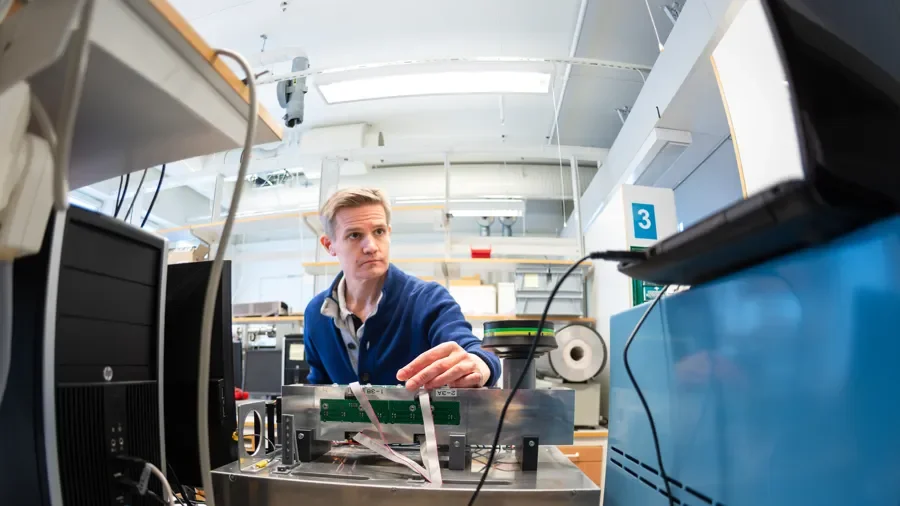
A blood sample may not have an obvious odor to a human, but to an electronic nose, it can carry a chemical signature indicative of disease. In a groundbreaking study from Linköping University in Sweden, researchers have demonstrated that a sensor device paired with machine learning can effectively sort blood-plasma samples into three categories: ovarian cancer, endometrial cancer, and healthy controls. This innovative approach could revolutionize cancer screening by moving beyond reliance on single biomarker tests.
“We’re trying to mimic the mammalian sense of smell artificially. We’ve now developed an algorithm that can distinguish ovarian cancer from endometrial cancer and healthy control groups, using data from an electronic nose,” explained Donatella Puglisi, an associate professor at Linköping University.
Vague Symptoms, Late Diagnoses
Ovarian cancer is notoriously difficult to detect early due to its vague symptoms, which often resemble more common ailments. This allows the disease to progress undetected, posing significant risks. In 2022 alone, approximately 325,000 new cases of ovarian cancer and over 200,000 deaths were reported globally, according to the researchers. The World Cancer Research Fund predicts these numbers will rise sharply by 2050.
“More and more people are being diagnosed with cancer, especially young adults, and this is alarming,” Puglisi noted. “If screening were more accessible, both in terms of cost and location, it would be possible to improve early diagnosis. Our approach could facilitate the adoption of new screening protocols and the development of new diagnostic methods, improving survival rates, quality of life, and overall clinical outcomes.”
The Nose, Rebuilt in Hardware
Electronic nose technology, though not new, has been refined by the Linköping team using a prototype with 32 sensors that react to various volatile substances emitted by blood samples. Different cancers release unique blends of volatile substances, creating distinct “smell” patterns. The sensors, which are commercially available, work in tandem with machine learning to identify these patterns, even amidst complex chemical mixes.
Instead of searching for a single biomarker, the electronic nose analyzes a broad spectrum of volatile substances from blood plasma. The machine-learning models then identify patterns that match ovarian cancer, achieving an impressive 97 percent accuracy in tests.
“It’s a simple test that takes 10 minutes and gives a clear result,” said Jens Eriksson, an associate professor at Linköping University and CTO at VOC Diagnostics AB. “Our method can test many people at a low cost and is much more accurate than what’s on the market today. This study is a pilot, but we hope it will be used as part of cancer screening within three years.”
A Closer Look at the Model’s Performance
The study involved analyzing blood-plasma samples from 134 individuals with ovarian cancer, 41 with endometrial cancer, and 115 healthy controls. The researchers evaluated 43 different machine-learning models, extracting 85 features from each sensor signal. They employed a 90–10 train-test split and fivefold cross-validation to refine their approach.
Through an iterative process, they discovered that excluding two sensors, identified as #17 and #25, improved model performance without overfitting. The model’s mean test accuracy reached approximately 97 percent, with sensitivity and specificity also around that level.
Addressing potential data leakage, the team performed a patient-level split and used majority voting across multiple signals to ensure accurate patient-level predictions, achieving perfect classification in this setup.
Not Just Detection, But Staging
Early-stage detection is crucial for effective treatment. The researchers also worked on distinguishing stage I ovarian cancer from more advanced stages II to IV. Using a similar approach, they reported a mean test accuracy of around 93 percent, with sensitivity in the mid-90 percent range and specificity in the mid-80 percent range.
These results indicate both promise and challenges. While the tool effectively flagged stage I cases, it was less consistent at ruling out stage I when a case was actually later-stage disease.
The Endometrial Cancer Challenge
Misclassification between ovarian and endometrial cancers could lead to incorrect diagnoses, increased patient distress, and higher healthcare costs. The team developed a classifier to distinguish between these cancers using the same electronic nose signals, achieving a mean test accuracy of around 97 percent, with high sensitivity and specificity.
However, in more complex, screening-like scenarios, sensitivity did not exceed 80 percent, although specificity remained high. This highlights an important constraint, as the system was better at excluding non-cancer cases than reliably detecting every early-stage cancer.
Practical Implications and Future Prospects
If this approach proves effective beyond the pilot study, it could lead to a new type of blood screening test that does not rely on a single biomarker and can be conducted quickly and cost-effectively in various locations. The strongest results were achieved through controlled comparisons and patient-level voting, which could fit seamlessly into clinical workflows if standardized.
Nonetheless, the study’s more challenging experiments, mixing multiple conditions into a screening-like pool, suggest that real-world early-stage detection will be the ultimate test. The research indicates that the tool may be most beneficial as part of a stepwise diagnostic pathway, identifying likely cancer cases and aiding clinicians in narrowing down diagnoses.
Research findings are available online in the journal Advanced Intelligent Systems. The original story “AI-powered electronic nose can ‘smell’ early signs of ovarian cancer in the blood” is published in The Brighter Side of News.