



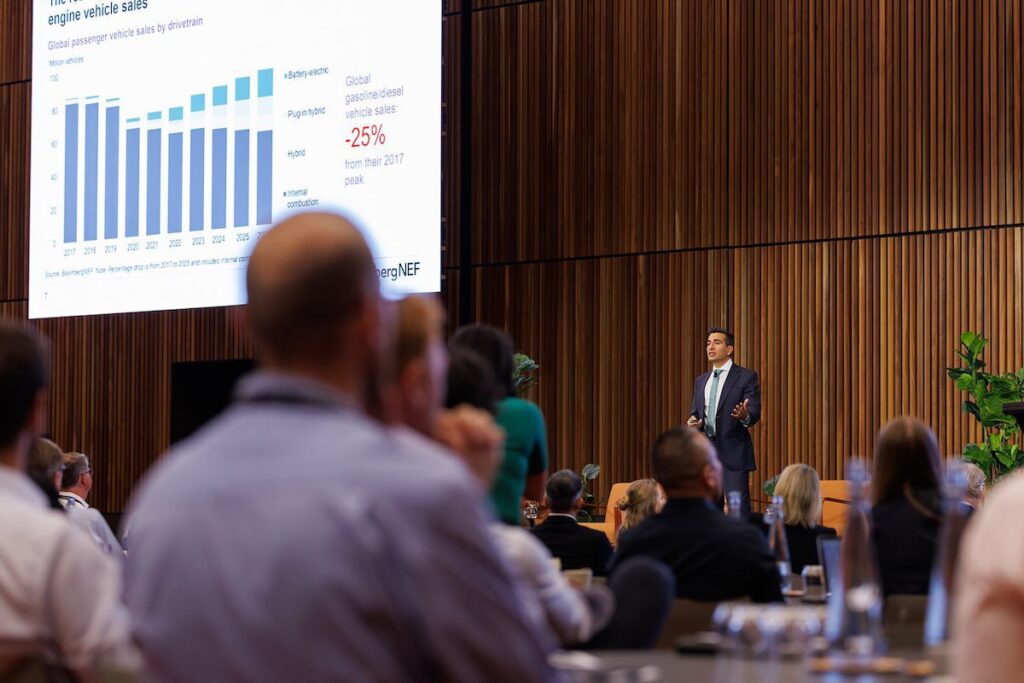
There is a significant disconnect in the eMobility sector, not just in Australia but globally. At the recent Climate Investor Forum in Melbourne, Kobad Bhavnagri, Global Head of Strategy at BloombergNEF, painted a picture of both a promising future and a vibrant present. Bhavnagri declared that green hydrogen is economically unviable for mobility and most other applications, suggesting that the transition to cleaner energy will be driven by electrification and biological molecules.
Electric vehicles (EVs) have reached price parity with internal combustion engine (ICE) vehicles in several markets—first in China, followed by Europe, with the United States expected to achieve parity by 2027. The economics of this transition are compelling: clean solutions are not only cheaper to purchase but also more economical to operate. Australia, benefiting from its trading relationship with China, has seen rapid growth in the Chinese solar and battery industries, fueling its own clean energy revolution.
Australia’s EV Market Stagnation
Despite the dominance of Chinese EVs in sales charts and their price parity with ICE and hybrid vehicles in many categories, EV uptake in Australia remains stagnant. This is in stark contrast to the surge in home battery installations, largely driven by government subsidies. Successful investment stories do exist in the Australian eMobility space. For instance, Tim Washington, founder of JetCharge, highlighted their success in securing $72 million from the Mirova Clean Energy Transition Fund and other investors.
JetCharge is leveraging these funds to deploy Charging as a Service and enhance its software stack for improved reliability. However, at the Climate Investor Forum, there was little discussion about investing in EV charging infrastructure for cars, although there was some conditional interest in infrastructure for trucks. Investors are hesitant to commit without visible growth in EV sales, which have not increased in 2024. The Climate Change Authority reports a decline in carbon emissions from transport for the first time since the COVID-19 pandemic, but the reduction is insufficient to meet targets.
The Role of Government Incentives
Australian homeowners and small businesses have been pivotal in driving the renewable energy revolution, investing in solar panels and batteries on their properties. These investments, supported by state governments, are building a clean, low-cost, and renewable future. Australians are savvy investors, ready to embrace opportunities with tangible and immediate returns.
While the Fringe Benefits Tax (FBT) exemption for novated lease EVs offers some incentive, it is limited. It benefits only those with a salary to sacrifice, frequent car use for work, a willingness to lease, and awareness of the scheme. For many, the FBT is ineffective. Instead, small business owners could benefit more from applying the Instant Asset Write-Off to EVs.
The Instant Asset Write-Off has been instrumental in filling the streets with “business utes.” If policymakers want to boost EV ownership, this is the lever to pull.
Instant Asset Write-Off: A Game Changer
The Instant Asset Write-Off accelerates investment returns by allowing businesses to depreciate new vehicle purchases quickly, reducing their tax liabilities. This mechanism encourages businesses to invest in assets they might otherwise avoid. In the case of EVs, the long-term benefits of ownership extend beyond the initial tax relief, offering sustained improvements to the bottom line.
As the Instant Asset Write-Off comes up for renewal in the budget, there is a call for it to be targeted specifically at electric vehicles. By increasing the value threshold, the number of vehicles a business can purchase, and the revenue threshold to $50 million, the government can stimulate investment and accelerate transport decarbonization.
Awareness and Education: The Missing Link
Incentives are only effective if people are aware of them. Many well-informed, climate-conscious Australians remain unaware of the novated lease opportunity. Ann Liao of Asian Australians for Climate Solutions has highlighted this gap within her community. Many potential car buyers are unaware of the FBT incentive’s availability and value.
Australians have consistently shown a willingness to invest in the energy transition, recognizing the benefits that directly impact their finances. EVs represent the next logical step in decarbonization—they are practical, exciting, and offer real cost savings. By increasing awareness and accessibility to incentives like the Instant Asset Write-Off, Australia can unlock the full potential of its EV market.