

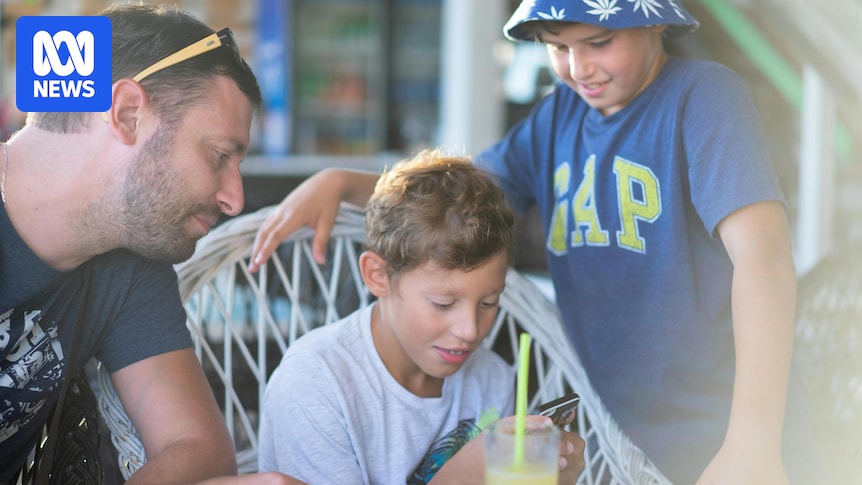
It’s been a little over two months since Australia’s social media ban took effect, a move aimed at curbing online risks for minors. Parents have been grappling with these changes, particularly during the long Christmas school holidays. The question remains: how are families coping with this new reality?
To understand the impact, we spoke with three parents about how the ban has affected their families and the different strategies they’ve adopted to navigate these challenges.
Impact on Young Musicians: A Career Disrupted
Peter De Waard, a father from the Kabi Kabi/Sunshine Coast region, shares how the ban has significantly impacted his teenage sons’ alternative rock band. His eldest son, 15-year-old Pete Jr, had been managing the Wave Raiders’ social media presence until the ban was enforced.
“He was doing that since he was 12 … and he was doing it under my guidance,” Mr. De Waard explains. “If there was ever any issue with comments, he would let me know, and I would always try and monitor it as best I could.”
The band, which includes his younger son Thomas (13) and their friend Jayden Georg (14), is more than just a hobby. “This is a business, the boys see this as their career,” he emphasizes. “The only way you can show that you have a solid following is through social media.”
With the ban in place, Mr. De Waard has taken over full-time management of the accounts, a task he finds cumbersome. “Everything’s done through me and on my devices, I get all the notifications and it’s an absolute nightmare, to be honest,” he admits. “It’s not something that I really want to be doing.”
While he acknowledges the ban’s intent to protect children, he argues that social media access should ultimately be a parental responsibility. “For some kids, banning social media is absolutely the right measure,” he says. “For others, it’s way more harmful than positive. And I think musicians are an example of where that’s the case.”
Social Media as a Lifeline for Connection
Amanda Lennestaal, a single mother of three from Sydney/Gadigal, describes the ban’s timing as unfortunate. Her teenage children, who have disabilities, relied on social media for connection during the school holidays.
“It’s removed a space of authentic connection and it’s not an easy replace,” she notes. “For kids with disabilities, those online spaces are actually some of the most accessible social environments, where you don’t have the physical, sensory, or even at times communication barriers.”
With mainstream activities and organized sports out of reach, social media filled a critical gap. “There’s a lack of social infrastructure that’s inclusive for young people,” she explains. “And then you cut off social media, which is that community engagement, voice, expression, exploration of identity.”
“And it means, in my opinion, kids like mine are less visible, less heard. Even if that wasn’t the intention, the effect is a really powerful effect and [in our case] it’s quite detrimental to them.”
Adjusting to New Norms: Finding Alternatives
Craig Muldoon from Tarntanya/Adelaide has three children aged 10 and under who were not previously active on platforms like Instagram or Snapchat. However, the ban’s impact on YouTube has been significant for his family.
“I had a premium account, so by adding them onto my account, it removed ads for them and gave them a curated way of viewing videos,” he explains. “We were able to actually see what they were watching as well and monitor that.”
Now, his children watch YouTube in “guest mode,” which requires more parental oversight. Recently, he decided to ban YouTube entirely to encourage other activities. “YouTube was the greatest draw card for them to actually be watching TV, so banning them was enough to get them to find something else to do.”
Mr. Muldoon notes that some children continue using banned platforms through other means. “The ban has made things a little bit more difficult for some people and probably has done nothing to make things safer for the kids who were going to use the platforms anyway,” he says.
Broader Implications and Future Considerations
The social media ban in Australia highlights a complex issue: balancing safety and freedom in the digital age. While intended to protect minors, the ban has inadvertently created challenges for families who rely on social media for connection and career development.
Experts suggest that a more nuanced approach, involving parental control and education, might better serve the diverse needs of families. As the debate continues, the experiences of families like the De Waards, Lennestaals, and Muldoons underscore the need for policies that consider the varied roles social media plays in modern life.
As Australia navigates this new terrain, the conversation around digital safety and accessibility remains crucial. Policymakers will need to weigh these factors carefully to ensure that protective measures do not inadvertently harm those they aim to protect.