




A groundbreaking development in wearable bioelectronics has emerged with the introduction of a new ECG patch that forgoes traditional gels and adhesives. Developed by researchers at UNIST, this innovative patch features a self-adhesive design that promises enhanced skin conformity and reduced irritation, marking a significant advancement in the field of medical monitoring devices.
Led by Professor Hoon Eui Jeong from the Department of Mechanical Engineering, the research team has unveiled a patch that integrates liquid metal microchannels with microstructured silicone elastomers. This design not only eliminates the need for conventional adhesives but also ensures high-fidelity cardiac signal recording, even during intense physical activity.
Innovative Design and Performance
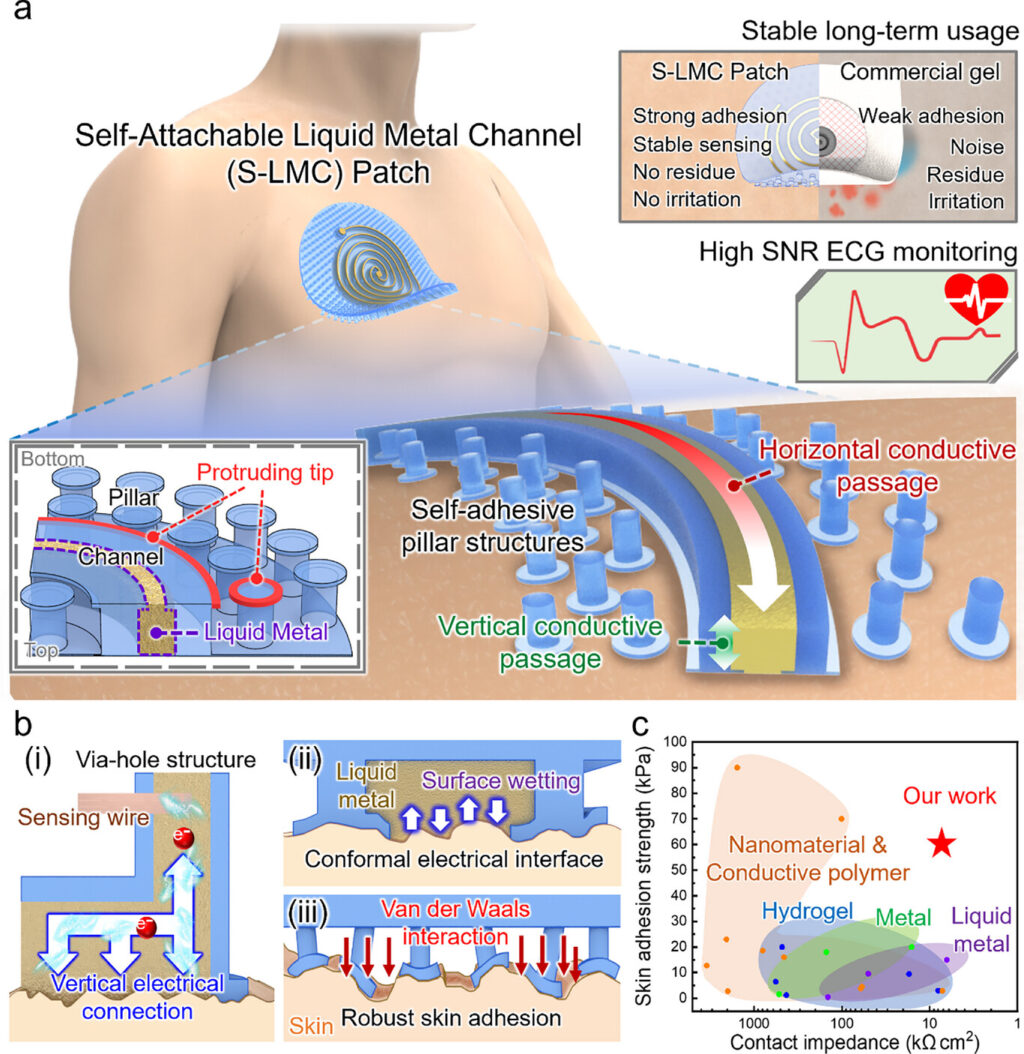
The patch’s design includes a spiral-shaped liquid metal channel, approximately 20 micrometers wide, that directly interfaces with the skin through an open-bottom structure. This configuration facilitates direct transmission of cardiac signals to the electrodes, a critical feature for maintaining signal integrity during motion. To further enhance performance, the patch incorporates inwardly curled horizontal microstructures that prevent liquid metal leakage, ensuring device integrity under pressure.
Moreover, the patch’s surface is embedded with microprotrusions measuring 28 micrometers in diameter and 20 micrometers in height. These structures act as physical anchors, conforming tightly to the skin’s microcurvatures and significantly enhancing adhesion. As a result, the patch maintains a strong, reusable bond, even during vigorous activities such as walking or running.
Comparative Advantages and Long-Term Use
Performance evaluations have demonstrated that the new patch’s electrode impedance is over five times lower than that of commercial products, enabling the detection of weak signals with greater clarity. Its robust adhesion, capable of supporting a weight of 100 grams, ensures stable contact during physical activity. Importantly, the patch maintains more than twice the adhesion strength of conventional disposable patches, even after seven days of repeated use, reducing motion artifacts and improving signal stability.
“We have successfully solved the challenges of liquid metal leakage and skin adhesion through precise structural design,” remarked Professor Jeong. “This technology lays the foundation for next-generation wearable health monitoring systems, especially for patients with sensitive skin, and for high-precision human-machine interfaces.”
Commercialization and Future Prospects
The research team is currently collaborating with Anvix Lab Co., Ltd. to commercialize the technology. Recognized for its innovation, the project was selected for the TIPS program supported by the Ministry of SMEs and Startups, with initial investments already underway. Anvix Lab Co., Ltd., founded by Professor Jeong and Professor Jae Joon Kim of the Department of Electrical Engineering, aims to lead the future of wearable healthcare devices by integrating this advanced patch technology with on-chip AI solutions.
The findings of this research have been featured as the Inside Front Cover of the January 2026 issue of Advanced Science. The research was supported by the Ministry of Science and ICT (MSIT), the Ministry of Trade, Industry & Energy (MOTIE), and the National Research Foundation of Korea (NRF).
Implications for Wearable Technology
This development represents a significant leap forward in the field of wearable bioelectronics. By addressing the limitations of traditional ECG patches, the S-LMC patch not only improves user comfort and signal accuracy but also paves the way for more durable and reliable health monitoring solutions. As the technology moves towards commercialization, it holds the potential to revolutionize patient care, particularly for those with sensitive skin or those requiring long-term monitoring.
As the healthcare industry continues to embrace technological advancements, the integration of such innovative solutions will likely become more prevalent. The collaboration between academia and industry, as demonstrated by the partnership with Anvix Lab Co., Ltd., underscores the importance of bridging research and practical application to drive progress in medical technology.