


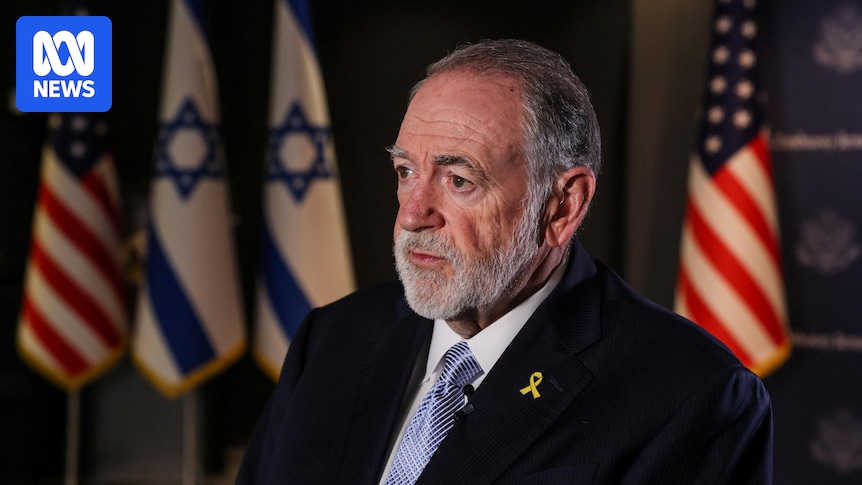
Arab and Muslim nations have expressed “strong condemnation and profound concern” following comments made by Mike Huckabee, the United States ambassador to Israel. Huckabee suggested that Israel could claim a biblical right to territories extending far beyond its current borders in the Middle East. The remarks were made during an interview with right-wing American commentator Tucker Carlson.
The conversation, which took place in Israel, revolved around the interpretation of a passage from Genesis in the Old Testament. Carlson questioned Huckabee about Genesis chapter 15, verse 18, which describes the land promised to Abram, later Abraham. Carlson interpreted the passage as granting land from the Euphrates to the Nile, encompassing much of the Middle East, including Israel, Jordan, Syria, Lebanon, and parts of Saudi Arabia and Iraq.
While Huckabee, an evangelical Christian, acknowledged the significance of the biblical promise, he stopped short of endorsing the full territorial claim suggested by Carlson. “This particular area that we’re talking about now, Israel is a land that God gave through Abraham to a people that he chose,” Huckabee stated, adding that it was a “hyperbolic statement” to suggest Israel would take over the entire region.
Regional Backlash and International Concerns
The comments have sparked a strong reaction from Arab and Muslim countries. In a joint statement, the foreign ministries of Saudi Arabia, Egypt, Jordan, the United Arab Emirates, Indonesia, Pakistan, Türkiye, Qatar, Kuwait, Oman, Bahrain, Lebanon, Syria, and the Palestinian Authority labeled Huckabee’s rhetoric as “dangerous and inflammatory.”
“The ministries reaffirmed that Israel has no sovereignty whatsoever over the Occupied Palestinian Territory or any other occupied Arab lands,” the statement read.
The statement further condemned any attempts to annex the West Bank or separate it from the Gaza Strip, and opposed the expansion of settlement activities in the Occupied Palestinian Territory. The ministries warned that Israel’s expansionist policies could escalate violence and conflict in the region, undermining peace prospects.
Historical Context and Ongoing Tensions
Israel’s occupation of Palestinian territories, including East Jerusalem, the West Bank, and Gaza, is considered illegal under international law. The issue of territorial claims has long been a contentious point in the Israeli-Palestinian conflict, with historical, religious, and political dimensions.
Israel’s far-right Finance Minister Bezalel Smotrich, known for advocating the annexation of Palestinian territories, expressed support for Huckabee’s comments on social media. Meanwhile, Tucker Carlson, who has recently criticized Israel, called it “probably the most violent country on Earth” in the same episode as the Huckabee interview.
Public Opinion and Regional Dynamics
Recent surveys highlight the complex dynamics in the region. A poll conducted by the Arab Center Washington DC found that 28% of respondents across the Arab world view Israel as the greatest threat to regional security, followed by the United States at 10%. Iran was cited by 8% of respondents as the greatest threat.
“The continuation of Israel’s expansionist policies and unlawful measures will only inflame violence and conflict in the region and undermine the prospects for peace,” the joint statement from Arab nations warned.
The ongoing debate over territorial rights and sovereignty remains a pivotal issue in Middle Eastern geopolitics. As tensions simmer, the international community continues to grapple with finding a path toward lasting peace and stability in the region.
The controversy surrounding Huckabee’s comments underscores the delicate balance of religious interpretations, historical claims, and modern political realities. As the situation develops, the world watches closely, hoping for dialogue and diplomacy to prevail over division and discord.