




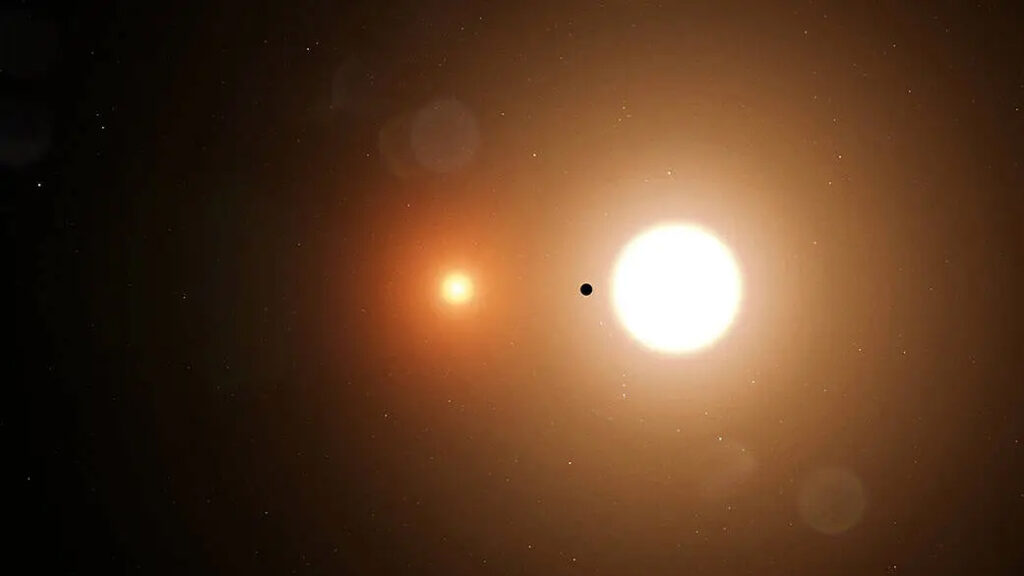
In the vast expanse of our universe, a peculiar statistic has puzzled astronomers: among the more than 4,500 stars known to host planets, only a scant few have planets that orbit both stars in a binary system. Despite expectations that nearly all stars should have planets and most stars form in pairs, planets akin to the fictional Tatooine from “Star Wars” are exceedingly rare.
Of the over 6,000 confirmed extrasolar planets, or exoplanets, discovered primarily by NASA’s Kepler Space Telescope and the Transiting Exoplanet Survey Satellite (TESS), only 14 have been observed orbiting binary stars. This number starkly contrasts with the hundreds that scientists anticipated. The question remains: where are all the planets with two suns?
Understanding the Cosmic Rarity
Astrophysicists from the University of California, Berkeley, and the American University of Beirut propose that the scarcity of circumbinary exoplanets can be attributed to the effects of Einstein’s general theory of relativity. In most binary star systems, the stars have similar but not identical masses and orbit each other in an elliptical path. If a planet orbits such a pair, the gravitational pulls from the stars cause the planet’s orbit to precess, akin to the way a spinning top’s axis rotates under Earth’s gravity.
This precession is further complicated by the orbit of the binary stars themselves, which also precesses due to general relativity. Over time, tidal interactions between the binary stars shrink their orbit, increasing their precession rate while slowing the planet’s. When these rates resonate, the planet’s orbit becomes wildly elongated, potentially leading to its destruction or ejection from the system.
“Two things can happen: Either the planet gets very, very close to the binary, suffering tidal disruption or being engulfed by one of the stars, or its orbit gets significantly perturbed by the binary to be eventually ejected from the system,” said Mohammad Farhat, a Miller Postdoctoral Fellow at UC Berkeley and first author of the study.
The Search for Circumbinary Planets
Despite the challenges, Farhat emphasizes that binary stars likely still have planets, but these are often too distant to be detected with current transit techniques. Co-author Jihad Touma, a physics professor at the American University of Beirut, concurs, suggesting that many planets remain undiscovered due to the limitations of existing instruments.
Their findings, published in The Astrophysical Journal Letters on December 8, indicate that while Kepler and TESS have identified thousands of eclipsing binary stars, the expected number of large planets around these binaries has not materialized. Of the 47 candidate planets found, only 14 have been confirmed as transiting circumbinary planets.
“You have a scarcity of circumbinary planets in general and you have an absolute desert around binaries with orbital periods of seven days or less,” Farhat noted.
General Relativity’s Role
The researchers highlight that binaries have an instability zone where no planet can survive. Within this zone, the gravitational interactions between the two stars and a planet either expel the planet or cause it to merge with the stars. Interestingly, 12 of the 14 known transiting exoplanets around tight binaries are just beyond this instability zone, suggesting they migrated from further out.
Farhat and Touma’s work builds on earlier collaborations exploring planetary orbits in various star systems. Touma’s interest in binary black holes and stars led him to consider how general relativity might influence planetary movements around double-star systems. Their mathematical and computer models reveal that general relativity dramatically affects circumbinary planets, disrupting eight out of every ten around tight binaries, with 75% of these being destroyed.
The Historical Context of Relativity
Einstein’s general theory of relativity, proposed in 1915, describes gravity as a warping of spacetime by mass. This concept was initially confirmed by the observed precession of Mercury’s orbit, which deviated slightly from predictions made by Newtonian physics. The same relativistic effects are at play in binary star systems, where stars likely start far apart but gradually move closer over millions of years due to interactions with surrounding gas.
As binary stars tighten their orbits, general-relativistic precession becomes crucial, causing their orbits to precess and potentially destabilizing any nearby planets. This process explains the rarity of exoplanets around tight binaries, as these planets are either flung out or consumed by the stars.
“A planet caught in resonance finds its orbit deformed to higher and higher eccentricities, precessing faster and faster while staying in tune with the orbit of the binary, which is shrinking,” said Touma.
Future Implications and Research
The researchers are extending their models to study the impact of general relativistic effects on star clusters around supermassive black holes and the scarcity of planets around binary pulsars. This work underscores the significant role of Einstein’s theory in understanding both the stability and disruption of planetary systems.
Farhat, supported by the Miller Institute for Basic Research in Science at UC Berkeley, continues to explore the intricate dance of celestial bodies influenced by the profound insights of general relativity. As our understanding deepens, the mystery of Tatooine-like planets may eventually unravel, revealing the complex interplay of forces shaping our universe.