


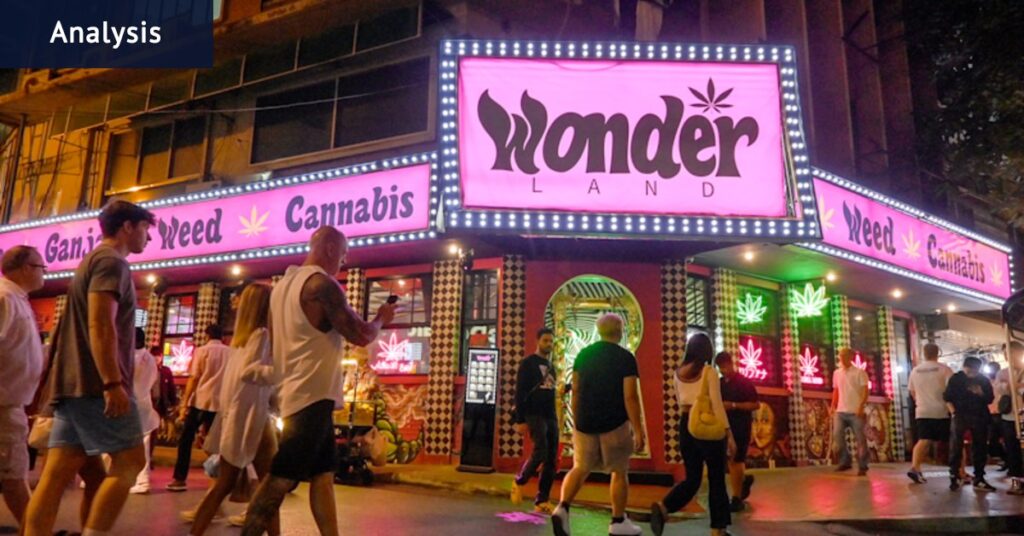
Bangkok, February 15, 2026 — On the bustling streets of Bangkok, the scent of marijuana has become as familiar as the aroma of street food. Since Thailand decriminalized cannabis in 2022, the country has seen an explosion of marijuana parlours, with approximately 18,000 establishments sprouting up nationwide. However, despite recent political developments that seemed promising for the industry, uncertainty looms over its future.
The decriminalization of cannabis was championed by Anutin Charnvirakul, a tycoon turned pro-business politician, who has served as Thailand’s prime minister since September. His Bhumjaithai Party recently won the most seats in the country’s snap elections, a result that many in the cannabis industry hoped would secure their future. Yet, the reality is more complex.
The Rise and Fall of Thailand’s Cannabis Boom
Thailand’s decision to remove cannabis from its narcotics list was groundbreaking, making it the first Asian country to do so. The move aimed to boost the nation’s image as a wellness destination, provide farmers with a lucrative cash crop, and alleviate overcrowded prisons. Coming out of the COVID-19 pandemic, with tourism accounting for roughly 15% of the GDP, it seemed like a strategic choice.
However, the rapid proliferation of cannabis shops, likened to the ubiquity of pubs in London, quickly spiraled out of control. With minimal regulations, the industry attracted a wide range of users, including minors, leading to public backlash. Midway through the previous year, the ruling Pheu Thai party imposed a requirement for a doctor’s prescription to purchase cannabis, effectively crippling the burgeoning market.
Challenges and Adaptations in the Cannabis Market
The prescription mandate decimated many cannabis businesses, which were already struggling with an oversupply of low-priced products and dwindling customer bases. Some shops resorted to bending the rules, fostering a black market that operated openly under neon signs.
Survival in this turbulent market has necessitated creative strategies. In Bangkok’s Sukhumvit area, one shop redesigned its appearance to mimic a pharmacy. Ramil, a 26-year-old server, expressed cautious optimism about the election results, noting, “Maybe? We’ll just have to see.” He described the industry’s challenges, from market saturation to the prescription requirement that hurt profits.
Innovation and Legal Loopholes
Some establishments, like Cloud Nine, have adopted novel approaches to navigate the legal landscape. An A-frame sign outside the shop advertises “free prescription with every purchase.” The server explained that customers consult with a doctor via telehealth, receiving a prescription almost instantly. “We won’t sell without [a] prescription. That’s the golden rule here,” she emphasized, highlighting their commitment to compliance amidst widespread non-compliance by competitors.
Despite these efforts, the future remains uncertain. The server admitted, “I have no idea whether Bhumjaithai will do away with the prescription law introduced by the previous government.”
Implications for Thailand’s Cannabis Experiment
The Thai government’s experiment with cannabis has been marked by regulatory challenges and public controversy. While some view it as a progressive step, others see it as a poorly managed initiative that has led to unintended consequences.
“The Thai government’s experiment with marijuana has not only been sloppy. For some people, it has been a disaster.”
As Thailand navigates its political landscape, the cannabis industry’s fate hangs in the balance. The Bhumjaithai Party’s victory could signal a shift, but whether it will bring stability or further upheaval remains to be seen. For now, the industry and its stakeholders must brace themselves for whatever comes next.