



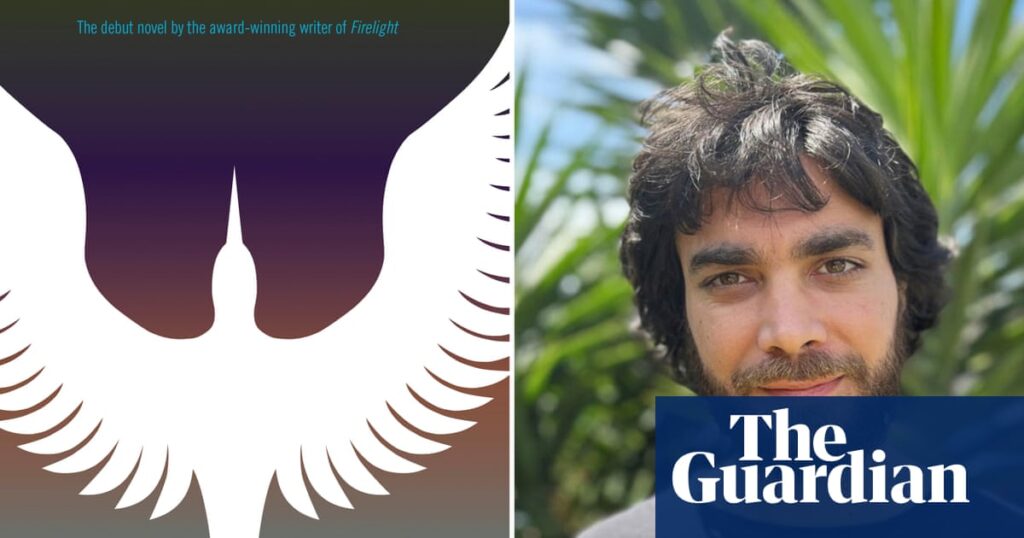
In his debut novel Bird Deity, John Morrissey, a Melbourne writer of Kalkadoon descent, delves into the dark corners of colonialism through the lens of science fiction. Following the success of his award-winning 2023 story collection Firelight, Morrissey continues to explore themes of extraction, settlement, and sacrifice in a bleak narrative set on a foreign planet.
The protagonist, David, is a “scout” who has spent a decade on this alien world, hunting for valuable artifacts to amass his fortune. However, his quest comes at a high moral cost. The artifacts he seeks are worn by the native humanoid species known as “parasapes,” who inhabit the plateau above the colonial settlement. Collecting these treasures often means violence against the parasapes, whom David believes to be devoid of consciousness or culture. As he explains to a visiting anthropologist, “They don’t even have a language. They don’t make plans for the future. Nothing.”
The colony itself is a desolate landscape, reminiscent of real-world mining sites, with its logging trucks, garbage heaps, and makeshift hovels. At its heart lies a government compound, a stark symbol of authority and control, surrounded by hopeful individuals yearning for passage back to their home world. Morrissey’s narrative is laced with dark satire, echoing the works of writers like Magnus Mills, where characters engage in brutal acts with little introspection or consequence.
The Cost of Empire
The settlers in Bird Deity are bound by five-year contracts, yet many remain indefinitely, seduced by the promise of wealth. Despite their prolonged stay, few manage to establish real lives, treating violence as a mere occupational hazard rather than a reflection of their true selves. Tom and Eliza, however, stand apart. As a couple, they yearn for family amidst the chaos. Tom, David’s mentor, has been a scout for two decades, while Eliza, a botanist, has a child whose paternity is uncertain.
The arrival of anthropologist Sarah introduces a new dynamic. Sent by a trillionaire sponsor, her mission is to study the parasapes and advocate for their protection as a “non-human species.” David becomes her guide, and their journey to the plateau challenges his perceptions. Encounters with the parasapes and a mysterious entity lead David to question the very foundations of his existence, as the violence he once normalized becomes both meaningless and consuming.
Alienation and Reflection
Morrissey’s novel paints a stark picture of the alienation wrought by colonization, not only separating people from land but also from each other. David’s relationship with Eliza is distant, her presence “fey and untouchable,” and their shared bed “cold and empty.” The child David believes to be his feels foreign, “like a pupa,” and he struggles to recall her name. This raises poignant questions about the pursuit of wealth in a society devoid of familial bonds or genuine connections.
“What are these riches for? None of the men in the colony have families, connections or even friends. Their lives are ruled by violence and a never-ending quest for wealth.”
Eliza’s desire to escape the settlement and ensure her child’s safety underscores the novel’s exploration of new life and hope amidst the ruins of colonial ambition. Morrissey effectively captures a fragmented society, though his commitment to depicting alienation sometimes hinders deeper engagement with David’s world.
Science Fiction as Political Commentary
Bird Deity aligns with a long tradition of science fiction serving as a vehicle for political commentary. By setting the narrative in an intergalactic empire, Morrissey uses the distance of another world to reflect on contemporary issues. The novel employs familiar genre elements—an anthropologist studying alien species, challenges of interspecies communication—yet the characters’ psychological depth occasionally falls short.
Eliza’s character, in particular, feels underdeveloped, her role often reduced to symbolism rather than a fully realized individual. This can make the relationships between the central characters feel frustratingly shallow at times. Despite these shortcomings, Bird Deity remains an original work, rewarding those who engage deeply with its themes.
Hope Amidst Destruction
Within Morrissey’s grim portrayal of colonial exploitation, there are glimmers of hope. The novel suggests that amidst the destruction, there lies potential for personal and societal transformation. This duality—of an immense force that is both life-giving and life-destroying—adds a compelling layer to the narrative.
As readers navigate the complexities of Morrissey’s world, they are invited to reflect on the broader implications of colonization and the human capacity for change. Bird Deity challenges us to consider the cost of empire and the possibility of redemption, both in its fictional universe and our own.