



In a groundbreaking revelation, scientists have identified Australia’s oldest-known dinosaur fossil, a discovery that reshapes the understanding of the continent’s prehistoric timeline. The fossil, found in sandstone at Petrie’s Quarry, has been confirmed as one of the oldest dinosaur remains globally, according to Dr. Anthony Romilio, a leading paleontologist.
This discovery, announced recently, provides compelling evidence that dinosaurs roamed Australia far earlier than previously believed. “It shows how globally significant discoveries can remain hidden in plain sight,” Dr. Romilio told the Australian Associated Press (AAP).
Uncovering a Hidden Treasure
The fossil’s journey began in 1958 when Bruce Runnegar, then a high school student, stumbled upon it with friends during a visit to Petrie’s Quarry. Known for its Triassic plant fossils, the quarry’s sandstone was also used in the construction of iconic buildings like Brisbane’s General Post Office. Runnegar, who later became a renowned paleontologist, preserved the fossil for over six decades.
Decades later, Runnegar reached out to Dr. Romilio after learning about his innovative use of photographic and 3D technology to study dinosaur footprints. “When I saw Dr. Romilio’s ability to reconstruct, analyse and map dinosaur footprints, I decided to reach out to have the fossil formally documented,” Professor Runnegar explained. “More than 60 years after we found it, it’s extraordinary to see it recognised as Australia’s oldest dinosaur fossil.”
Scientific Breakthrough and Identification
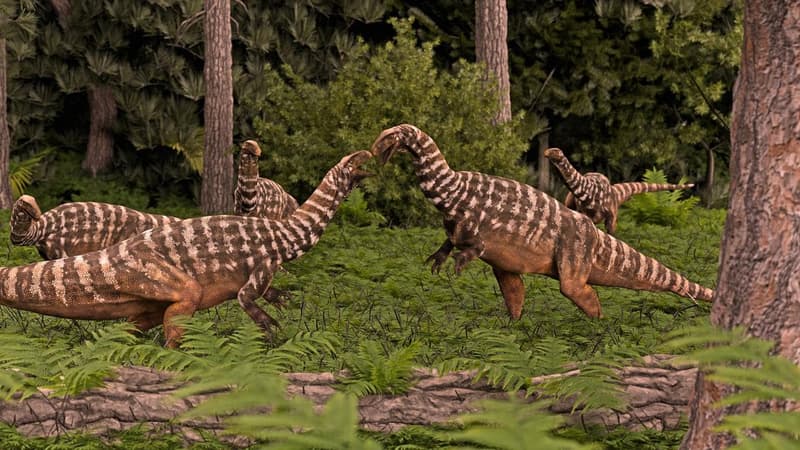
Through detailed comparisons with other fossilised footprints and skeletal remains worldwide, scientists identified the dinosaur as a prosauropod. This primitive relative of later long-necked dinosaurs stood approximately 75cm to 80cm tall at the hip and weighed about 140kg.
“It’s likely the dinosaur was walking through or alongside a waterway when it left the footprint, before it was then preserved in sandstone,” Dr. Romilio said.
Previously, the oldest-known dinosaur fossils in Australia were footprints found in Ipswich, west of Brisbane, dating back around 215 million years. This new finding predates those, offering fresh insights into the early presence of dinosaurs on the continent.
Implications for Paleontology
The identification of this fossil not only enriches Australia’s paleontological record but also highlights the potential for future discoveries. The fossil is now housed at the Queensland Museum, where it will be available for ongoing research and public viewing.
Dr. Romilio emphasized the importance of such findings in understanding the global distribution and evolution of dinosaurs. “Discoveries like these are crucial for piecing together the history of life on Earth,” he noted.
This development follows a series of significant paleontological discoveries in Australia, which continue to draw international attention. As researchers delve deeper into the continent’s ancient past, they anticipate more revelations that could further alter the scientific narrative.
Meanwhile, the scientific community is abuzz with discussions on how this discovery might influence future research directions. The fossil’s preservation and subsequent identification underscore the importance of revisiting old sites with new technologies, potentially unveiling more hidden treasures.
As the fossil takes its place in the Queensland Museum, it stands as a testament to the enduring curiosity and dedication of paleontologists like Dr. Romilio and Professor Runnegar. Their work not only enriches our understanding of prehistoric life but also inspires future generations to explore the mysteries of the past.