

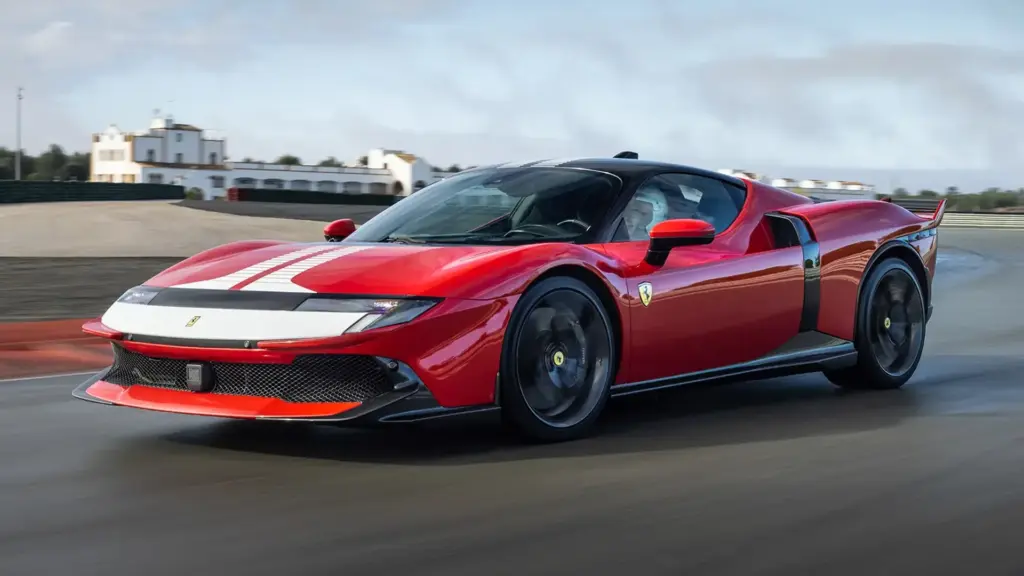
Ferrari has officially retired the SF90 Stradale, replacing it with a machine that bridges the past and future: the 849 Testarossa. This new model revives a nameplate not seen since the 1980s, a time of acid-wash jeans and gravity-defying hairstyles. However, this ‘redhead redemption’ features a mid-rear V8 twin-turbo engine, partially hidden under two giant turbos and linked to three electric motors, rather than the original screaming V12.
The 849 Testarossa, named for its eight cylinders and 490cc per cylinder, raises questions among Ferrari enthusiasts: does it truly deserve the Testarossa badge, or is it merely an SF90 facelift with a nostalgic name? With over a thousand horsepower and a 0–100 km/h time of 2.3 seconds, the stats suggest it’s more than just a cosmetic update. Priced at $932,648 before on-road costs, it is $85,760 more than the SF90 at launch five years ago. The car makes significant technical strides, adding 37kW and 42Nm through a complete re-engineering of its components, with a focus on downforce and new driver technology.
Design and Engineering: A Nod to the Past, a Leap to the Future
The Testarossa’s design echoes the 1984 model’s philosophy of high-end mechanical technology wrapped in a futuristic shell. The squared-off front face is a distinct departure from the SF90’s curves, with a geometric aesthetic that polarizes opinions. The stacked front lip and nose feed two large asymmetrical radiators, while the bonnet features a long black band hiding the headlights, reminiscent of the ’80s pop-up headlights.
At the rear, Ferrari pays homage to its 1970s sports prototypes with ‘twin tail’ spoilers inspired by the 512 S and M race cars, complemented by an active rear wing from the 296 GTB. The side profile lacks the hallmark strakes of the original Testarossa but features a black vertical panel resembling a cinched-up belt, giving the car a classic Coke-bottle waist.
Performance: Power and Precision
Ferrari has equipped the 849 with the largest turbochargers ever placed in a road car, utilizing a turbine heat shield from the 296 GT3 and low-friction bearings from the F80. The V8 engine produces 610kW, reaching an 8300rpm redline, with electric motors adding 163kW for a total of 773kW. Torque is a robust 842Nm. The power increase necessitates 15% more engine cooling, managed by dual radiators.
The V8’s re-engineering includes new cylinder heads, a stronger engine block, and titanium fasteners. An Inconel exhaust manifold manages heat and improves sound, a material used in jet engines and nuclear power stations. The engine castings now use recycled aluminum, reflecting environmental awareness, with a claimed fuel consumption of 9.1 liters per 100 kilometers. Despite the power boost, the 849 weighs the same as the SF90 at 1570kg.
The power is managed through an eight-speed dual-clutch F1 gearbox, with on-demand and torque-vectoring all-wheel drive rooted in F1 technology.
Driving Experience: From Track to Road
The 849 Testarossa’s triple e-motors allow for 25km of full hybrid, front-wheel-drive travel. The system provides extra power and torque vectoring, enabling silent starts and exits from garages. The car features the largest brake discs on a production Ferrari, with optimized ventilation channels and improved cooling for the rear calipers.
The 849’s suspension reduces body roll by 10%, with the Assetto Fiorano pack offering stiffer shock absorbers and lighter road springs. The aero is more aggressive, with vortex generators and stacked wings increasing downforce without significant drag.
On a wet Circuito Monteblanco, the 849 demonstrated its electronic prowess. The FIVE digital system, Ferrari Integrated Vehicle Estimator, uses real-time measurements to optimize traction and braking, making the car feel almost intuitive to drive. Despite the wet conditions, the car reached 240 km/h before the start/finish line, showcasing its impressive speed and control.
On the Road: A Blend of Comfort and Performance
Driving the 849 on Spanish mountain passes highlights its physical presence and driver assistance systems. At 2304mm wide, the car’s lane-keeping assist is a welcome feature. The cabin offers excellent visibility, improved rearward vision, and ergonomic functionality, though storage is limited to a 74-liter front space.
The cockpit blends classic and modern elements, with floating console ‘sails’ and a more ergonomic shifter position. The reliance on haptics has been reduced, with physical buttons for key controls.
Ultimately, the Ferrari 849 Testarossa is a testament to the brand’s ability to innovate while honoring its heritage. It combines cutting-edge technology with design elements that nod to its iconic predecessors, offering a driving experience that is both thrilling and refined.