




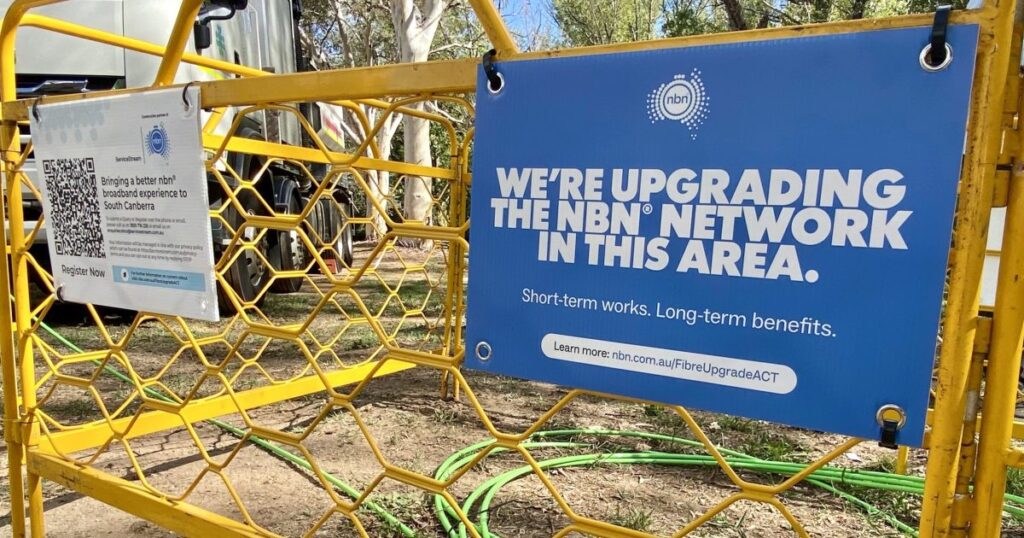
Almost all homes and businesses in Canberra are set to receive full fibre internet connections, promising significantly improved internet speeds and reliability within the next four years. This ambitious upgrade plan was initially backed by a $3 billion commitment from the Commonwealth to transition 94% of ACT premises from Fibre to the Node (FTTN) to Fibre to the Premises (FTTP). However, recent announcements reveal that the target has been increased to 99% of Canberra premises.
On Wednesday, NBN Co CEO Ellie Sweeney confirmed the expanded scope of the project, stating, “It is the fastest, it is the most reliable, it is the highest availability network that we have.” She emphasized the benefits for various users, including remote workers, businesses, streamers, gamers, and those accessing telehealth and government services.
Understanding the Shift from FTTN to FTTP
FTTN involves optical fibre being laid to a node on a street, with the remaining distance to homes covered by existing copper wiring. This setup can lead to variable network speeds, depending on proximity to the node and the quality of the copper wiring. In contrast, FTTP delivers optical fibre directly to homes, offering superior performance, higher data speeds, and greater reliability.
The upgrade will be executed through 50 projects spanning 85 suburbs, with over 2,500 km of fibre to be installed across Canberra. This initiative will see approximately 97,000 ACT premises currently on FTTN upgraded to full fibre connections by December 2030. Construction has already commenced in Narrabundah and Symonston, with the rollout extending from southern suburbs like Mawson, Kambah, and Calwell to northern areas such as Campbell, Holt, and Flynn.
Challenges and Long-Term Investment
The project will employ a mix of underground and aerial installation methods, tailored to the specific needs of each area. “The majority is going to be underground,” noted Ms. Sweeney, highlighting the intricate nature of the build in Canberra. She added, “From our perspective, this is an investment not only today but for decades to come. Once that fibre is in the ground, it’s there, and it is only the electronics on either end that we need to upgrade to take those speeds even higher in the decades to come.”
For the remaining 1% of premises, full fibre connections are deemed “uneconomical,” but alternative solutions such as fixed wireless and low-earth-orbit technologies are under consideration. “We’ll be looking at a better technology than what people are on today, which is copper,” Ms. Sweeney assured.
National Investment and Economic Implications
This upgrade is part of a broader national effort to enhance Australia’s FTTN network, supported by a $3 billion equity investment from the Federal Government in NBN Co, alongside over $800 million in company contributions. Finance Minister and ACT Labor Senator Katy Gallagher emphasized the importance of fulfilling the high-speed broadband promise initially made to Canberrans before the plan was revised by the previous Liberal government.
“This is about finishing that job, making sure that households and businesses can have the choice to have that access to high-speed broadband delivered by the NBN, in a time when we know demand through households and businesses for high-speed internet is increasing all the time,” she said.
With the average household expected to increase its number of connected devices from 25 to 44, the demand for high-speed internet is escalating. Businesses, too, rely heavily on robust internet access, making this upgrade crucial for economic growth.
Collaborative Efforts and Future Prospects
NBN Co is anticipated to collaborate closely with ACT Government directorates to ensure the project’s successful completion. Chief Minister Andrew Barr highlighted the “enormous” benefits of the initiative, stating, “A really important part of the federal government’s role through NBN Co is to provide an efficient and effective broadband network for this city, and its economic development potential is significant, right across Canberra.”
The move represents a significant step towards enhancing productivity and economic potential across the city. As Canberra edges closer to achieving near-universal full fibre coverage, the implications for residents and businesses are profound, promising a future where connectivity is not just faster, but also more reliable and resilient.