



Researchers at North Carolina State University have pioneered a novel method to create ultra-stretchable, superomniphobic materials using laser ablation, bypassing the need for harsh chemical solvents. These materials, which can stretch up to five times their original length and endure over 5,000 stretch cycles, hold significant potential for applications in fields such as soft robotics and artificial skin patches.
The team, led by Arun Kumar Kota, associate professor of mechanical and aerospace engineering at NC State, has developed these materials to repel virtually any liquid, including harsh acids, bases, or solvents, as effectively as they repel water. “They are useful in a wide range of applications, such as soft robots, which may need materials that can withstand harsh environments, stretch, and change shape,” Kota explained.
Innovative Approach to Material Creation
Traditionally, superomniphobic materials are created by applying a nanoparticle-laden spray coating to a substrate, forming a rough, liquid-repellent surface. However, these coatings often delaminate when the material is stretched beyond its original dimensions. Kota’s previous work addressed this issue by introducing microprotrusions, or tiny pillars, on the material’s surface, which helped maintain the coating’s integrity during stretching.
“As a crude analogy, think of my outstretched arms as the material and my hair as the microprotrusions,” Kota illustrated. “If you pull my arms, my hair does not feel the stress and remains unaffected.”
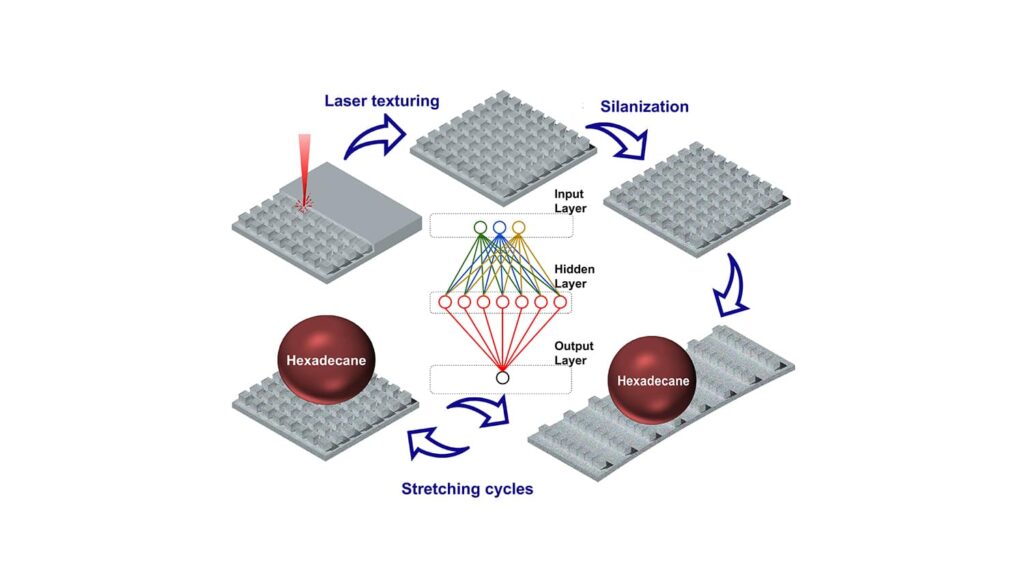
In their latest research, the team has replaced the spray coating process with laser ablation, which creates both the microprotrusions and the rough surface necessary for superomniphobicity. This method eliminates the need for chemical solvents and extensive trial-and-error testing.
Advanced Techniques and Machine Learning
The research team employed a machine-learning framework to optimize the laser ablation process. By inputting parameters such as laser power, speed, and spatial frequency, alongside the desired sliding angle of the material, the framework determined the optimal settings for achieving superomniphobicity.
Their experiments focused on a siloxane elastomer, chosen for its inherent stretchability, which was modified with a fluorocarbon silane to enhance its hydrophobic properties. The resulting material retained its superomniphobic characteristics through extensive stretching and repeated use.
“We have created a platform for creating stretchable superomniphobic materials without the use of chemical solvents and without needing hundreds of thousands of trial-and-error experiments,” Kota stated. “This method is a greener, more cost-effective way to produce materials for a diverse array of applications ranging from textile dressings to stretchable electronics that can be used in chemically harsh environments.”
Implications and Future Applications
This breakthrough offers a sustainable and efficient pathway for developing advanced materials that can withstand extreme conditions. The potential applications are vast, spanning from medical devices and wearable technology to industrial uses in harsh chemical environments.
The research, published in the journal Matter, was supported by the National Science Foundation, the National Institutes of Health, and Congressionally Directed Medical Research Programs. The study’s first author, Mohammad Javad Zarei, along with contributors Sreekiran Pillai, Adil M. Rather, Mohammed S. Barrubeeah, and Tarek Echekki, played key roles in this innovative project.
As the scientific community continues to explore the capabilities of these materials, the potential for new technologies and applications appears boundless. The integration of laser ablation and machine learning in material science marks a significant step forward, promising to revolutionize how materials are designed and utilized across various industries.