

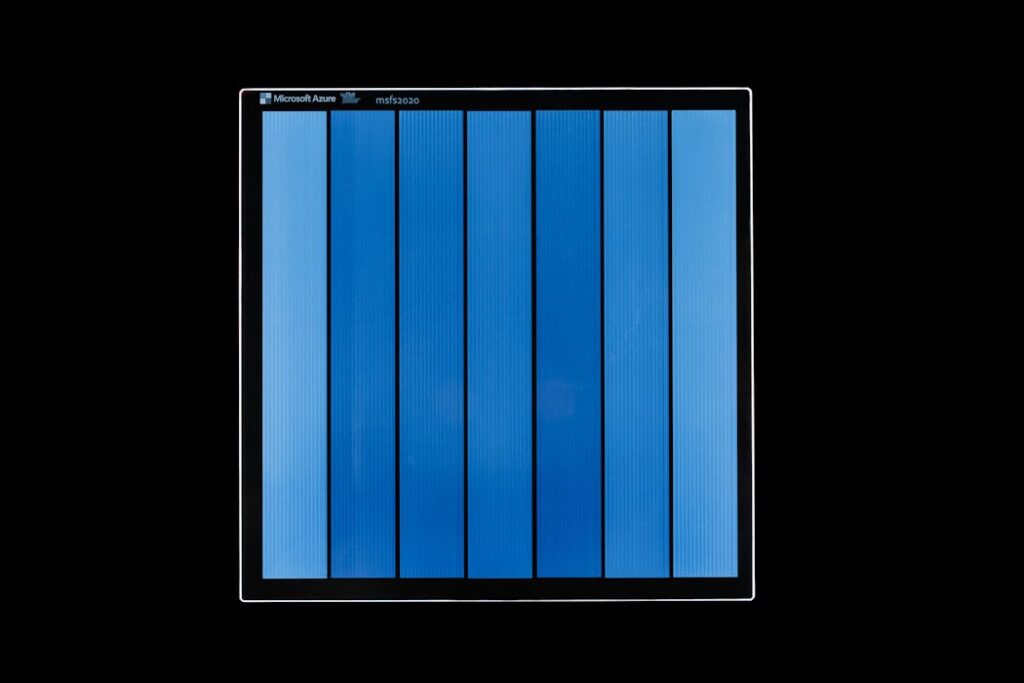
Scientists at Microsoft Research in the United States have unveiled a groundbreaking system called Silica, which uses ordinary glass to store vast amounts of data. This innovative approach can potentially store the equivalent of two million books in a thin, palm-sized glass square. According to a paper published today in Nature, the data stored using this method could remain readable for over 10,000 years.
The announcement comes as researchers explore new frontiers in data storage, aiming to address the growing need for durable and high-capacity solutions. The Silica project leverages ultrashort laser pulses to inscribe information into glass, promising a future where data longevity far surpasses current technologies.
What Tiny Pulses of Light Can Do
The Silica system employs femtosecond laser pulses, which are incredibly brief flashes of light lasting mere quadrillionths of a second. These ultrashort pulses allow for precise alterations within a block of glass, creating a durable data storage medium. To put this into perspective, comparing ten femtoseconds to a single minute is akin to comparing one minute to the entire age of the universe.
These laser pulses can also generate attosecond bursts, which are even shorter and have been used to observe electron movements within atoms. This capability was recognized with the 2023 Nobel Prize in Physics, awarded to researchers including Ferenc Krausz, Anne L’Huillier, and Pierre Agostini for their pioneering work in this field.
Writing in Glass: A Historical Perspective
The concept of using laser-written voxels for three-dimensional data storage is not new. In the 1990s, Eric Mazur and his team at Harvard University demonstrated the potential of femtosecond lasers for inscribing permanent data structures into glass. This laid the groundwork for future innovations in glass-based data storage.
In 2014, researchers at the University of Southampton, led by Peter Kazansky, reported on data storage in fused quartz glass with an “unlimited lifetime.” This research further solidified the idea of ultra-stable memory devices. Kazansky later founded SPhotonix to commercialize this technology, which even inspired a fictional portrayal in the film Mission Impossible: The Final Reckoning.
The Silica System: A Complete Data Storage Solution
The Silica project does not claim a new scientific breakthrough but rather presents a comprehensive demonstration of a practical technology. The system integrates all necessary components for a storage platform, including data encoding, writing, reading, decoding, and error correction. It explores strategies for enhancing reliability, writing speed, energy efficiency, and data density.
Silica utilizes two types of laser-written voxels. The first type involves creating tiny void-like features through laser-driven micro-explosions, achieving a high storage density of 1.59 gigabits per cubic millimeter. The second type modifies the local refractive index of the glass, allowing for faster writing with less energy consumption, albeit at a lower data density.
Accelerated aging experiments suggest that data stored in glass could remain stable for over 10,000 years, vastly exceeding the lifespan of conventional storage media like magnetic tapes and hard drives.
The Future of Data Storage
As ultrafast photonics technology continues to mature, the potential applications for femtosecond lasers expand. Dense, fast, and energy-efficient archival data storage is just one exciting possibility. The development of reliable, off-the-shelf ultrafast lasers marks a significant advancement from the late 1990s when only a few laboratories had the capability to build such devices.
According to experts, the Silica project represents a significant step forward in the quest for sustainable and long-lasting data storage solutions. As the demand for data storage continues to grow, innovations like Silica could play a crucial role in meeting future needs.
This article is republished from The Conversation. It was written by Alex Fuerbach, Macquarie University.
Read more:
- Can we predict domestic homicide? New research suggests we can’t
- Does exercise really work for osteoarthritis?
- Indigenous businesses are losing millions to fraudulent firms. We need stronger oversight
Alex Fuerbach received funding from the Australian Research Council, the Australian Department of Defence, The US Office of Aerospace Research and Development, Arthrolase, HB11 Energy, and Macquarie University.