




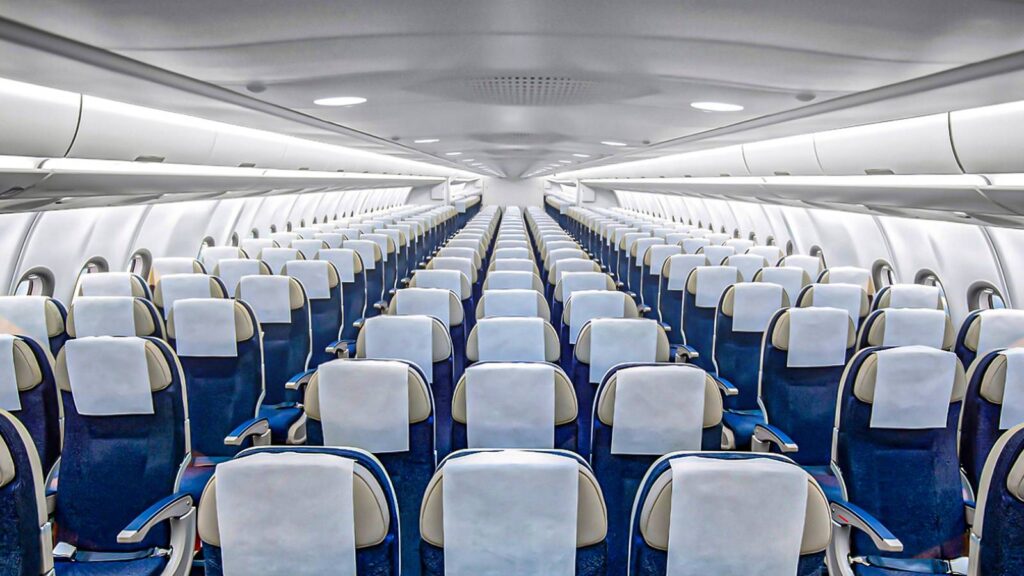
Flying in basic economy can often be an uncomfortable experience, with cramped seating and limited space between rows. However, for those booking long-haul flights, extra legroom can significantly enhance comfort. By 2026, travelers heading to or from Japan will find solace in the generous legroom offered by Japan Airlines (JAL) and All Nippon Airways (ANA), both providing a pitch of 34 inches (86.4 cm). Meanwhile, American flyers can enjoy above-average legroom with JetBlue, which offers 32.3 inches (82.0 cm) of space.
Let’s delve into the top global airlines that prioritize passenger comfort by providing extra space in economy class.
Prioritizing Flyers in Japan
Japan Airlines has consistently received accolades for its ‘Best Economy Class Seat,’ thanks to its refusal to follow the industry’s trend of densification. JAL’s “Sky Wider” strategy features a 2-4-2 layout on Boeing 787 Dreamliners, contrasting with the typical 3-3-3 configuration that reduces individual seat width and pitch. This strategic choice allows JAL to offer more space without compromising on passenger comfort.
Similarly, ANA maintains a 34-inch pitch across much of its long-haul fleet, including the Boeing 777-300ER and 787-9. In the summer of 2026, ANA plans to introduce newly designed Recaro seats on its Boeing 787-9 aircraft, offering an additional inch of knee space. These seats will also feature a 1.5 times greater recline than previous models, reaching up to seven inches, setting a high standard for economy class comfort.
The Economy Class Leaderboard
Economy class presents a paradox for many airlines: passengers desire comfort but often choose the lowest fare, overlooking the qualitative differences between cabin products. The industry standard pitch has settled at 31-32 inches, driven by the need to maximize passenger capacity. Reducing seat pitch by even an inch can allow an airline to add an extra row of seats, translating into significant revenue gains across a fleet.
To compete with ultra-low-cost carriers like Spirit and Ryanair, which offer as little as 28 inches of pitch, full-service airlines have reduced seat pitches to maintain competitive base fares. Despite these trends, some airlines continue to prioritize passenger comfort. Notably, Emirates offers 34 inches of legroom on its Airbus A380 “superjumbos.”
Modern ‘slim-back’ seat designs claim to offer similar knee room at a 31-inch pitch as older 34-inch seats, despite the actual measured distance being less.
A Tough Market for Economy Airfares
Throughout the evolution of modern air travel, carriers have discovered that while passengers frequently complain about legroom, they are often unwilling to pay higher ticket prices for increased space. American Airlines’ ‘More Room Throughout Coach’ initiative in the early 2000s highlighted this market reality. Despite positive feedback, the program was ultimately scrapped due to a lack of willingness to pay a premium for more legroom.
The initiative coincided with a challenging economic climate, including the aftermath of the September 11 attacks, a major recession, and rising fuel costs. These factors contributed to the program’s failure, which is frequently cited by airline executives as a reason for the current cramped conditions in economy cabins.
The Leading American Carriers
JetBlue has strategically differentiated itself in the US market by offering more legroom than its competitors. The airline provides 32 to 34 inches of pitch across its fleet of Airbus A320 and A321 aircraft, significantly more than the 30 to 31 inches found on rival narrowbody and widebody jets. This focus on comfort, combined with seatback entertainment and free high-speed Wi-Fi, sets JetBlue apart.
Delta Air Lines and Alaska Airlines offer 31 inches of pitch, slightly behind Southwest Airlines at 31.8 inches. Delta is renowned for its reliable service and extensive network, while Alaska is praised for its high-quality service. Southwest maintains its status as a favored affordable airline, although changes to its free services are expected this year.
The Middle of the Pack
Qantas, Cathay Pacific, and Singapore Airlines occupy a middle ground in global economy class rankings. These carriers offer a superior experience compared to American and European airlines but fall short of the exceptional comfort provided by Japanese airlines like JAL and ANA. The primary reason is the nine-seat-per-row configuration on most widebodies, compared to the eight-seat-per-row layout used by Japanese carriers.
Despite this, these airlines outshine many American and European operators due to their superior service standards and high-quality products. Gulf and Asian carriers emphasize service excellence, offering complimentary meals and attentive service as standard on long-haul flights.
As airlines continue to navigate the challenges of providing comfort in economy class, the examples set by Japanese carriers and JetBlue highlight the potential for balancing passenger satisfaction with financial viability. As the industry evolves, the quest for the perfect balance between comfort and cost remains a central focus for airlines worldwide.