




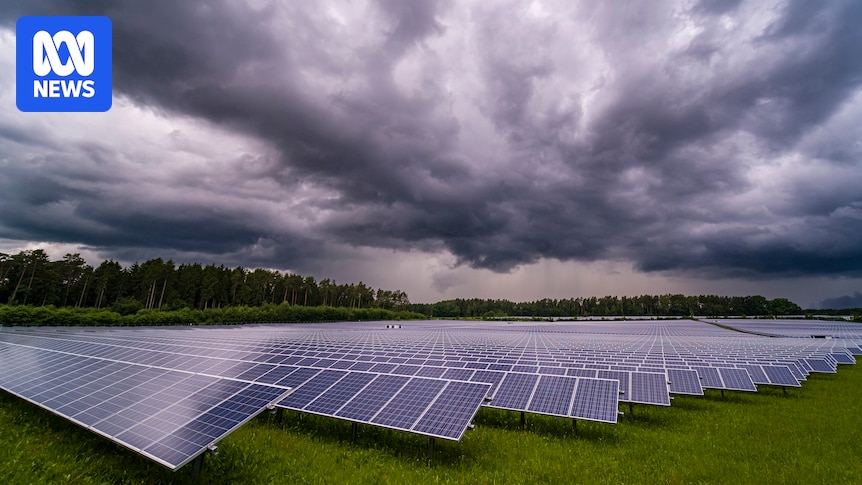
On a seemingly ordinary Wednesday in November last year, Sydney witnessed a dramatic fluctuation in the wholesale electricity market within just an hour. The day began with energy demand in New South Wales following the typical “duck curve” pattern, where rooftop solar panels reduced household reliance on grid electricity, causing a dip in demand through the morning. However, by midday, the script was unexpectedly rewritten as clouds rolled in, altering the dynamics of energy supply and demand.
The sudden cloud cover led to a significant drop in solar generation, causing a spike in household energy demand. According to Julian de Hoog, CEO of Solstice AI, “Suddenly there was way less [rooftop] generation than expected. In aggregate, it’s like losing a power plant. And that’s when the price spikes.” The wholesale cost of electricity in NSW soared to over $20,000 per megawatt-hour, a stark contrast to the monthly average of about $75/MWh. This volatility, driven by immediate supply and demand shifts, underscores the critical role of solar forecasting in maintaining grid stability.
The Role of Solar Forecasting in Energy Markets
As reliance on solar energy grows, predicting cloud formation and sunlight availability has become a multi-billion-dollar industry. Solar forecasting, an intersection of AI, big data, and complex weather systems, answers a deceptively simple question: Will it be sunny? Australia, with its advanced forecasting technology, has become a global leader in this field, exporting its innovations worldwide.
On that fateful Wednesday, a spring thunderstorm with fast-moving clouds disrupted solar generation, leading to a temporary surge in energy prices. However, once the skies cleared, the storm’s cooling effect reduced energy demand for air conditioning, causing prices to plummet. This volatility, while dramatic, is mitigated by solar forecasting, which helps anticipate changes in solar output and adjust grid operations accordingly.
Australia’s Leadership in Solar Forecasting
More than a decade ago, Nick Engerer, a PhD student at the Australian National University, foresaw the impact of solar energy on grid sensitivity to cloud cover. In 2011, solar accounted for a mere 3% of Australia’s generation capacity, but Engerer predicted it would dominate on sunny days within a decade. He co-founded Solcast, a company that pioneered “nowcasting,” forecasting sunlight in five-minute intervals.
Solcast’s data is integral to the Australian Energy Market Operator and is utilized by 80% of network operators and generator-retailers in Australia. The company’s reach extends globally, with its data supporting over 300 gigawatts of solar projects. “There’s a huge amount of solar that’s going to be built globally in the next three decades,” said Ben King, Solcast’s chief commercial officer. “Solar forecasting is a core enabling technology for the reliable operation of electricity grids.”
Implications for Energy Prices and Grid Stability
Solar forecasting plays a crucial role in shaping household power costs and ensuring continuous power flow. Australia’s wholesale power prices are among the most volatile globally, exacerbated by the integration of intermittent power sources like wind and solar. This volatility leads to higher power bills as retailers hedge against price spikes. Extreme volatility could even risk grid stability, potentially causing power outages.
Accurate solar forecasting helps mitigate price spikes by enabling preemptive adjustments in power supply. For instance, if a decline in rooftop solar generation is forecasted, other power sources can be activated in advance. This predictive capability is not only essential for grid stability but also presents lucrative opportunities for energy traders and battery operators.
Technological Advancements and Future Directions
Australia’s leadership in solar forecasting is partly due to the fortuitous launch of the Himawari-8 satellite in 2014, which provided high-resolution images crucial for cloud tracking. Solcast developed algorithms to process this data, distinguishing between clouds and other elements to predict sunlight availability accurately.
Despite technological advancements, some weather events, such as convective clouds, remain challenging to predict. AI models offer a promising solution, providing cost-effective and potentially superior alternatives to traditional physics-based weather models. “We are starting to see in the weather space AI models that can get really close to or even beat the performance of the physics models,” noted Ben King.
Looking ahead, the industry aims to use solar panels themselves to detect clouds, enhancing forecasting accuracy. This innovative approach could track cloud movement across cities by monitoring changes in rooftop solar generation, providing high-resolution data for improved forecasts.
As the world continues to embrace solar energy, Australia’s pioneering efforts in solar forecasting will play a vital role in ensuring stable and efficient energy markets globally. The ongoing advancements in technology and data analytics promise to further enhance the reliability and economic viability of solar power.