




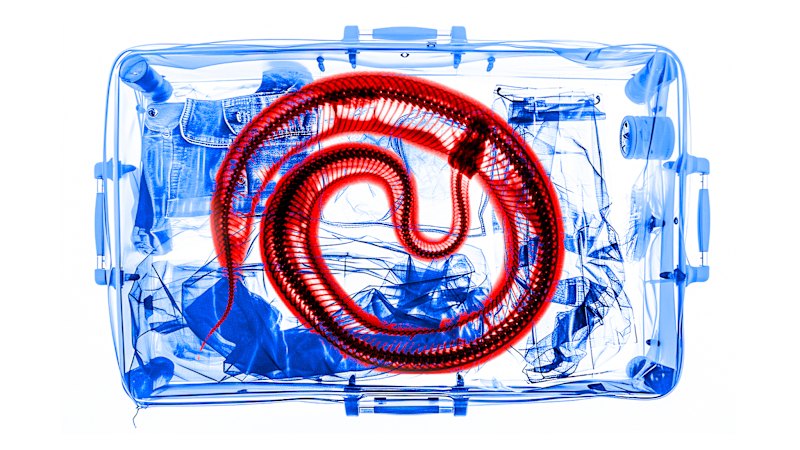
The intricate web of animal smuggling operations has been laid bare, revealing a global crisis that continues to grow in scale and complexity. Recent operations involving informants, data scraping, and advanced postal scanning have intercepted hundreds of shipments containing animals cruelly concealed in everyday items. These shipments, often destined for underground markets in Hong Kong and Germany, highlight the ongoing battle against illegal wildlife trade.
Organizations such as Rapiscan Technologies, Taronga Zoo, and the Australian Museum have been instrumental in developing cutting-edge scanning technology to detect live animals at Australia’s borders. As a result, the federal wildlife watchdog seized 1,118 specimens last year, marking a significant increase from 331 in 2024 and 584 in 2023. This crackdown has made it harder for organized crime syndicates, who are now shifting towards “higher-risk, higher-volume” shipments, according to intelligence reports.
Adapting to New Challenges
Despite a decline in the number of illegal parcels detected—from 151 in 2023 to 75 in 2024, and 102 in 2025—the overall number of animals contained within these parcels has nearly tripled. This shift has prompted authorities to conduct thorough investigations to trace the origins of these shipments. The number of warrants executed by federal Environment Department officials at smuggling headquarters has increased from 11 in 2023 to 16 in 2025.
Wildlife Forensics and Cyber-Crime Tracking
Wildlife Crime Research Hub manager Katie Smith and her team are at the forefront of using wildlife forensics and cyber-crime tracking technology to uncover illegal markets in Australia. Despite a significant increase in detections, Smith notes that only 10 percent of illegally traded animals are being detected. “Since COVID, we’re seeing almost an exponential increase again in the number of seizures being made,” Smith said.
“Australia, because of its geographic positioning, has a whole heap of unique species found nowhere else. The exotic pet trade, which is the biggest place we see Australian species being laundered into, is driven by rarity.” – Katie Smith
The Economic Incentives Behind Smuggling
The Wildlife Crime Research Hub, based at the University of Adelaide and supported by the Australian Research Council, collaborates with state and federal agencies to coordinate seizures across the country. Using data-scraping technology, researchers trace purchasing orders, sale offers, and smuggler recruitment ads on social media and e-commerce sites dating back to 2019. This intelligence not only maps illegal trades but also identifies ongoing operations for targeted interventions.
Illegal sales data reveals stark economic incentives. A shingleback sold domestically for $200 to $300 can fetch an average of $11,000 in Hong Kong. Rarer species, such as the Oenpelli python, sell for $100,000. The escalating demand for these snakes led to their classification as “vulnerable” due to illegal trade impacts rather than conservation issues.
“It shows that Australian native species that should never have been leaving the country are everywhere. There are huge markets in North America, there are huge markets in Europe.” – Katie Smith
Challenges in Tracking Smuggled Animals
Professor Alice Hughes of the University of Melbourne highlights the complexities of tracking smuggled animals once they leave their native countries. A system akin to money laundering makes it nearly impossible to trace them. The Convention on International Trade in Endangered Species (CITES) aims to combat wildlife trafficking, but it has significant gaps. Only 9.5 percent of reptile species are listed, despite 45 percent being detected in illegal trade.
“When you talk about illegal trade, people talk about ivory, or maybe they’ll talk about rhino horn, and then they’ll talk about pangolins – we never talk about exotic animal trade in the context of the pet trade, and it is booming.” – Professor Alice Hughes
The Role of Social Media and Influencers
Social media influencers are driving the rare animal market, significantly altering markets that have existed for centuries. A single US-based reptile influencer nearly wiped out a newly detected species of New Caledonia skinks. Similarly, when jumping spiders trended on TikTok in 2021, they became the second most traded arachnid globally.
Japan has emerged as a rapidly growing market for small and rare Australian reptiles, which can be easily housed in small indoor enclosures. While China’s traditional medicine market has historically fueled the underground trade, it is now being overtaken by illegally sourced pets for a new generation.
“These animals are very compatible with the modern lifestyle because they are low maintenance, because they take up less space, because they don’t eat as much, and a lot of people will have them just because it’s easier.” – Professor Alice Hughes
The global wildlife trade continues to pose significant challenges, with authorities and researchers striving to keep pace with evolving smuggling tactics. As the demand for exotic pets grows, so too does the need for robust international regulations and enforcement to protect vulnerable species and preserve biodiversity.