

The United States is quietly working to reassert its influence over the Compact of Free Association (COFA) states, three strategically located island nations in the central Pacific Ocean. Recent congressional hearings have unveiled the Trump administration’s efforts to bolster military and intelligence operations in Palau, the Marshall Islands, and the Federated States of Micronesia. These nations are seen as pivotal for U.S. power projection and a critical arena for geopolitical competition with China.
“This is a region that is increasingly central to United States security and global stability,” said Tony Greubel, a State Department official. “As geopolitical competition intensifies, the Pacific strategic sea lanes, abundant resources, and vibrant communities are more important than ever to the United States and our allies and partners.”
Historical Context of U.S. Influence
For decades, the United States has maintained a unique relationship with the compact states, collectively known as the Freely Associated States (FAS). Through COFA agreements, the U.S. has exercised exclusive military controls and claimed special privileges over a vast oceanic area comparable in size to the continental United States. These powers significantly limit the sovereignty of the compact states, allowing the U.S. to veto their security arrangements with other nations and deny foreign military access.
Despite these limitations, the compact states have repeatedly renewed their agreements with the U.S., largely due to the economic assistance provided, which includes $7.1 billion in funding over the next two decades. This financial support, coupled with visa-free access to the U.S. for islanders, has been a compelling incentive.
Geopolitical Tensions with China
The U.S. strategy in the Pacific is not without its critics. Some congressional leaders have voiced concerns over what they describe as the Trump administration’s imperial ambitions. Representative Jared Huffman (D-CA) has warned of a “colonial conquest binge,” yet many lawmakers from both parties emphasize the importance of maintaining U.S. military controls in the compact states.
“If we lose the foothold there, we are never going to get it back,” cautioned Representative Addison McDowell (R-NC).
Concerns over China’s growing influence in the Pacific have heightened these tensions. U.S. officials are wary of China establishing a direct presence in the compact states, with some lawmakers suggesting a battle for control is underway. Representative McDowell highlighted fears that China is attempting to “push the United States out of its own backyard and rewrite the balance of power in the Pacific.”
Challenges and Criticisms
Amidst these geopolitical maneuvers, the compact states face significant challenges, notably climate change. Leaders from the Pacific Islands have long warned that climate change poses an existential threat to their homelands, a concern that was starkly highlighted after President Trump dismissed climate change as “the greatest con job ever perpetrated on the world.”
“The climate crisis is not up for debate,” stated Wesley Simina, president of the Federated States of Micronesia. “The only question now is whether we as leaders will act with the urgency it demands.”
Meanwhile, depopulation due to poor living conditions and lack of economic opportunities remains a pressing issue. Angel Demapan, an official from Insular Affairs, emphasized that “the most significant threat in that region is depopulation of the communities.”
U.S. Military and Strategic Actions
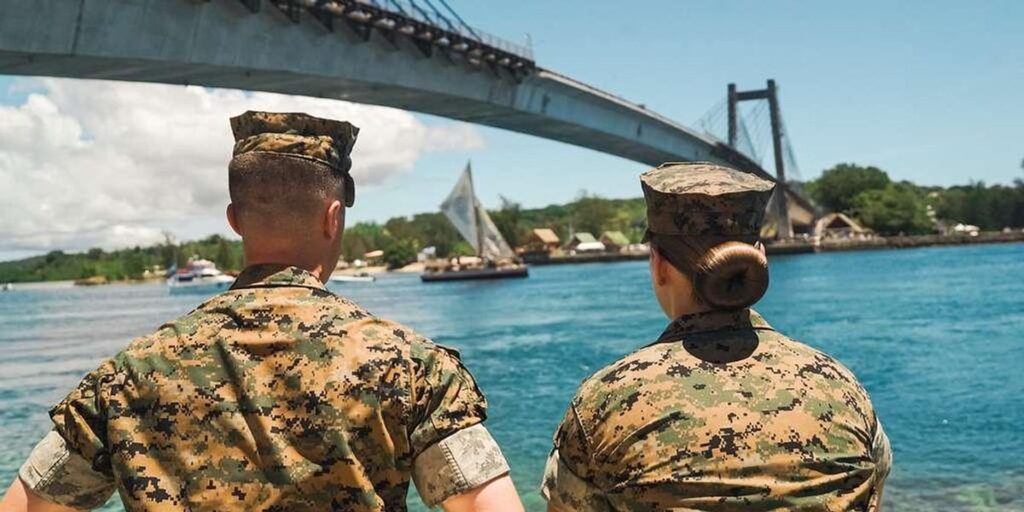
The Trump administration continues to prioritize strengthening the U.S. military presence in the compact states. This includes constructing radar stations and airstrips in Palau, testing hypersonic missiles in the Marshall Islands, and expanding seaports and airports in the Federated States of Micronesia. These efforts are part of a broader strategy to counter Chinese influence and maintain U.S. dominance in the region.
“The United States currently maintains, or is planning to build, improve, or expand defense sites,” acknowledged Angel Demapan.
Efforts to curb Chinese influence have also intensified, with U.S. diplomats in Palau warning of alleged criminal activities by Chinese entities. This has led to some Palauan officials seeking assistance from the U.S., including the CIA, to address these concerns.
Future Implications
While U.S. leaders insist their actions support a free and open Indo-Pacific, their strategies often contradict this ideal. The emphasis on strategic denial and military dominance raises questions about the true nature of U.S. intentions in the region. As the geopolitical chess game with China continues, the compact states find themselves at the center of a complex web of international relations, with their sovereignty and future hanging in the balance.
In conclusion, the U.S. efforts to expand its influence in the Pacific illustrate the intricate dynamics of modern geopolitics, where strategic interests often overshadow the pressing needs of local populations. As the world watches, the compact states remain a critical focal point in the ongoing power struggle between the United States and China.