




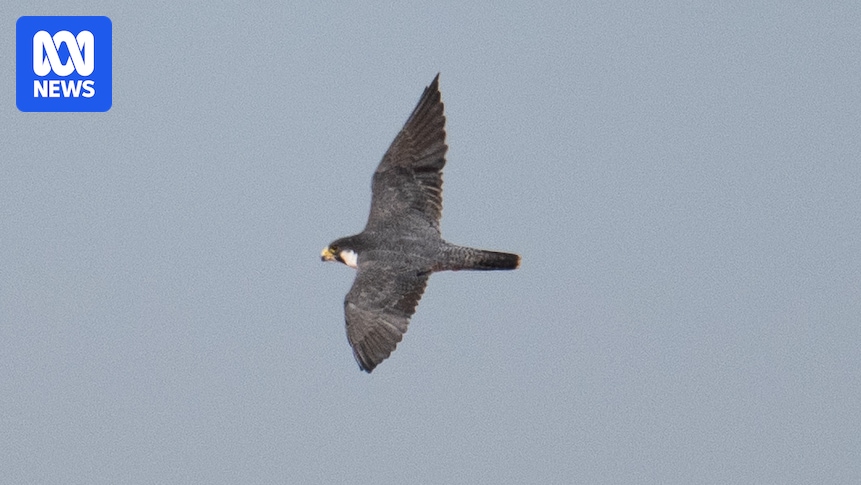
The world’s fastest animal has been spotted soaring over the Central Australian outback for the first time, setting two new records. Over Newhaven Wildlife Sanctuary, ecologist Tim Henderson was shocked to recently capture a clear photo of the Siberian Peregrine Falcon — a bird capable of reaching speeds of up to 300 km/h, more than twice the land speed of a cheetah.
The bird was moving too quickly for Dr. Henderson to identify the species initially. However, upon reviewing the photos he had taken, it became evident how rare the sighting was. The photo, taken on Ngalia-Walpiri and Luritja country near Alice Springs, marks the furthest inland sighting of a Siberian Peregrine Falcon and its first recorded appearance in Australia’s arid zone.
Unprecedented Sighting in the Arid Zone
Speaking on ABC Radio Alice Springs, Dr. Henderson expressed amazement that the photo wasn’t blurry, given the falcon’s incredible speed. He noted that there are more than a dozen subspecies of peregrine falcons, including one that gained popularity further south in Melbourne through livestreaming technology.
The Siberian Peregrine Falcon typically migrates south after spending the summer in the northern hemisphere. Dr. Henderson mentioned that sightings are “quite common” along Australian coastlines and in the ranges, but they usually breed in the Arctic tundra, leaving the frequency of their visits to Australia largely unknown.
“We sometimes get rare migrants or vagrants that come from elsewhere in the world,” Dr. Henderson said. “So I’m always keeping an eye out for any sort of interesting facial patterns that might be different [between subspecies].”
Why Was the Falcon in the Desert?
It was a thin stripe below the bird’s eye that first caught Dr. Henderson’s attention, confirming that his photograph had made history. He suggested that the falcon’s unusual presence in the outback might be linked to heavy rains in recent years, which have transformed the typically dry landscape.
The wet weather has created temporary wetlands, attracting a diverse range of raptors by providing a habitat for their prey. Dr. Henderson noted that the region isn’t “a very often birded place,” but with birdwatching gaining popularity and digital cameras becoming more accessible, this is changing.
“I think the more and more people that are out and about taking photos, the more likely you are to see a bird like this,” Dr. Henderson said.
Implications and Future Observations
The sighting of the Siberian Peregrine Falcon in Central Australia not only sets new records but also highlights the dynamic nature of wildlife patterns in response to environmental changes. As climate conditions continue to shift, such occurrences may become more frequent, offering new opportunities for ecologists and bird enthusiasts alike.
Meanwhile, the increased interest in birdwatching and advancements in technology may lead to more discoveries of rare species in unexpected locations. Dr. Henderson’s experience underscores the importance of vigilance and curiosity in the field of ecology, as well as the potential for significant findings even in well-trodden areas.
As the global climate continues to evolve, the scientific community remains keenly interested in tracking the movements of migratory species like the Siberian Peregrine Falcon. Future observations and studies may provide further insights into the adaptive behaviors of these remarkable birds, contributing to a broader understanding of biodiversity and ecosystem dynamics.