


February 15, 2026 — 5:58am
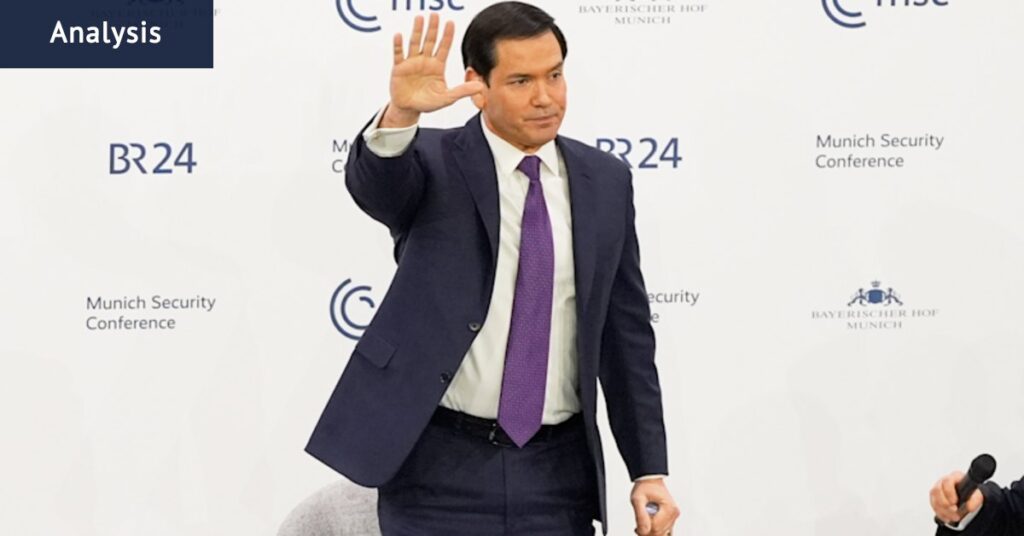
In a marked departure from last year’s contentious rhetoric, U.S. Secretary of State Marco Rubio delivered a speech at the Munich Security Conference that aimed to reassure European allies of America’s commitment to the transatlantic alliance. This shift in tone comes a year after Vice President JD Vance’s stark warning about Europe’s handling of free speech, social media censorship, and immigration policies.
Rubio’s address, emphasizing unity, was a stark contrast to Vance’s previous message. “The United States and Europe, we belong together,” Rubio stated, underscoring the intertwined destinies of the two regions. He refuted claims that the U.S. intended to dismantle the transatlantic partnership, asserting, “For us Americans, our home may be in the Western Hemisphere, but we will always be a child of Europe.”
Reassurance Amidst Concerns
Rubio’s conciliatory language was met with relief by the European audience, with MSC chairman Wolfgang Ischinger describing the speech as a “message of reassurance.” However, despite the softer tone, Rubio reiterated concerns similar to those expressed by Vance, particularly regarding mass migration.
According to Rubio, controlling migration is not an act of xenophobia but a necessary measure to protect societal stability. “The failure to do so is not just an abdication of one of our most basic duties owed to our people, it is an urgent threat to the fabric of our societies and the survival of our civilization itself,” he argued.
Shared Challenges and Responsibilities
Rubio’s speech also touched on broader themes of western civilization’s identity and challenges. He criticized what he perceives as a pervasive sense of guilt and shame within the West, urging a return to pride in its history and values. Additionally, he echoed President Trump’s sentiments by dismissing climate change concerns as a “cult” and questioning the effectiveness of the rules-based global order.
Where Rubio diverged slightly from the administration’s previous stance was in acknowledging shared mistakes between the U.S. and Europe. “We made these mistakes together,” he admitted, calling for a collective effort to address these issues and rebuild.
Global Implications and Reactions
Rubio’s remarks follow Canadian Prime Minister Mark Carney’s recent speech at Davos, which highlighted a “rupture in the world order” and suggested that middle powers like Canada and Australia must forge new paths. While Carney did not mention Trump explicitly, his comments were seen as a critique of the U.S. president’s approach to global norms.
Rubio, however, argued for reform rather than dismantling of international institutions, citing the United Nations’ limited role in resolving global conflicts. “In a perfect world all of these problems would be solved by diplomats and strongly worded resolutions. But we do not live in a perfect world,” he stated.
Looking Ahead
Australian Deputy Prime Minister Richard Marles, participating in a panel discussion at the conference, responded to Rubio’s speech by emphasizing the importance of maintaining a rules-based order. “What Secretary Rubio said today was that there is an order which we should not be removing – repairing, but not removing – and I think it is well to remember that,” Marles remarked.
As the international community grapples with these complex issues, Rubio’s speech represents a nuanced approach that seeks to balance reassurance with a call for action. The coming months will reveal whether this shift in tone translates into tangible policy changes and strengthened alliances.
Michael Koziol is the North America correspondent for The Age and Sydney Morning Herald. He is a former Sydney editor, Sun-Herald deputy editor, and a federal political reporter in Canberra. Connect via X or email.