


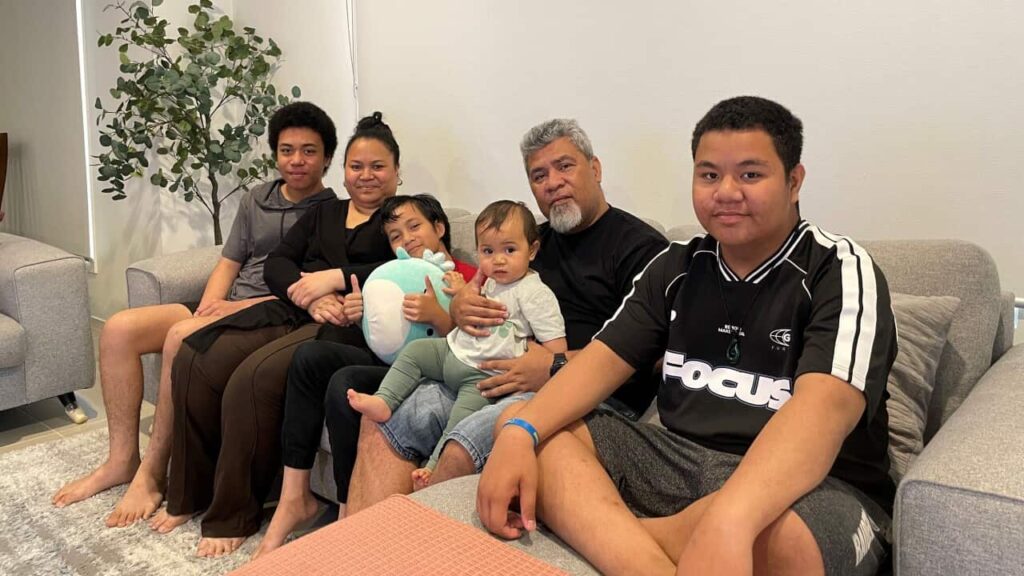
The Manuella family is among the first to arrive in Australia under a groundbreaking new visa program designed to assist those from Tuvalu, a Pacific Island nation facing existential threats from rising sea levels. This initiative, a result of the Falepili Union treaty, allows 280 Tuvaluans annually to relocate to Australia, marking a global first in climate migration policy.
The visa aims to support those on the front lines of climate change, offering them a chance for a new beginning. However, the transition is not without its challenges, as families like the Manuellas strive to maintain connections to their culture while adapting to a new environment. Two weeks ago, Telieta and Kaumaile Manuella, along with their four children, arrived in Melbourne to start this new chapter.
“It’s a new home and it’s a new journey … Tuvalu will always be in our heart and our home, but Australia is another new chapter to our family journey,” said Telieta Manuella.
A New Chapter for Tuvaluan Families
Telieta, who previously worked for Tuvalu’s department of labour, and her husband Kaumaile, with a background in architecture, are among over 8,700 applicants for the Falepili Mobility Pathway visa. This visa grants permanent residency to those selected, offering them and their families a chance at better education and job opportunities.
The selection process is competitive, with a one in more than 30 chance of being chosen. Kaumaile vividly remembers the moment they received the good news. “It was funny, I was in the shower and then came out of the room, and my wife was on the phone. I saw her face was like changing, it was like surprised. So I said ‘oh, what happened?’ and I thought something happened to her family or relative. But actually she just told me that we got an email saying that we’d been selected.”
Opportunities and Challenges
Professor Jane McAdam, director of the University of New South Wales’ Evacuations Research Hub, highlights the visa’s flexibility. It does not require applicants to have pre-arranged work or study plans, allowing them to diversify their livelihoods. “It provides opportunities for what we call livelihood diversification, it enables kids to go to school in Australia, for people to acquire further skills and training which they might want to use here, but equally might want to take back to Tuvalu,” McAdam explained.
Despite the opportunities, settling in Australia poses challenges. The Tuvaluan diaspora in Melbourne is small but close-knit. The Manuellas are fortunate to stay with Niuelesolo Boland, a relative deeply involved with the community. Boland believes more support is needed for new arrivals. “I think it’s falling back on the Tuvaluan diaspora in Australia to pick up the burden,” he said.
“Like a lot of them are looking at forms like ‘what is this?’ you know? Coming from Tuvalu, where we don’t even have tax file numbers, you know? Or a Medicare scheme. So to them it’s totally foreign.”
Debate Over Random Selection
The random nature of the visa selection process has sparked debate. Dr. Yvonne Su from Harvard University’s School of Public Health questions the randomness of a visa branded as a response to climate change. “Climate change is not random. Climate change doesn’t just happen to anybody, unfortunately,” she noted.
Federal Minister for Pacific Affairs, Pat Conroy, defended the random selection, arguing it prevents a brain drain from Tuvalu. “If you didn’t have a ballot system that introduced an element of random selection, in the end the people who would qualify first for this visa would be the people with the highest educational and professional qualifications within Tuvalu, and that would lead to a brain drain,” he said.
Looking Forward
As the first families settle in, the success of the Falepili Mobility Pathway visa will be closely watched. It represents a pioneering approach to climate-induced migration, with potential implications for other vulnerable nations. The program’s progress will be crucial in shaping future policies and providing a lifeline for those affected by climate change.
The Manuellas, along with other Tuvaluan families, embark on a journey of adaptation and hope, carrying with them the essence of their homeland while embracing new opportunities in Australia.