

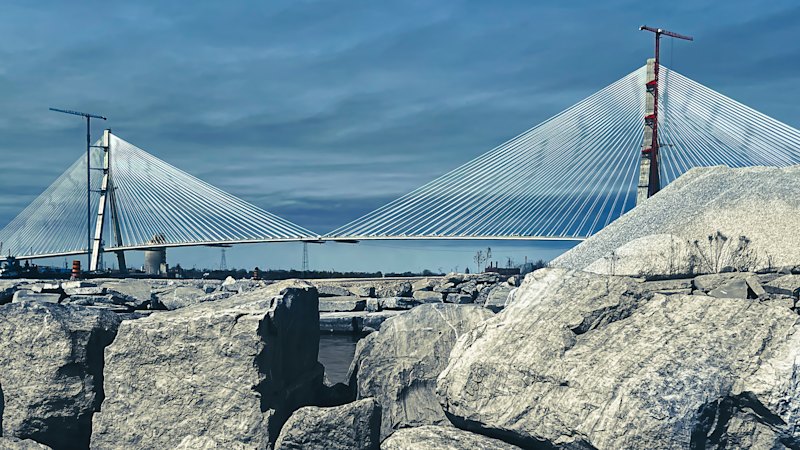
US President Donald Trump has issued a stark warning regarding the Gordie Howe International Bridge, a newly constructed Canadian-built bridge spanning the Detroit River. Trump has threatened to prevent its opening unless Canada agrees to cede at least half ownership of the bridge to the United States, along with other unspecified demands. This latest move is part of a broader clash over cross-border trade issues.
In a detailed social media post on Monday, Trump stated, “We will start negotiations, IMMEDIATELY. With all that we have given them, we should own, perhaps, at least one half of this asset.” He criticized the project for not utilizing American steel and lamented that the United States would receive no direct benefits from the bridge.
The Gordie Howe International Bridge: A Cross-Border Initiative
The Gordie Howe International Bridge, named after the legendary Canadian hockey player who played for the Detroit Red Wings, was anticipated to open in early 2026. The project, initiated by former Michigan Governor Rick Snyder, was fully funded by the Canadian government to alleviate congestion at the existing Ambassador Bridge and Detroit-Windsor Tunnel. Construction has been ongoing since 2018.
Despite Trump’s threats, it remains uncertain how he might legally block the bridge’s opening. Both the White House and the Canadian embassy in Washington have not responded to requests for further details.
Political and Economic Implications
This development comes amidst strained relations between the US and Canada during Trump’s second presidential term. The United States-Mexico-Canada Agreement (USMCA) is scheduled for review this year, with Trump adopting a hard-line stance, including new tariff threats. Canadian Prime Minister Mark Carney has publicly criticized the US for economic coercion.
Senator Elissa Slotkin, a Michigan Democrat, emphasized the bridge’s importance, calling it a “huge boon” for Michigan’s economy. She noted, “You’ll be able to move cargo from Montreal to Miami without ever stopping at a street light.” Slotkin criticized Trump’s approach, suggesting it harms US interests more than it pressures Canada.
Local Reactions and Broader Context
Michigan, a pivotal swing state that Trump won in 2016 and 2024, has largely been spared from his administration’s more aggressive policies, which have targeted Democratic strongholds with immigration raids and funding cuts. Despite this, Trump has maintained a positive relationship with Michigan’s Democratic Governor Gretchen Whitmer, praising her publicly and collaborating on military initiatives.
Stacey LaRouche, Whitmer’s press secretary, highlighted the bridge’s significance, stating, “This is the busiest trade crossing in North America. It’s good for Michigan workers and it’s good for Michigan’s auto industry.” She expressed confidence that the bridge would open as planned, underscoring its role in fostering international cooperation.
Economic Impact and Future Prospects
Democratic Congressman Shri Thanedar from Detroit described blocking the bridge as “crazy,” emphasizing its economic benefits for Michigan. “The bridge is going to help Michigan’s economy. There’s so much commerce between Michigan and Canada. They’re one of our biggest partners,” Thanedar remarked.
Similarly, Congresswoman Debbie Dingell dismissed Trump’s threats, expressing her anticipation for the bridge’s opening later this spring.
“The bridge is going to help Michigan’s economy. There’s so much commerce between Michigan and Canada. They’re one of our biggest partners.” — Shri Thanedar, Democratic Congressman
Looking Ahead
The Gordie Howe International Bridge represents a significant infrastructure project with potential to enhance trade and economic ties between the US and Canada. As tensions simmer, stakeholders on both sides of the border are keenly watching how negotiations unfold and whether the bridge will indeed open as scheduled.
As the USMCA review looms, the bridge dispute could become a focal point in broader discussions about trade and international cooperation. Observers will be watching closely to see if a resolution can be reached that satisfies both nations’ interests.