



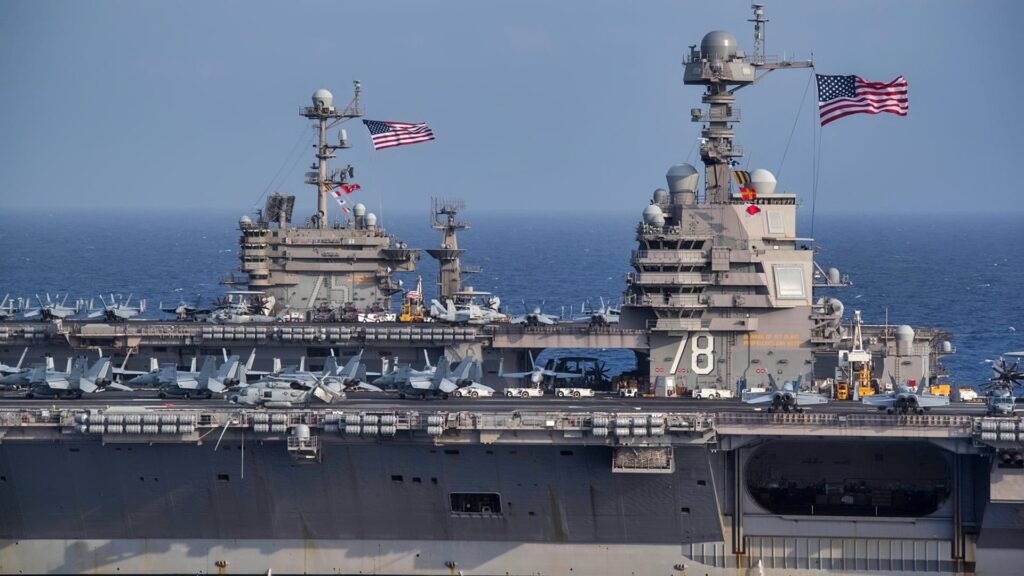
The USS Nimitz (CVN-68), the world’s oldest serving aircraft carrier, will no longer see active duty, marking the end of an era for a vessel that has been a cornerstone of American naval power for over five decades. Named after the legendary Admiral Chester Nimitz, this supercarrier has been a formidable presence since its commissioning in 1975, surviving the Cold War, the Gulf War, and numerous modern counter-terrorism operations.
With its two nuclear reactors and capacity to carry 90 aircraft, the USS Nimitz has been a vital asset in potential conflicts, especially as the U.S. Navy awaits the combat-readiness of its replacement, the USS John F. Kennedy. The Nimitz’s retirement represents a significant shift in naval strategy and capabilities as the Navy transitions to the next generation of carriers.
The Legacy of Admiral Chester Nimitz
Admiral Chester William Nimitz, one of the most revered figures in U.S. Navy history, served with distinction during World War II. As Commander in Chief of the U.S. Pacific Fleet, he played a crucial role in America’s naval victories over the Imperial Japanese Navy, including the pivotal battles of Midway, the Philippine Sea, and Leyte Gulf. His leadership and strategic acumen earned him a lasting legacy, culminating in the naming of an entire class of nuclear-powered supercarriers in his honor.
Interestingly, the USS Nimitz is the only ship in its class named solely after the surname of its namesake, unlike its sister ships, which bear the full names of historical figures such as the USS Abraham Lincoln and USS Harry S. Truman. This unique naming convention further cements the ship’s legendary status, affectionately known among its crew as “Uncle Chester.”
Technical Marvel: The USS Nimitz
Built by Newport News Shipbuilding in Virginia, the USS Nimitz was commissioned on May 3, 1975. Its technical specifications are a testament to its engineering prowess:
- Displacement: Approximately 100,000 tons fully laden
- Overall Hull Length: 332.8 meters (1,092 ft)
- Beam Width: 76.8 meters (252 ft)
- Primary Propulsion: 2 × Westinghouse A4W nuclear reactors generating 260,000 shp (194 MW)
- Max Speed: 30+ knots (56+ km/h)
- Range: Unlimited distance; 20-25 years endurance
- Crew Complement: 3,500 officers and sailors; 2,480 in the air wing
- Aircraft Capacity: 90 fixed-wing and rotary-wing assets
- Armament: Various missile systems and close-in weapon systems
Combat and Cultural Impact
The USS Nimitz first saw combat during the Gulf of Sidra Incident in 1981, when its F-14 Tomcats engaged Libyan jets. It played pivotal roles in several operations, including the Persian Gulf War and Operation Inherent Resolve against the Islamic State. These engagements underscore the carrier’s strategic importance and its ability to project power across the globe.
Beyond its military achievements, the USS Nimitz has also made its mark in popular culture. It starred in the 1980 film “The Final Countdown,” where it was depicted as being time-warped to the eve of the Pearl Harbor attack. The ship’s fictional portrayals, including a mention in Tom Clancy’s novel “SSN: A Strategy Guide to Submarine Warfare,” highlight its iconic status in American naval lore.
The Future of U.S. Naval Power
As the USS Nimitz prepares for retirement, the U.S. Navy faces the challenge of transitioning to newer carriers like the Gerald R. Ford-class USS John F. Kennedy. While the JFK has embarked on sea trials, its combat readiness remains uncertain. In the interim, “Uncle Chester” and its sister ships continue to stand ready, underscoring the ongoing need for robust naval capabilities amid global tensions.
The retirement of the USS Nimitz marks the end of an era, but its legacy will endure as a symbol of American strength and innovation. As the Navy looks to the future, the lessons and achievements of the Nimitz will continue to inform and inspire the next generation of naval warfare.