




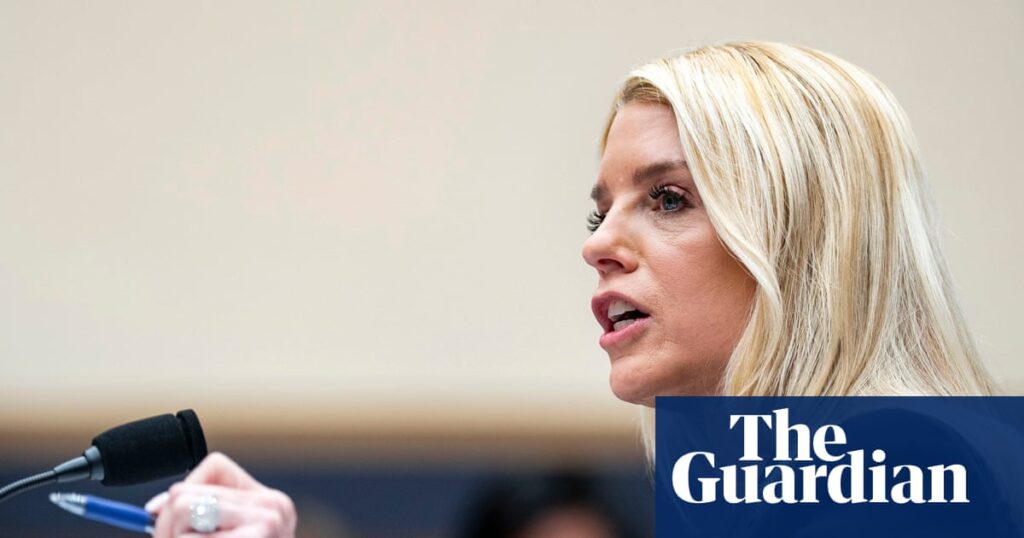
The U.S. Attorney General Pam Bondi engaged in a fiery exchange with Democrats during a House Judiciary Committee hearing on Wednesday, defending the Justice Department’s handling of files related to Jeffrey Epstein. The contentious session highlighted the ongoing debate over transparency and accountability in the release of sensitive documents.
Democrats pressed Bondi with questions regarding the department’s compliance with a law mandating the complete release of Epstein-related files, with limited room for redactions. The Justice Department has faced criticism for both revealing the names of survivors and redacting, without explanation, the names of individuals potentially involved in criminal activities. Bondi, however, sidestepped these questions, focusing instead on political attacks.
Contentious Exchanges and Political Overtones
During the hearing, Representative Pramila Jayapal of Washington urged Bondi to apologize to Epstein’s victims present in the room, a request Bondi dismissed as theatrics. “I’m not going to get in the gutter with this woman. She’s doing theatrics,” Bondi retorted.
The hearing saw further clashes, notably with Jamie Raskin of Maryland, the committee’s top Democrat. Raskin attempted to curb Bondi’s lengthy responses, which he claimed were designed to consume the limited time allotted for questioning. Bondi, however, responded with a personal attack, saying, “You’re a washed-up loser lawyer. You’re not even a lawyer.”
Democrats, including Zoe Lofgren of California, criticized the Justice Department for its broad redactions, arguing that such actions undermine the department’s credibility. “The justice department had lost credibility,” Lofgren stated.
Epstein Files and Political Ramifications
The Epstein files have unveiled connections between Epstein and several prominent figures close to former President Donald Trump, including U.S. Commerce Secretary Howard Lutnick, former strategist Steve Bannon, and entrepreneur Elon Musk. None have been charged with any wrongdoing related to Epstein.
Bondi’s defense of Trump was evident throughout the hearing. “I find it interesting that she keeps going after President Trump, the greatest president in American history,” Bondi remarked, emphasizing her stance against what she perceives as political attacks on Trump.
When questioned by Representative Ted Lieu of California about Trump’s potential involvement with underage girls at Epstein’s parties, Bondi dismissed the inquiry as baseless. “This is so ridiculous,” she said. Lieu countered, suggesting that Bondi’s denial could constitute perjury, given Trump’s name appears in the files.
Historical Context and Broader Implications
The Justice Department’s handling of the Epstein files is part of a broader narrative of political interference and transparency issues. Historically, the department has maintained a degree of separation from the White House to prevent perceived political bias in law enforcement. However, Bondi’s defense of Trump and her attacks on Democrats suggest a departure from this norm.
In a heated exchange with Thomas Massie of Kentucky, Bondi attempted to shift blame away from the Trump administration by implicating previous administrations in the Epstein cover-up. “This goes over four administrations. You don’t have to go back to Biden. Let’s go back to Obama. Let’s go back to George Bush,” Massie argued, highlighting the long-standing nature of Epstein’s activities.
Looking Ahead: The Path to Accountability
The hearing underscores the challenges faced by the Justice Department in balancing transparency with privacy and legal considerations. The department’s approach to the Epstein files will likely continue to be a focal point for both political and legal scrutiny.
As the Justice Department navigates these challenges, the broader implications for political accountability and justice for Epstein’s victims remain a critical concern. The ongoing debate over the handling of these files serves as a reminder of the complex intersection between law, politics, and public interest.