




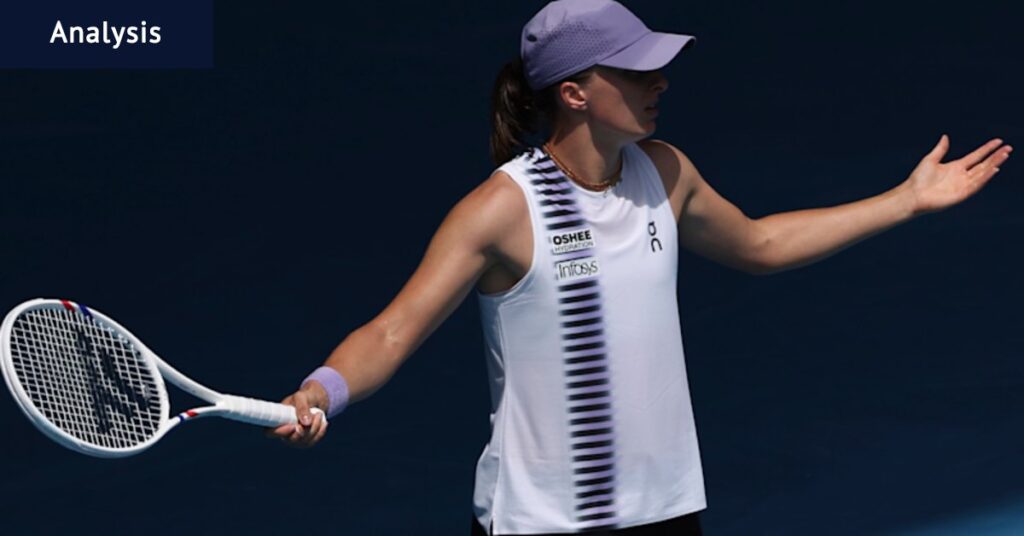
In a move that has sparked a heated debate, Tennis Australia has defended its decision to use behind-the-scenes cameras during the Australian Open. This comes after world No.2 Iga Swiatek supported Coco Gauff’s concerns over privacy, following an incident where Gauff was filmed in a moment of frustration after her quarter-final loss.
Gauff, ranked No.3 in the world, was caught on camera venting her frustration by smashing her racquet on a concrete ramp, believing she was in a private space. Swiatek, who also experienced a disappointing quarter-final exit against Elena Rybakina, expressed empathy for Gauff’s situation.
Privacy Concerns in Professional Tennis
Swiatek questioned the extent of media intrusion in tennis, comparing the constant surveillance to being observed “like animals in the zoo.” She emphasized the need for privacy, stating, “It would be nice to have some privacy. It would be nice also to, I don’t know, have your own process and not always be observed.”
Tennis Australia, responsible for the in-house broadcast, argued that the cameras strike a balance between respecting players’ privacy and showcasing their personalities. They believe this access helps players build their brands.
The Role of Media in Modern Sports
The controversy highlights a broader issue in sports today: the demand for content beyond the court. Players are increasingly seen as personalities, with fans eager to connect with them on a personal level. This has led to a growing trend of players creating their own content to engage with their audience.
Novak Djokovic, a ten-time Australian Open champion, also voiced his support for Gauff, acknowledging the challenges of constant media attention. “It’s really sad that you can’t basically move away anywhere and hide and – what do you call that – fume out your frustration, your anger in a way that won’t be captured by a camera,” he said.
Behind-the-Scenes Access: A Double-Edged Sword
During the 2024 Australian Open, 45 behind-the-scenes cameras were used to capture players’ journeys from the tunnels to the courts. However, Tennis Australia has set boundaries, excluding certain private moments from being filmed, such as players spending time with their families or receiving massages.
According to Tennis Australia, “Each year we provide more private spaces for players where they can relax, focus on their preparation and work with their teams privately. This includes a player quiet room and strategy rooms, a sleep room, private locker rooms, medical, health, wellbeing and beauty rooms.”
“Our goal is always to create an environment that supports the players to perform at their best, while also helping fans appreciate their skill, professionalism and personalities.”
The Impact on Player Performance
Swiatek’s loss to Rybakina was a significant upset, disrupting her plans to become the third-youngest woman of the Open era to win a career grand slam. Despite her six grand slam titles, she has yet to reach the final in Melbourne. Rybakina, who lost to Aryna Sabalenka in the final three years ago, demonstrated her prowess by defeating Swiatek in straight sets.
As the tournament progresses, Rybakina faces a challenging path ahead, needing to overcome Jess Pegula to potentially meet Sabalenka in the final. Pegula’s confidence and strategic play pose a formidable challenge, as evidenced by her recent victory over fourth seed Amanda Anisimova.
The Future of Tennis Broadcasting
As the debate over privacy and media access continues, Tennis Australia has committed to gathering feedback from players to improve their approach. Swiatek, however, remains skeptical about the effectiveness of such discussions, questioning the point of raising concerns with officials.
This situation underscores the evolving nature of sports broadcasting, where the line between sport and entertainment is increasingly blurred. As players navigate this landscape, the balance between maintaining privacy and engaging with fans will remain a contentious issue.