

“I’m obsessed with the monks,” my friend Sam told me. “It’s the only thing getting me through the violence of this second Trump administration. The monks, and my meds.” I nodded, recalling the tales my brother and sister-in-law shared after their journey to Alabama to witness the monks’ serene presence and grounded hope.
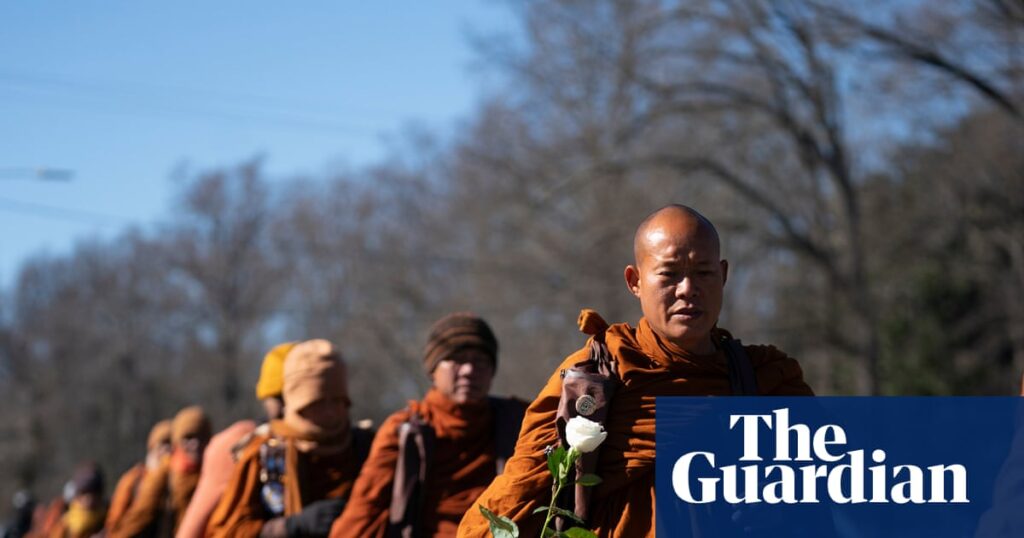
The monks are part of a 2,300-mile pilgrimage for peace, originating from a Buddhist temple in Fort Worth, Texas, and stretching across nine states to Washington D.C. Dressed in vibrant orange robes, they walk approximately 20 miles each day, subsisting on a single meal and practicing loving-kindness—a form of mindfulness that embodies non-violent resistance.
Their journey is a slow-moving meditation, an embodiment of peace rather than an argument for it. However, it has not been without challenges. A tragic accident in Texas resulted in a leg amputation for one monk, and they have braved the bitter, snowy cold that has engulfed much of the country.
The Journey of Peace and Resilience
Having spent over two decades as an environmental educator, engaging college students in community action, I believe in the power of small, repeated acts to effect change. The monks’ message, rooted in presence rather than protest, offered me a quieter way to summon peace in my life, community, and country.
Driven by this inspiration, I embarked on a two-and-a-half-hour drive from the Blue Ridge Mountains to the flatlands of High Point, North Carolina. There, I joined hundreds lining the sidewalks of this small southern town, eager to witness the monks’ message of “unity, compassion, and healing for the nation.”
To my right, four silver-haired women tracked the monks’ route on their phones, equipped with beach chairs, blankets, and snacks. Across the street, construction workers silenced their power tools, watching from a second-story office building. A woman with dreads held a poster echoing the monks’ mantra: “Today is our peaceful day.”
A Community United in Peace
At 10:45 a.m., a woman announced the monks’ imminent arrival, and we shuffled back, craning our necks to see. Street vendors hawked T-shirts emblazoned with images of the monks and Aloka, their companion dog. “Get your monks T-shirt now before you see them! Twenty bucks a pop!” one vendor shouted, prompting a chuckle from me and a text to Sam: “Monk merch!”
Despite the temptation to capture the moment on my phone, I vowed to observe the monks without the distraction of a camera. That evening, my younger daughter attended their talk in nearby Greensboro, where a monk remarked, “So often, people gather to watch us, but all we see are their phones, their lovers.” His words resonated as I clasped my hands together, abandoning my phone to be present in the moment.
In a heartbeat, the monks rounded the corner, their silent procession of shaved heads and flowing robes moving briskly, some barefoot, others in running shoes. They carried and distributed flowers along the way, embodying their belief that “when you give it away, it doesn’t diminish – it multiplies. When you share joy, you don’t lose it – you create more of it.”
A Lasting Impact
As the monks passed, I bowed my head and held my palms in prayer, joined by construction workers, families, and older women wrapped in blankets. A police officer lowered his gaze, and I found myself in tears. In that moment, five minutes of loving-kindness felt profound, even against the backdrop of an authoritarian regime.
When the monks depart from the nation’s capital this week, I will carry the practice and gift of kindness with me. Their peaceful pilgrimage, a testament to resilience and hope, offers a powerful reminder of the potential for unity and healing in a divided nation.