



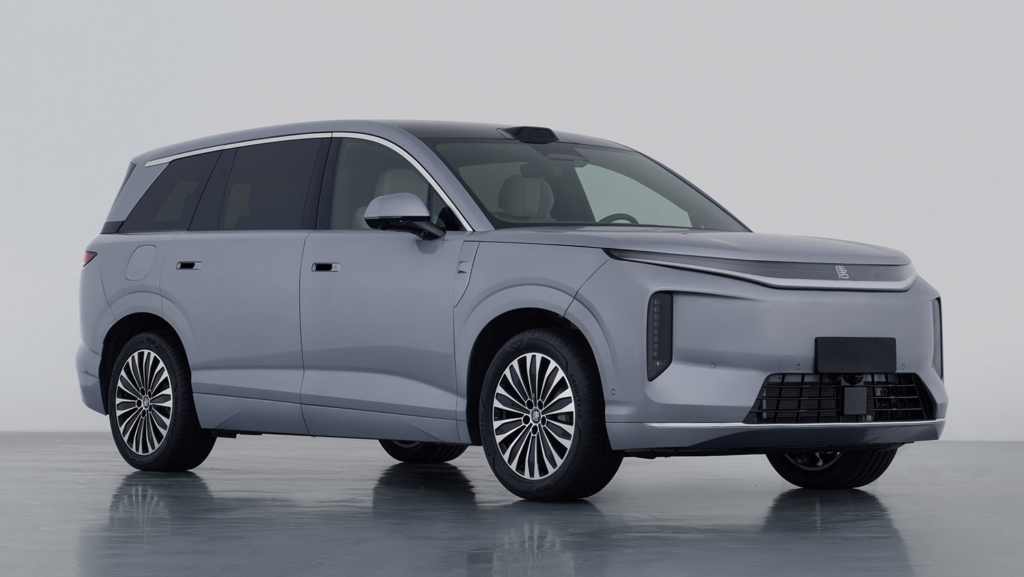
Information from the latest regulatory filings has unveiled details of BYD’s upcoming flagship SUV, the “Great Tang” (Datang). Positioned as a 9-series product within the brand’s Dynasty series, this new vehicle is set to become the lineup’s top-tier offering, targeting the luxury market segment above 400,000 yuan (approximately 57,000 USD). The Great Tang is expected to make its official debut in the first half of this year, marking a significant milestone for BYD in the competitive SUV market.
The Great Tang showcases a brand-new design language, featuring a closed grille complemented by star-ring-like chrome trim and a “Tang” logo rendered in ancient small seal script. Vertical air ducts on either side of the front bumper add a touch of sportiness. Along the sides, the SUV adopts newly designed semi-hidden door handles and intricate multi-spoke wheels, while the rear is characterized by a full-width taillight cluster.
Design and Specifications
In terms of dimensions, the Great Tang measures 5263 (or 5302) mm in length, 1999 mm in width, and 1790 (or 1800) mm in height. The wheelbase extends to 3130 mm, and the vehicle’s gross mass is listed at 3245 kg. These measurements place the Great Tang firmly in the full-size SUV category, significantly larger than current Tang models.
The models submitted for approval offer three powertrain configurations: single-motor versions with outputs of 300 kW (402 hp) and 370 kW (496 hp), and a dual-motor version featuring a 215 kW (288 hp) front motor and a 370 kW (496 hp) rear motor. This range of options highlights BYD’s commitment to providing versatile and powerful driving experiences.
Technological Innovations
Being built on the Super e-platform suggests that the Great Tang will feature advanced technologies such as megawatt flash charging and a 30,000 rpm motor. Furthermore, early tests of camouflaged prototypes indicate that the Datang will be the first BYD model to feature rear-wheel steering technology, enhancing maneuverability and driving dynamics.
“The Great Tang is a full-size flagship aiming at rivals like the Aito M9 and Li Auto L9,” industry analyst Chen Wei commented. “Its introduction could redefine the expectations for luxury SUVs in China.”
Market Position and Competition
The introduction of the Great Tang represents BYD’s strategic move to compete directly with high-end models such as the Aito M9 and Li Auto L9. With a length of over 5.2 meters and a wheelbase exceeding 3.1 meters, the Great Tang positions itself as a formidable contender in the full-size SUV market.
BYD’s decision to launch this model in the luxury segment reflects the company’s ambition to expand its market share and influence in the automotive industry. The Great Tang’s advanced features and luxurious design are expected to attract consumers seeking both performance and prestige.
Implications and Future Prospects
The unveiling of the Great Tang comes at a time when the global automotive industry is rapidly evolving, with increasing emphasis on electric vehicles and sustainable technologies. BYD’s focus on innovation and luxury with the Great Tang could set new benchmarks for electric SUVs, influencing future models and consumer expectations.
As the Great Tang prepares for its official debut, industry observers will be keenly watching how it performs in the market and whether it can live up to its promise of redefining luxury and performance in the SUV segment.
Looking ahead, BYD’s continued investment in research and development, coupled with its strategic positioning in the luxury market, suggests that the company is well-prepared to navigate the challenges and opportunities of the evolving automotive landscape.