



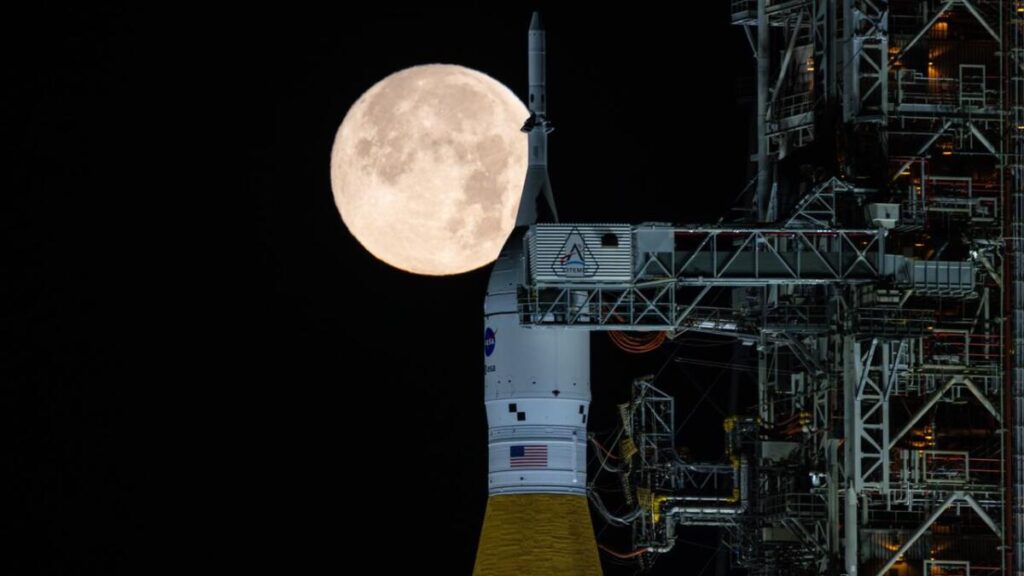
NASA has announced a delay in the launch of its Artemis II mission, opting to forego a February attempt due to technical difficulties encountered during a critical fueling test. Engineers faced leaks, cold-weather delays, and equipment issues, prompting the space agency to reschedule the launch to March. This decision highlights the ongoing challenges in preparing for NASA’s first crewed lunar mission in over 50 years.
The Artemis II mission is a pivotal step in NASA’s ambitious plan to return humans to the moon and eventually venture to Mars. The mission will send four astronauts—Commander Reid Wiseman, pilot Victor Glover, Christina Hammock Koch, and Jeremy Hansen—on a 10-day journey around the moon without landing. This flight will test the Orion spacecraft’s life-support systems, serving as a crucial precursor to the Artemis III mission, which aims to land astronauts on the lunar surface.
Technical Setbacks and Safety Priorities
The recent wet dress rehearsal conducted by NASA simulated launch countdown operations by loading 700,000 gallons of super-cold fuel into the 322-foot Space Launch System rocket. This test is designed to identify potential issues before liftoff. However, the test ended prematurely due to a hydrogen leak detected by sensors, which automatically stopped the countdown with about five minutes remaining.
“Safety remains our top priority, for our astronauts, our workforce, our systems, and the public,” stated NASA administrator Jared Isaacman in a post on X. “We will only launch when we believe we are ready to undertake this historic mission.”
“Safety remains our top priority, for our astronauts, our workforce, our systems, and the public.” – Jared Isaacman, NASA Administrator
Engineers encountered multiple issues during the two-day countdown simulation, which began on January 31 in Cape Canaveral, Florida. These included a liquid hydrogen leak, which required teams to pause and adjust the flow of hydrogen to address the seal. Despite these setbacks, engineers successfully filled all tanks, and a team completed Orion closeout operations as if the astronauts were boarding the spacecraft.
Understanding Hydrogen Leaks
Liquid hydrogen, NASA’s fuel of choice for decades, poses unique challenges due to its low molecular weight and super-cold temperature. These characteristics make it ideal for keeping rocket tanks light but also prone to leaks. The cold temperature causes rocket materials to contract, creating tiny gaps through which hydrogen can escape.
In addition to the hydrogen leak, NASA reported other issues during the test, including a valve linked to the Orion hatch pressurization that required retightening and cold temperatures affecting multiple cameras and equipment. Engineers also faced intermittent audio communication dropouts across ground teams, an issue under investigation for weeks.
Looking Forward: The Path to Artemis III
With the February launch window closed, the next opportunity for Artemis II is from March 6 to March 9, with an additional chance on March 11. The astronauts, who have been in quarantine at Johnson Space Center in Houston since January 21, will return to Kennedy Space Center about two weeks before the new targeted launch date.
The delay underscores the complexity of the Artemis program, which aims to establish a sustainable human presence on the moon as a stepping stone to Mars. As NASA continues to address the technical challenges, the agency remains committed to ensuring the success of Artemis II and the broader goals of the Artemis program.
“Getting this mission right means returning to the Moon to stay, and a future to Artemis 100 and beyond.” – Jared Isaacman
As NASA prepares for the next steps, the world watches with anticipation. The success of Artemis II is crucial not only for the future of lunar exploration but also for the broader aspirations of human space travel. The mission represents a significant milestone in humanity’s quest to explore the cosmos.