


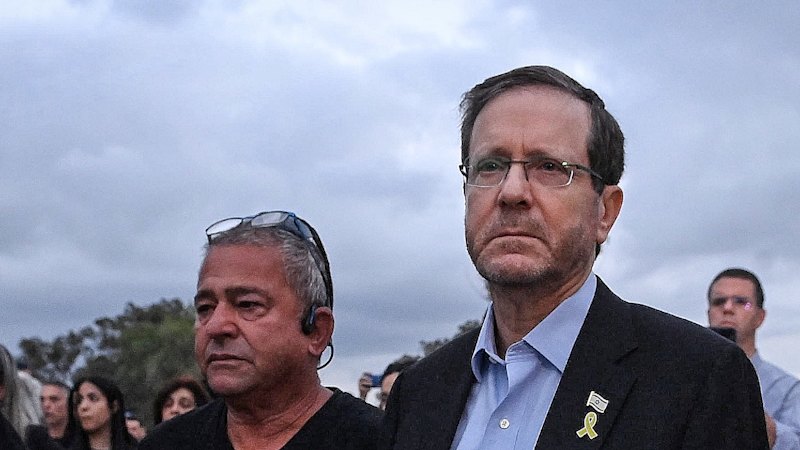
Israeli President Isaac Herzog’s visit to Sydney has become the focal point of significant public and legal activity. On his itinerary was a poignant ceremony at Bondi Pavilion, where he laid a wreath and two stones from Jerusalem in memory of the 15 victims of a recent attack on Jews celebrating Hanukkah. The stones, Herzog noted, symbolized “the unbreakable bond between the living and those we have lost.”
Meanwhile, a legal battle is unfolding in the Supreme Court, where pro-Palestinian protesters have launched a challenge against the extraordinary police powers granted by the New South Wales government during Herzog’s visit. The Palestine Action Group, which estimates a turnout of about 5,000 for a demonstration at Sydney Town Hall, is contesting the use of these powers, arguing they are intended to suppress legitimate protest.
Security Measures and Public Response
The security measures in place for Herzog’s visit are extensive. A motorcade escorted by police has been seen entering a secured street in Sydney’s CBD, with heavily armed officers and a police helicopter providing additional oversight. The NSW government had quietly declared Herzog’s visit a major event, a move typically reserved for managing large crowds at sporting events. This declaration has been a point of contention, as it grants police sweeping powers to manage the public and potential protests.
Protesters have voiced their concerns about these measures. Josh Lees, a spokesperson for the Palestine Action Group, emphasized that their intent is not to confront the police but to express their dissent peacefully. The group is also lobbying for permission to march to the NSW parliament, a request that has yet to be granted by the authorities.
Legal Proceedings and Arguments
In the Supreme Court, Justice Robertson Wright is presiding over the urgent legal challenge to the police powers. Barrister Felicity Graham, representing the Palestine Action Group, argued that the government’s declaration was improperly aimed at curbing protests rather than facilitating a major event. She pointed out the lack of evidence that Herzog intended to visit the sites where the protests are planned.
Justice Wright highlighted the government’s position that the declaration aimed to prevent potential conflicts between mourners, visitors, and protesters. The government has justified the measures by citing security concerns, referencing a violent incident on December 14th that targeted a religious celebration.
Public Sentiment and Historical Context
The visit and the associated protests have stirred emotions on both sides. A pro-Palestinian protester at Bondi Pavilion was issued a move-on direction after expressing dissent as Herzog departed. The Major Events Act, under which this action was taken, is part of the legal framework being contested in court.
Herzog, addressing the protests, reiterated the historical ties between Australia and Israel, emphasizing that the demonstrations undermine his nation’s existence. He referenced the recent conflict on October 7th, which resulted in tragic losses for Israeli families, some of whom have traveled to Sydney to participate in memorial events.
Implications and Future Developments
The court’s decision, expected by 4 PM, could have significant implications for the planned protest and future demonstrations in the region. The outcome will determine whether the police powers invoked for Herzog’s visit were legally justified, potentially setting a precedent for how similar events are managed in the future.
As the situation unfolds, the balance between security and the right to protest remains a critical issue. The developments in Sydney reflect broader global tensions and the challenges of managing international diplomatic visits in a highly interconnected and politically charged world.