



Injuries are an inherent part of sports, particularly in the high-risk world of winter athletics. For athletes like Lindsey Vonn, who have spent their careers performing breathtaking feats on the slopes, the question is not if they will face injury, but when. Vonn, a legendary figure in alpine skiing, is no stranger to this reality.
At the 2026 Winter Olympic Games in Cortina d’Ampezzo, Italy, Vonn’s career took another dramatic turn. Despite her extensive history of injuries, including a completely torn ACL suffered at the Crans Montana World Cup in Switzerland, Vonn was determined to compete. Her resilience was evident when she announced on Instagram the extent of her injuries, which included meniscal tears. Yet, she remained undeterred, driven by her love for ski racing.
The Lead-Up to Cortina
Vonn’s journey to the 2026 Olympics was fraught with challenges. In 2019, she competed in the World Championships with multiple fractures and a torn LCL, securing a bronze medal. Her return to the Olympics after a six-year retirement was made possible by a partial knee replacement. Despite these setbacks, Vonn’s passion for the sport never wavered.
On the eve of her race, Vonn addressed her critics with characteristic bluntness. Responding to a sports doctor on social media who questioned her decision to compete, she quipped, “lol, thanks doc. Just because it seems impossible to you doesn’t mean it’s not possible.” Her determination was palpable, even in the face of skepticism.
The Crash That Silenced the Slopes
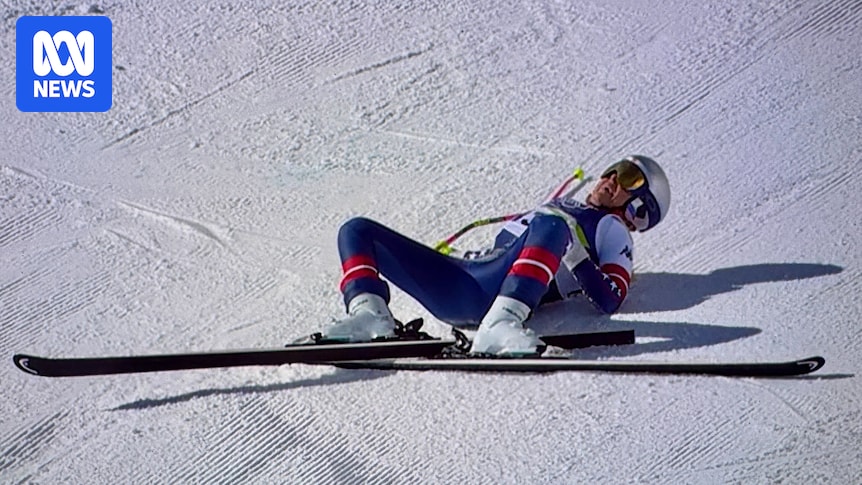
Vonn’s Olympic return ended abruptly on the upper slopes of the Tofane ski center. Wearing bib number 13, she lost control at the top of the Olympia delle Tofane course, resulting in a crash that twisted her already damaged knee. Her scream of pain echoed through the valley, silencing spectators and fans alike.
The scene was surreal as a helicopter arrived to transport Vonn to the hospital. Despite the gravity of the situation, the race continued, highlighting the relentless nature of downhill skiing. Vonn’s crash was a stark reminder of the risks inherent in the sport.
Reactions from the Skiing Community
The skiing community was quick to react to Vonn’s crash. Fellow American skier Breezy Johnson, who won the event, expressed her empathy, having herself suffered an ACL tear on the same course four years prior. “My heart goes out to her,” Johnson said. “I know how difficult it is to ski this course and how sometimes, because you love this course so much, when you crash on it, and it hurts you like that, it hurts you that much worse.”
Italian skier Laura Pirovano echoed these sentiments, acknowledging the shared experience of injury among athletes. “It’s something that is truly unpleasant, especially at an Olympics, on a beautiful day like this, on a beautiful track,” she remarked.
“My heart hurts for Lindsey … [she] has really been a huge mentor for all of us, and seeing her go down like that, it really sucks,” fellow American Jacqueline Wiles said. “It doesn’t change anything about her legacy. She’s a fighter, and that’s the way that she’s going to go out and ski every time.”
The Legacy of a Champion
Vonn’s coach, Aksel Lund Svindal, admitted to feeling nervous about her competing. “I’m different nervous [about] tomorrow,” he confessed before the race. Despite his concerns, Vonn’s determination was unwavering. Her pursuit of Olympic glory was a testament to her indomitable spirit.
Vonn’s remarkable comeback, marked by three World Cup victories this season, underscored her resilience. Her crash at the Olympics, while devastating, does not diminish her legacy. Instead, it highlights her relentless pursuit of excellence and her willingness to push the boundaries of what is possible.
As the world reflects on Vonn’s career, her story serves as a powerful reminder of the Olympic spirit. As modern Olympics founder Baron Pierre de Coubertin once said,
“The important thing in life is not to triumph, but the struggle. The essential thing is not to have conquered but to have fought well.”
Lindsey Vonn’s journey is a testament to this ethos, embodying the very principles that define the Olympic movement. Her legacy will continue to inspire future generations of athletes to fight to the end and battle to survive, no matter the odds.