




In the rapidly evolving field of genomic medicine, the interplay between uncertainty and trust is crucial for its success. As genomic technologies advance, they bring with them a host of uncertainties that can affect public trust in these innovations. This article delves into the relationship between uncertainty and trust within the realm of genomic medicine, drawing insights from a comprehensive literature review and thematic analysis.
Genomic medicine’s success hinges on public trust, even amidst factual uncertainties. Trust is often defined as an expectation that commitments, whether explicit or implicit, will be honored. In complex medical systems, trust becomes a vital tool for patient decision-making, especially when diagnoses involve numerous specialists whose expertise may be beyond a patient’s understanding. Understanding how uncertainty in genomics impacts patient trust is essential for advancing the field.
Unpacking Uncertainty in Genomics
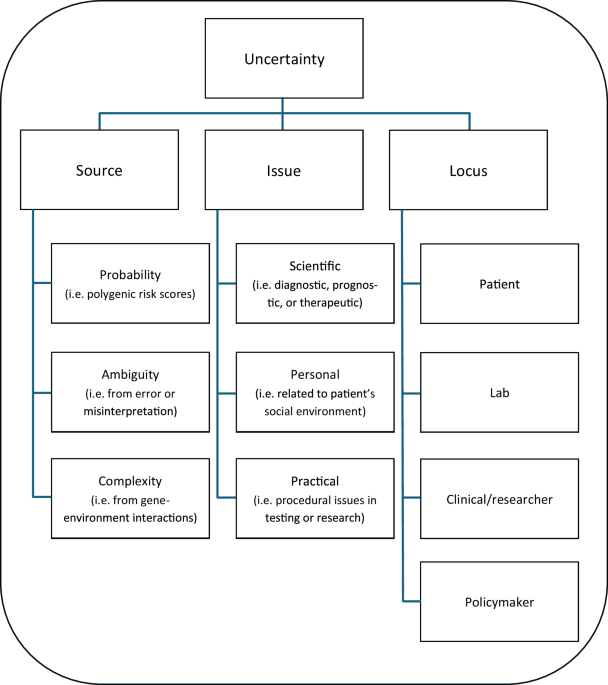
Uncertainty in genomics encompasses a range of meanings. Some studies focus on scientific uncertainties, such as the generalizability of polygenic risk scores across populations, while others highlight uncertainties arising from interpersonal interactions, like counseling practices. Han et al.’s influential taxonomy categorizes medical uncertainty into three dimensions: the source (probability, ambiguity, complexity), the issue (scientific, practical, personal), and the locus (who experiences the uncertainty).
However, this taxonomy does not directly address how these uncertainties relate to trust in genomics. Samuel et al. explore this connection, describing trust as the willingness to take risks based on the belief in reliable behavior from others, even amidst uncertainty. Despite some insights, the literature lacks a consistent conceptualization of the trust-uncertainty relationship.
Trust’s Role in Genomic Medicine
Trust in genomics is multifaceted, involving institutions like biobanks, medical authorities, and private companies. Trust can be lost, particularly when patients perceive a lack of transparency or experience negative interactions with healthcare providers. Studies suggest that trust can mitigate feelings of uncertainty, as seen in Bartley et al.’s review, where trust in healthcare providers reduces perceived uncertainty in genomic test results.
Conversely, uncertainty can impact trust, especially when clinicians navigate ambiguous laboratory reports. Communication of scientific uncertainty does not consistently affect trust, highlighting the complex nature of this relationship. Ni et al.’s survey of patients with dilated cardiomyopathy found a correlation between low trust and low knowledge about genome sequencing, suggesting that personal certainty influences trust levels.
Exploring the Literature: Methods and Findings
This literature review aimed to define how trust and uncertainty are conceptualized in genomics literature and assess the relationships between these concepts. The review included studies published from January 2018 to June 2024, capturing contemporary research and the potential impact of events like the COVID-19 pandemic on public trust in scientific uncertainty.
Studies were selected based on criteria such as discussing both trust and uncertainty in the context of human genomic research. The review identified 26 articles, with a mix of descriptive, analytic, and review studies. These studies explored themes like patient experience, clinical practice, public views, and donor trust in genomics.
Thematic Analysis: Trust, Uncertainty, and Social Groups
The thematic analysis yielded several themes for trust and uncertainty. Trust themes included trust in institutions, loss of trust, experiences of trust, trust as governance, and trust as a research parameter. Uncertainty themes covered informational, clinical, processual, personal, and uncertainty as a research parameter.
Informational uncertainty involves ambiguous or complex information, while clinical uncertainty relates to the interpretation of genomic test results and scientific unknowns. Processual uncertainty stems from managing genomic data use, and personal uncertainty reflects how individuals experience uncertainty in their genomic test results.
Implications and Future Directions
The relationship between trust and uncertainty in genomics is complex, with studies highlighting causal, coincidental, and mediated relationships. Addressing this complexity requires acknowledging uncertainties and adapting practices to build trust. Strategies like patient-centered communication and involving multi-disciplinary teams can help manage uncertainty and foster trust.
Future research should consider social contexts and group membership in understanding how genomic uncertainty impacts trust. Collaborative projects with Indigenous communities, for instance, depend on strong trust relationships. Addressing literature gaps in these areas will enhance our understanding of how uncertainty shapes trust in diverse social contexts.
Ultimately, fostering trust in genomic medicine involves embracing an ethics of uncertainty, where resilience, welfare, autonomy, and solidarity guide interactions with patients and research participants. By acknowledging and adapting to uncertainties, genomic medicine can build trust and advance its potential to transform healthcare.