


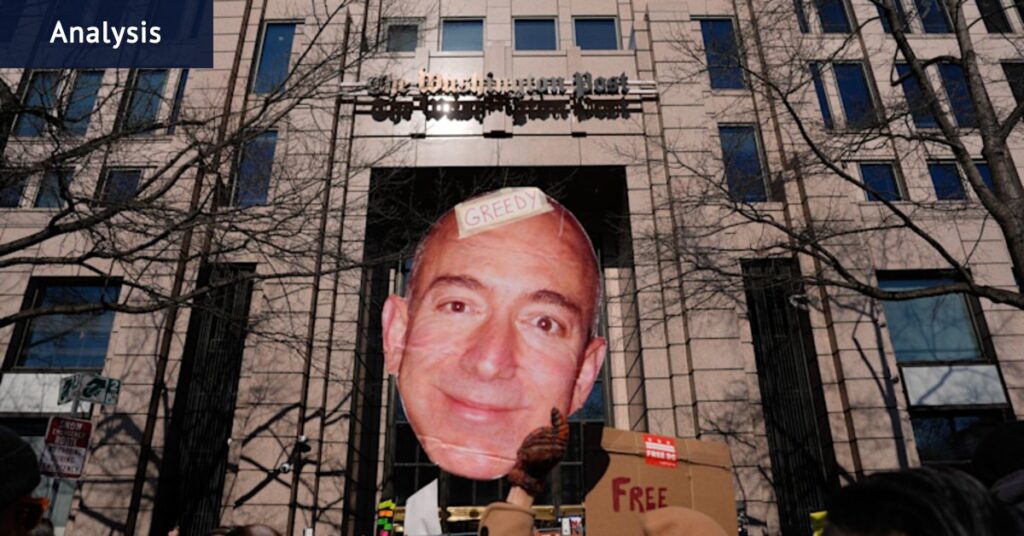
February 8, 2026 — In a dramatic display of dissent, hundreds of journalists, photographers, and supporters gathered in Washington, D.C., to protest sweeping job cuts at The Washington Post. The layoffs, which could see a third of the newsroom dismissed, have sparked outrage among staff and the broader journalistic community, who accuse owner Jeff Bezos of undermining the storied newspaper.
Rivan Stinson, a former audience editor, was at home when she received the devastating news via email. “It’s a very sad day – a sucky situation for me and my colleagues,” she lamented. “Really smart, great journalists. People make this paper. People make the Post.” Around her, the crowd chanted, “Save the Post!”
Bezos Under Fire
The layoffs come at a time when accountability in the U.S. capital is crucial. Critics argue that Bezos, whose net worth is estimated at nearly $US250 billion, is deliberately weakening the newspaper. Timmy Le, an IT worker at the Post, expressed his frustration, noting that a colleague due to give birth soon was among those laid off. “How can you do that to someone, especially if you’re one of the richest men in the world?” Le questioned.
The notion that Bezos is dismantling the newspaper to avoid scrutiny of the Trump administration was prevalent at the protest. This theory gained traction following Bezos’ controversial decision to halt editorial endorsements, including a planned endorsement of Kamala Harris for president in 2024, which led to significant subscription cancellations.
Shifts in Editorial Policy
Bezos’ editorial changes have further fueled discontent. Last year, he announced that the Post’s opinion pages would focus on “personal liberties and free markets,” aligning with his vision of America. This shift coincided with Amazon’s financial support of Trump-related initiatives, raising questions about Bezos’ motivations.
Despite these changes, media analyst Brian Stelter argues that the Post’s political coverage remains robust. “The proverbial thorns in the side of the Trump administration are, for the most part, still there,” Stelter noted on X, suggesting that the cuts were not aimed at reducing political scrutiny.
Comparisons with Rivals
The Washington Post’s struggles stand in stark contrast to the success of its competitors. The New York Times recently reported a surge in digital subscriptions, while The Wall Street Journal continues to expand its offerings. These developments highlight the challenges faced by the Post in maintaining its financial viability.
In a message to staff, departing CEO William Lewis emphasized the difficult decisions made to ensure the Post’s future. “During my tenure, difficult decisions have been taken in order to ensure the sustainable future of The Post so it can for many years ahead publish high-quality non-partisan news,” Lewis wrote.
Voices of the Past and Future
John Kelly, a former Post veteran, acknowledged that Bezos initially helped stabilize the newspaper. “When the Graham family sold the paper to Jeff Bezos, it was because they realized they could not just keep cutting costs and laying off staff and still have a quality product,” Kelly said. However, the recent cuts have reignited concerns about the paper’s direction.
Katie Mettler, a Post journalist and union member, questioned Bezos’ commitment to the paper. “I think he can if he’s the fourth-richest person in the history of the world,” she said, pointing to Bezos’ other ventures as evidence of misplaced priorities. Mettler has long advocated for strategies to rebuild trust with readers, emphasizing the Post’s role in holding power to account.
Legendary journalist Bob Woodward expressed his dismay at the cuts, stating that readers deserve better. “Under executive editor Matt Murray there have been many superb and excellent ground-breaking stories,” Woodward said. “There will be more. I will do everything in my power to help make sure the Washington Post thrives and survives.”
As the protestors dispersed, the future of The Washington Post remains uncertain. The newsroom’s resilience and commitment to journalistic integrity will be crucial as it navigates these turbulent times.