

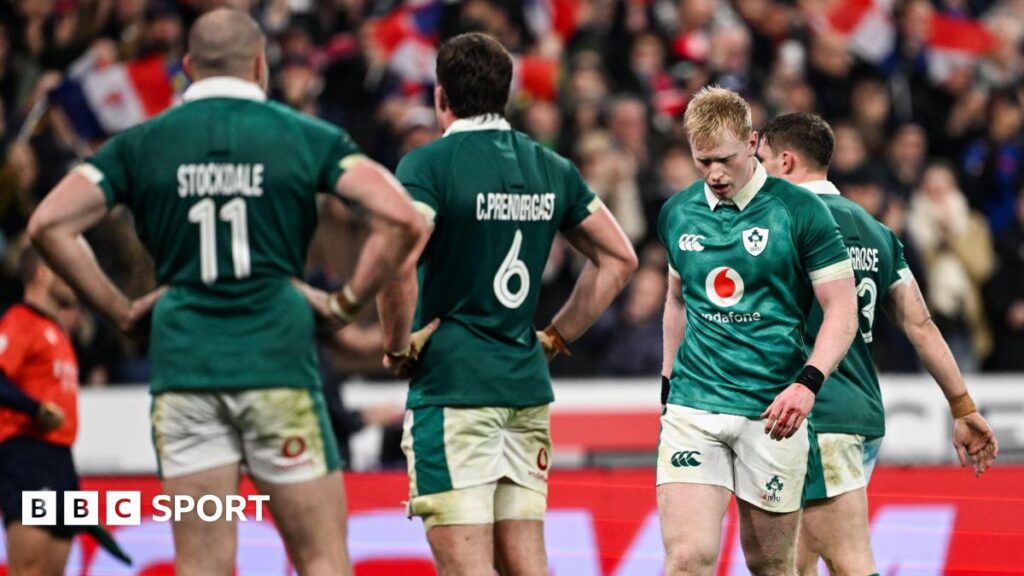
On an unusually early opening night for the Six Nations, Ireland faced a harsh reality check in Paris on Thursday, starting their 2026 campaign with a bruising 36-14 defeat to France. The loss was as damaging to their morale as it was to their physical condition. This encounter, between two teams that have dominated the competition in recent years, highlighted a worrying trend for Ireland, who have now been convincingly beaten by France for the second consecutive season.
Head coach Andy Farrell described his team’s performance as lacking “intent,” a continuation of troubling patterns seen in previous matches. Despite entering the game as underdogs, Farrell attempted to shift the narrative, positioning his team as hunters rather than the hunted. However, during the 80 minutes in Paris, Ireland appeared more like prey to a superior French side.
“It’s coming again next week [against Italy],” former Ireland lock Donncha O’Callaghan told BBC Sport. “This Irish team are on the ropes and everyone is coming after them – they might be the hunted again. They have to find the answers because Six Nations rugby is ruthless and they need to stop the rot.”
Selection Gambles and Missed Opportunities
Farrell’s decision to shake up the lineup by dropping James Lowe and giving Cian Prendergast a rare start created several intriguing subplots. However, the nature of the defeat in Paris meant these storylines received little attention. Ireland’s strategy to compete in the air fell short, with the new back three of Jamie Osborne, Tommy O’Brien, and Jacob Stockdale largely ineffective.
The absence of regular starting props due to injury, alongside two backup players on the loose-head side, offered others a chance to shine. Yet, the set-piece was a non-factor. Ireland managed to win a scrum penalty in the 45th minute, but it was the first time referee Karl Dickson blew the whistle against Les Bleus, highlighting Ireland’s lack of pressure elsewhere.
Discipline and Defensive Struggles
Discipline was a focal point for improvement following the autumn matches. While Ireland conceded only six penalties, they struggled to get close enough to infringe, missing 38 tackles during the game. The failure to address these non-negotiables, as Farrell termed them, left little room for analyzing other aspects of the match.
“I think you make your own luck in this game,” said Farrell. “Without the ball, I thought we lost that battle in the first half. The things like the high ball and winning the scraps on the floor, running through tackles or missing tackles etc – that’s the main part of the game. We certainly came off second best in that regard in the first half. Our response was gallant, but that’s not what we want to be, we don’t want to be a responding team. We needed to show it from the get go.”
Historical Context and Future Challenges
Despite another World Cup quarter-final exit in 2023, Ireland felt on par with the best teams globally just over two years ago. They seemed to have overcome any World Cup hangover by defeating France 38-17 in Marseille during the 2024 Six Nations. However, the subsequent narrative has been starkly different. In the nine matches since against teams ranked above them, Ireland has won only two, losing seven. Five of these losses were by margins of 10 points or more, underscoring the growing gap between Ireland and top-tier teams.
While Ireland remains consistent in winning matches they are expected to win, securing victories in more challenging encounters is increasingly elusive. The loss of three players in the specialized position of loose-head prop exemplifies their injury woes. Jeremy Loughman, with just five caps before Thursday’s game, and Michael Milne, with limited Test experience, highlight the depth issues Ireland faces.
Squad Depth and Strategic Concerns
Beyond injuries, Ireland’s squad depth is a pressing concern. Outside their starting XV and a select few, the team appears underexposed to high-level Test rugby. Reserve scrum-half Craig Casey, part of the squad for nearly five years, has yet to start a Six Nations game against top opposition, seeing only seven minutes of action against France.
Nick Timoney’s performance off the bench, scoring Ireland’s first points and leading a late charge, was notable. Yet, five years after his debut, this was his first Six Nations cap. O’Callaghan pointed out the over-reliance on the Leinster base, which has not yielded the desired results in recent years.
“You could use the excuses and they are there, the injuries, we haven’t the depth of squad to go that deep, but there’s been a fundamental thought of relying on the Leinster base and for the last few years that hasn’t gone as well for the Leinster team,” said O’Callaghan. “You’re trying to integrate players and it’s just been too much of a gap.”
As Ireland prepares to face Italy next week, the team must address these strategic and depth issues to halt their downward trajectory in the Six Nations. The coming matches will be crucial for Ireland to regain their footing and demonstrate resilience in the face of mounting challenges.