




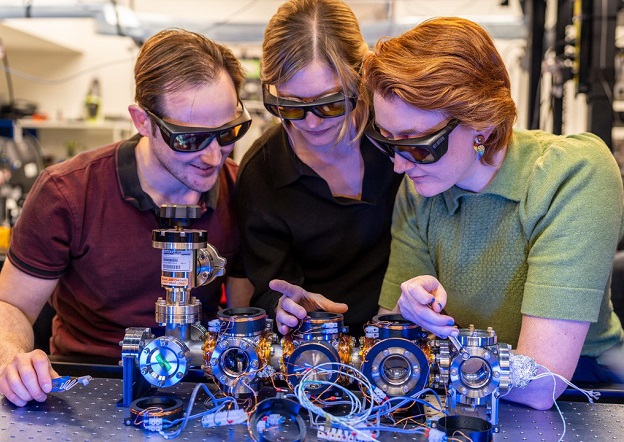
Time is almost up for traditional methods of tracking each second, as optical atomic clocks are on the brink of redefining how the world measures time. Researchers from Adelaide University, in collaboration with the US National Institute of Standards and Technology (NIST) and the National Physical Laboratory (NPL) in the United Kingdom, have conducted a comprehensive review on the future of next-generation timekeeping.
Their findings suggest that the rapid development of optical atomic clocks positions them to become the gold standard for timekeeping within the next few years, provided certain technical challenges can be overcome. “Optical atomic clocks have advanced rapidly over the past decade, to the point where they are now one of the most precise measurement tools ever built,” said Professor Andre Luiten from Adelaide University’s Institute for Photonics and Advanced Sensing, co-author of a new paper on the subject.
Technology Whose Time Has Come
Optical atomic clocks are constructed using laser-cooled trapped ions and atoms. By repeatedly probing these atoms with a laser, they respond at a specific frequency, which can be converted into precise time ticks. The review, published in the journal Optica, outlines the key features, progress over the past decade, challenges, and future applications of this technology.
“A decade ago, optical atomic clocks had no impact on the steering of international time. Today, at least ten have been approved for use,” noted Professor Luiten. A roadmap for redefining how the second is measured is underway, with researchers identifying other potential uses for optical atomic clocks, such as gravity sensors that could aid in creating an international height reference system independent of sea level.
Their precision and sensitivity also make them valuable tools for testing fundamental physics, including dark matter. Moreover, they could maintain accurate time during satellite outages caused by solar storms or malicious attacks, a prospect that has sparked significant commercial interest, including from Adelaide University spin-out, QuantX Labs.
Challenges and Opportunities
Despite the rapid advancements, several challenges remain. Many optical atomic clocks still operate intermittently, and decisions on how to redefine the second need to be made. This includes determining whether a single type of optical atomic clock or a group is the most reliable replacement for caesium fountain clocks, with direct comparisons needed.
Additionally, supply chains for critical components are underdeveloped, leading to higher costs. However, researchers are optimistic that progress in quantum computing and bioscience will make these systems more affordable and accessible in the future.
“Optical clocks have advanced at an extraordinary rate, improving by more than a factor of 100 every decade, thanks to breakthroughs in atomic physics and laser science,” said lead author Tara Fortier from NIST, which provides the official time for the United States and plays a role in setting the world’s time scale. “By showcasing their performance, emerging roles, and the challenges that lie ahead, we hope to inspire a wider community to explore and technically build on nature’s most precise timekeepers,” added Fortier.
Looking Ahead
The research, supported by the National Institute of Science and Technology Physical Measurement Laboratory, Defence Science and Technology Group, and the Australian Research Council Centre of Excellence in Optical Microcombs for Breakthrough Science, indicates a promising future for optical atomic clocks. The move towards adopting these clocks represents a significant shift in timekeeping technology, with implications for both scientific research and practical applications worldwide.
As the world edges closer to embracing optical atomic clocks, the potential for enhanced precision in time measurement and new scientific discoveries grows. The coming years will be crucial in addressing the remaining technical challenges and setting the stage for a new era of timekeeping.