




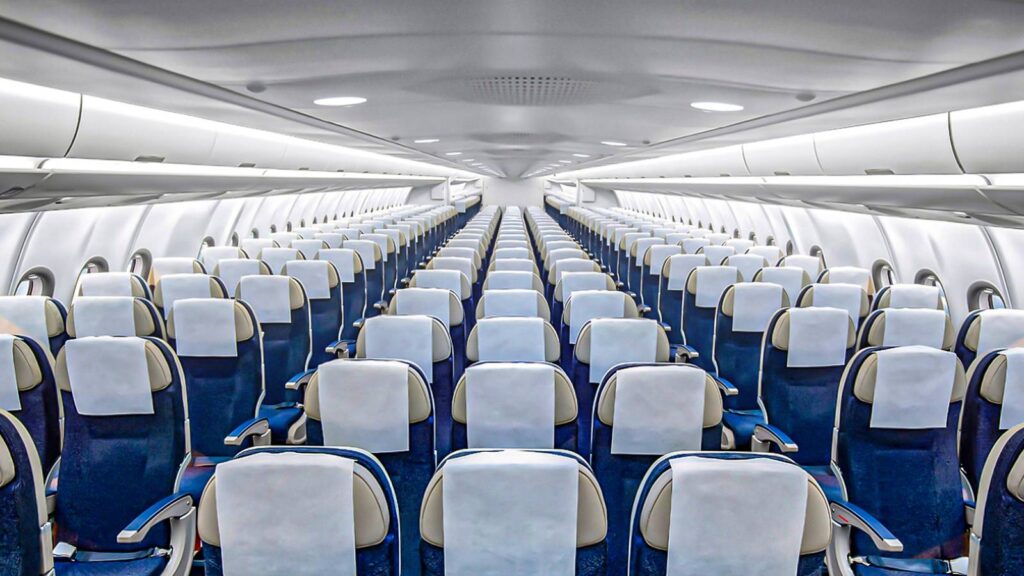
Flying in basic economy is often a cramped and uncomfortable experience for many travelers, primarily due to small seats and limited space between rows. This can be particularly challenging on long-haul flights, where extra legroom becomes a significant factor in choosing an airline. For those traveling to or from Japan, Japan Airlines (JAL) and All Nippon Airways (ANA) offer a reprieve with industry-leading legroom of 34 inches (86.4 cm). Meanwhile, American flyers can find above-average space with JetBlue, which provides 32.3 inches (82.0 cm) of legroom.
Let’s delve into the top airlines worldwide that offer economy travelers a bit more space to stretch out and enjoy their flights.
Prioritizing Flyers in Japan
Japan Airlines has consistently received accolades for its ‘Best Economy Class Seat,’ thanks to its decision to reject the industry trend of densification. Dubbed the “Sky Wider” strategy, JAL’s approach includes a 2-4-2 layout on Boeing 787 Dreamliners, which are typically configured in a 3-3-3 cabin layout. This strategy allows for more space per passenger by reducing the number of seats per row.
JAL employs a specialized slim-seatback design that maximizes knee room without sacrificing cushion comfort. ANA, not to be outdone by its domestic rival, maintains similar standards with a 34-inch pitch across much of its long-haul fleet, including the Boeing 777-300ER and 787-9. In the summer of 2026, ANA plans to introduce newly designed Recaro seats on its Boeing 787-9 aircraft, which will offer an additional inch of knee space and increased recline.
The Economy Class Leaderboard
Economy class presents a paradox for many airlines. While passengers desire comfort, they often choose the lowest fare without considering qualitative differences between airline cabin products. The industry standard pitch is 31-32 inches, driven by the need to fit more passengers onto a single aircraft. Reducing seat pitch by even one inch can allow an airline to add an extra row of seats on a narrowbody jet, translating into millions of dollars in additional revenue.
Emirates offers 34 inches of legroom on its Airbus A380 “superjumbos,” according to data from Business Traveller and Conde Nast Traveler.
Modern ‘slim-back’ seat designs use thinner padding and molded composites, which manufacturers claim can offer a similar feeling of knee room at a 31-inch pitch as an older 34-inch seat would, despite the actual measured distance being less.
A Tough Market for Economy Airfares
Over decades of refinement, airlines have discovered that while customers frequently complain about legroom, they are often unwilling to pay even a small increase in ticket prices to compensate for the revenue loss that increased space in economy class entails. American Airlines’ ‘More Room Throughout Coach’ initiative in the early 2000s highlighted this market reality.
The FAA and other regulatory bodies do not mandate a minimum seat size or pitch, allowing airlines to prioritize profit margins from business and first-class tickets while configuring economy class to cover basic operating costs. Many carriers encourage passengers to upgrade to extra legroom or premium economy seats.
However, airlines like Japan Airlines and ANA maintain a 34-inch pitch, focusing on a premium passenger experience and higher returns per seat. This approach is rooted in cultural business philosophy, competitive strategy, and market dynamics unique to Japan.
The Japanese concept of ‘Omotenashi’ emphasizes anticipating a guest’s needs and providing unparalleled service, extending to the airline seat and overall flying experience.
The Leading American Carriers
JetBlue differentiates itself in the US market by offering more legroom than its competitors, with a standard 32 to 34 inches of pitch across its fleet. This strategy contrasts with other US carriers that prioritize seat count. JetBlue’s Airbus A320 and A321 aircraft are configured with fewer rows, allowing for more space per passenger.
Delta Air Lines and Alaska Airlines offer 31 inches of pitch, just behind Southwest Airlines at 31.8 inches. Delta is known for its extensive network and reliable service, while Alaska receives high reviews for its soft product. Southwest maintains its status as a favored affordable airline due to its low costs and free baggage, though changes are expected this year.
The Middle of the Pack
Qantas, Cathay Pacific, and Singapore Airlines occupy a middle ground in global economy class rankings. These carriers offer a superior experience compared to standard American and European airlines but fall short of the exceptional comfort provided by Japanese airlines. A primary reason is the nine seats per row configuration on most widebodies, compared to the eight seats per row on Japanese carriers.
Gulf and Asian carriers operate with an elevated service philosophy, offering complimentary hot meals, high-quality amenity kits, and attentive service as standard practice on long-haul flights.
More Room Throughout Coach
In February 2000, American Airlines launched ‘More Room Throughout Coach,’ a $70 million initiative to improve comfort for economy passengers. The airline removed approximately 7,200 seats across its fleet, increasing seat pitch to 34 to 35 inches. Despite positive feedback, the program was deemed a financial failure and scrapped by 2004 due to passengers’ unwillingness to pay a premium for more legroom.
The failure of ‘More Room Throughout Coach’ is frequently cited by airline executives as a reason why economy cabins remain cramped.
The initiative coincided with an industry downturn following the September 11 attacks, a major recession, and rising fuel costs, further contributing to its demise.
As airlines continue to navigate the balance between passenger comfort and profitability, the examples set by JAL, ANA, and JetBlue highlight the potential for differentiation in a crowded market. Whether other carriers will follow suit remains to be seen, but for now, these airlines lead the way in offering a more comfortable economy class experience.