



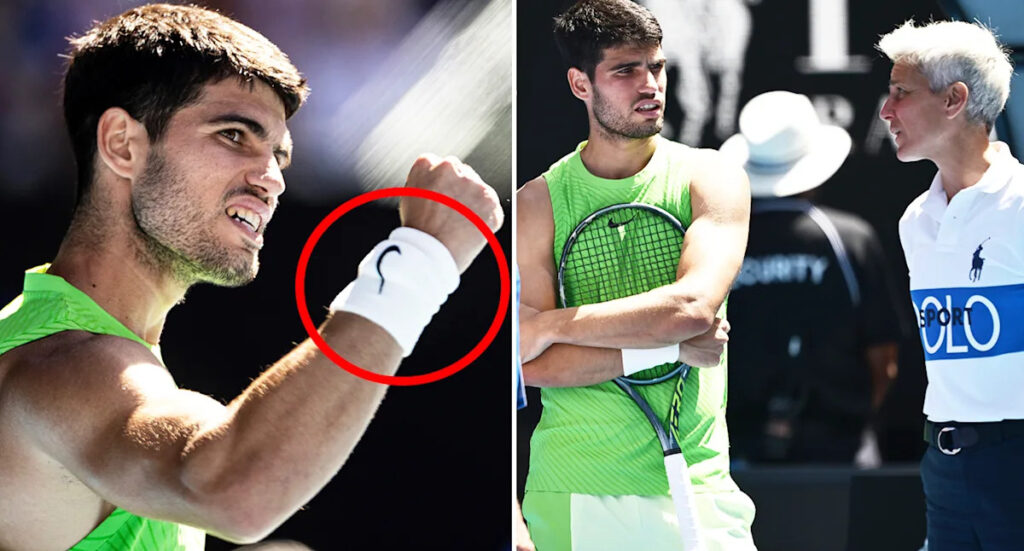
Tennis fans and commentators are once again questioning the rules at the Australian Open after World No.1 Carlos Alcaraz was asked to remove a controversial item during his fourth-round win on Sunday. Alcaraz triumphed over 19th seed Tommy Paul with scores of 7-6 (8-6), 6-4, 7-5, paving the way for a quarter-final clash against Australia’s Alex de Minaur.
De Minaur, in a remarkable display of skill, defeated 10th seed Alexander Bublik 6-4, 6-1, 6-1 in just over an hour and a half. This performance underscored his readiness to challenge Alcaraz, signaling that he will not be easily overcome.
Controversy Over Wearable Technology
Before his match commenced, Alcaraz faced an unexpected hurdle when officials asked him to remove his ‘Whoop’ fitness band. The ‘Whoop’ is a screen-less health tracking device that monitors sleep, heart rate, and physical output, widely used by athletes for recovery purposes. Alcaraz had worn it discreetly under a sweatband on his right wrist throughout the tournament.
Despite its acceptance on the ATP and WTA tours, where ‘Whoop’ is an official partner, the device is banned under ITF (International Tennis Federation) rules without prior approval. The primary concern is its capability to transmit data during play, which could potentially offer an unfair advantage.
Debate Among Tennis Community
The incident has ignited a debate among tennis fans and commentators. Many argue that with mid-match coaching now permitted, the transmission of data from wearable devices should not be problematic. However, concerns linger about the potential misuse of such technology during non-coaching periods, like changeovers.
“Why shouldn’t athletes be allowed to track their own data?” questioned Australian tennis legend Todd Woodbridge on Channel 9. He criticized the ITF’s differing rules compared to the ATP and WTA tours, calling the ban on wearable devices senseless.
Fans have also voiced their opinions on social media, with one stating, “A weird and nonsense decision considering it’s just a tool that helps players monitor their physical condition.” Another remarked, “Tennis rules still living in 2010 while every other sport tracks recovery like it’s 2026.”
Historical Context and Expert Opinions
The controversy surrounding wearable technology in sports is not new. Historically, sports have grappled with integrating technology, balancing innovation with fair play. In tennis, the introduction of Hawk-Eye technology faced similar scrutiny before becoming an accepted part of the game.
Experts suggest that the current debate may lead to a reevaluation of ITF rules. Dr. Sarah Collins, a sports technology analyst, notes, “As technology evolves, sports governing bodies must adapt to ensure rules reflect modern practices while maintaining competitive integrity.”
Looking Ahead
The incident with Alcaraz may prompt the ITF to reconsider its stance on wearable technology, especially as other sports embrace data-driven performance monitoring. The outcome of this debate could influence future regulations, potentially allowing players to use such devices under controlled conditions.
Meanwhile, Alcaraz continues his quest for the Australian Open title, undeterred by the controversy. His upcoming match against De Minaur promises to be a thrilling encounter, as both players aim to secure a place in the semi-finals.
As the tennis world watches closely, the implications of this debate extend beyond the court, highlighting the ongoing tension between tradition and innovation in sports.