


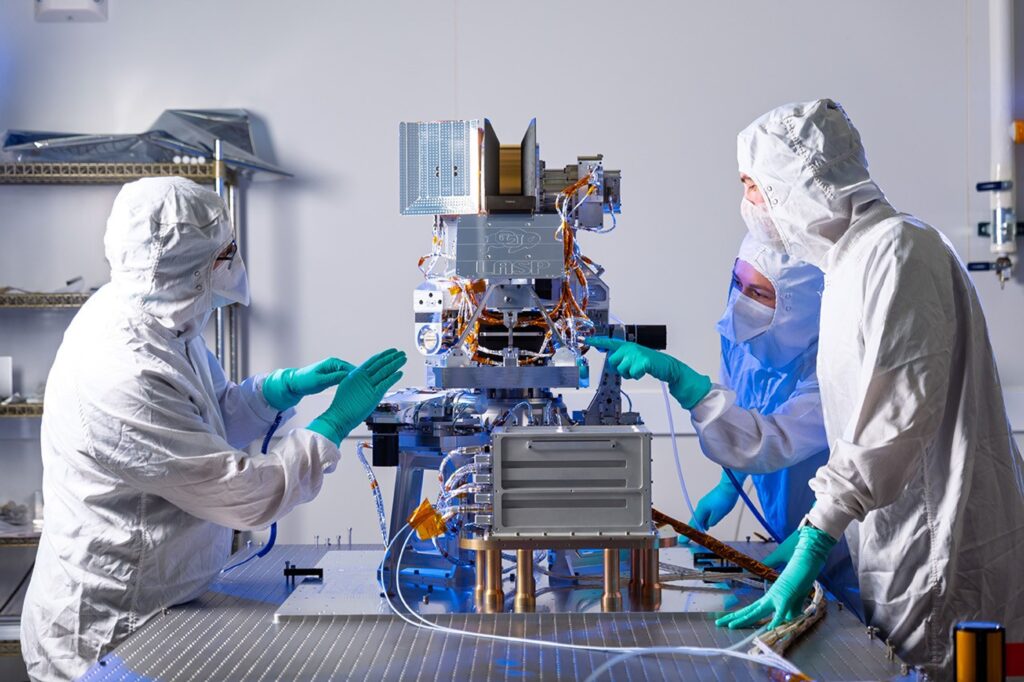
NASA’s Libera instrument, a key component in maintaining the global data record of Earth’s radiation budget, has successfully completed rigorous environmental testing. This significant milestone involved thermal vacuum tests simulating the extreme space temperatures and environments it will encounter. The instrument is set to fly aboard the Joint Polar Satellite System-4 (JPSS-4), a collaborative effort between NASA and the National Oceanic and Atmospheric Administration (NOAA), scheduled for launch in 2027.
Developed by the University of Colorado Boulder’s Laboratory for Atmospheric and Space Physics (LASP), Libera was selected as the first Earth Venture Continuity mission. This NASA initiative focuses on cost-effective, innovative strategies to sustain critical Earth science measurements as older missions conclude. Libera will continue the legacy of the Clouds and the Earth’s Radiant Energy System (CERES) instruments, which began with the Tropical Rainfall Measuring Mission in 1997 and have since been integral to several other satellites.
Continuing a Legacy of Earth Observation
Libera’s mission is to extend the data record of Earth’s radiation budget, a crucial factor in understanding climate dynamics. The instrument is named after the daughter of Ceres in Roman mythology, reflecting its role as a successor to the CERES instruments. This lineage underscores NASA’s longstanding commitment to monitoring the flow of radiant energy in the Earth-atmosphere system, a pursuit that has spanned over five decades.
These energy flows are vital for numerous processes, including atmospheric and oceanic movements, plant photosynthesis, and the formation of the ozone layer. They are also essential for weather forecasting, agricultural planning, and strategic risk assessments by both governmental and commercial sectors.
Technical Achievements and Collaborations
Libera will be the fifth and final instrument delivered to Northrop Grumman in Gilbert, Arizona, for integration onto the JPSS-4 satellite. Other instruments onboard include the Visible Infrared Imaging Radiometer Suite, the Cross-track Infrared Sounder, the Advanced Technology Microwave Sounder, and the Ozone Mapping Profiler Suite. Together, these instruments will enhance our understanding of Earth’s climate and environmental changes.
The management of the Libera mission falls under NASA’s Earth System Science Pathfinder Program Office, based at NASA’s Langley Research Center in Hampton, Virginia. The JPSS-4 satellite is overseen through a partnership between NOAA and NASA’s Goddard Spaceflight Center in Greenbelt, Maryland.
Implications for Future Earth Science Missions
The successful testing and upcoming deployment of the Libera instrument represent a critical step forward in Earth observation technology. By ensuring the continuity of vital climate data, NASA and its partners are poised to provide invaluable insights into global environmental changes. This data will support a wide range of applications, from improving weather forecasts to informing policy decisions on climate change mitigation and adaptation strategies.
As the world faces increasing climate-related challenges, the role of advanced instruments like Libera becomes ever more crucial. The data it provides will help scientists and policymakers better understand and respond to the Earth’s complex climate system, ultimately contributing to more informed decision-making and a more sustainable future.
With the JPSS-4 satellite’s launch on the horizon, the collaboration between NASA and NOAA continues to exemplify the power of scientific partnerships in advancing our understanding of the planet. As Libera prepares to join the ranks of its predecessors, it carries with it the promise of enhanced Earth observation capabilities and a deeper comprehension of our changing world.