




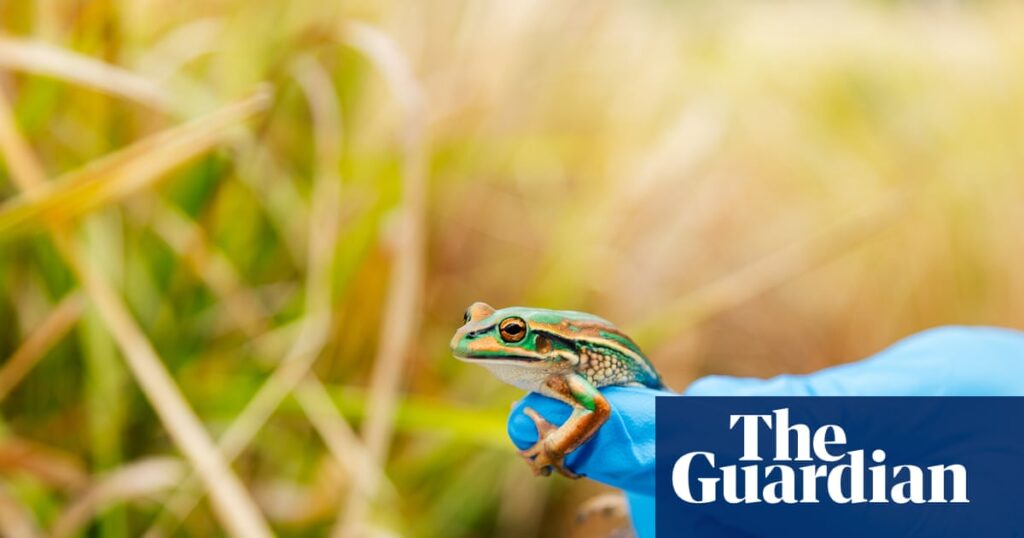
Scientists have successfully reintroduced green and golden bell frogs to the Australian Capital Territory (ACT) for the first time since the species became locally extinct nearly four decades ago. On Tuesday morning, the first group of 25 frogs was released, marking a significant milestone in conservation efforts to revive a species devastated by the chytrid fungal disease, which has wiped out 90 amphibian species globally over the past 50 years.
Associate Professor Simon Clulow of the University of Canberra, who co-led the project, expressed the profound significance of the event. “It felt quite incredible and really significant to return [the species] back to this region for the first time in almost 50 years,” he said. The species was believed to have gone extinct in the ACT around 1981.
Innovative Conservation Techniques
The 25 frogs, released at Mawson Ponds, are approximately 14 months old and have been immunized against chytridiomycosis, a disease caused by two fungal species. This reintroduction is the first of 15 planned releases across wetland sites around Canberra, ultimately aiming to introduce about 375 frogs back into the wild.
Each frog has been microchipped and named, thanks to the creative efforts of volunteers involved in the project. Dr. Jarrod Sopniewski, a postdoctoral research fellow at the University of Canberra, noted, “We’ve had some creative ones. We have a James Pond and Dua Leaper.”
Creating Safe Havens
To ensure the best chance of survival for these amphibians, the team has constructed 60 “frog spas” and installed 180 “frog saunas” across the wetland sites. These innovative structures aim to provide disease refuges for the frogs’ offspring, which are not immunized.
Frog saunas, designed as perspex pyramids covering a three-level tower of black-painted bricks, are intended to create environments with temperatures lethal to the chytrid fungi. “The pathogen itself is quite susceptible to elevated temperature – it doesn’t like temperatures over 25C; 27 or 28C is quite lethal to it,” Clulow explained. “A lot of Australian frogs … prefer those temperatures – the green and golden bell frog likes to be about 30C.”
“Even when the temperatures are barely reaching 10C here, we’re still [passively] getting into the high 20s on a sunny day.” – Dr. Jarrod Sopniewski
Historical Context and Future Prospects
The green and golden bell frog, which can grow up to 8.5cm in body length, was once common along Australia’s east coast. Today, it is considered endangered in New South Wales. Despite the impact of chytrid, some populations have survived in isolated pockets, often in areas with slightly higher water salinity.
Building on this discovery, scientists have installed satellite ponds, or “frog spas,” around larger wetlands with slightly saltier water. A salt concentration of about three parts per thousand is sufficient to negatively affect the chytrid without harming the frogs.
Looking Ahead
The ultimate goal is to establish a population of 200 frogs at each of the 15 sites. “One female can have up to 8,000 eggs, so their population growth should start really rapidly if our interventions against chytrid are helping those initial founders survive and reproduce,” Sopniewski stated.
“It’s almost like letting your children go out into the world themselves,” Sopniewski added. “A bit daunting, but overwhelmingly exciting.”
As these efforts continue, the reintroduction of the green and golden bell frogs not only represents a triumph in conservation but also offers hope for the recovery of other species affected by the chytrid fungus. The project stands as a testament to the resilience of nature and the potential for scientific intervention to reverse the damage caused by human activity and disease.